How to Develop an SEO Strategy: Step-by-Step Guide
This article explains how to develop an effective SEO strategy by focusing on business goals, audience research, keyword analysis, search intent, competitor research, content planning, technical SEO, internal linking, and performance measurement. It provides a step-by-step framework to improve organic visibility, attract relevant traffic, and achieve sustainable long-term digital growth.
Developing an SEO strategy requires more than choosing a few keywords and publishing blog posts. A successful strategy connects your business goals with audience needs, search intent, content, website structure, technical performance, and measurable outcomes.
Whether you are building SEO for a new website or improving an established one, the process should be systematic and adaptable. Search behavior changes, competitors publish new content, and search engines continuously refine how they evaluate websites.
This guide explains how to develop an SEO strategy from the ground up, including keyword research, competitor analysis, content planning, technical SEO, internal linking, measurement, and ongoing optimization.
What Is an SEO Strategy?
An SEO strategy is a structured plan for improving a website's visibility in organic search while attracting visitors who are relevant to the business. A complete SEO strategy typically includes:
- Business and SEO goals
- Audience research
- Keyword research
- Search-intent analysis
- Competitor research
- Content planning
- On-page SEO
- Technical SEO
- Internal linking
- User experience
- Performance measurement
- Continuous optimization
SEO should not be treated as a collection of isolated tasks. Each part should support the others. For example, keyword research can influence content planning, content can influence internal linking, and technical improvements can make those pages easier for search engines to crawl and users to access.
If you are building a broader digital strategy, you can also explore Inforisen's digital solutions to understand how SEO fits alongside development, design, and other digital services.
Why Is an SEO Strategy Important?
Without a strategy, SEO activities can quickly become reactive. A business may publish articles based on random keywords, optimize pages without considering search intent, or spend resources on traffic that has little business value. A structured strategy provides direction.
It can help businesses:
- Attract more relevant organic visitors
- Understand what their audience is searching for
- Build authority around important topics
- Improve website discoverability
- Create more useful content
- Strengthen internal website connections
- Identify technical problems
- Improve qualified leads and conversions
- Make SEO investment more measurable
Understanding how SEO works in digital marketing can also help businesses see how organic search fits into the wider customer acquisition process.
Step 1: Define Your Business Goals
The first step in developing an SEO strategy is determining what you want SEO to accomplish. Do not begin with keywords. Begin with the business. Your objectives might include:
- Increasing qualified leads
- Generating product sales
- Increasing service inquiries
- Building brand awareness
- Growing organic traffic
- Supporting a new product launch
- Increasing visibility in a specific market
- Reducing dependence on paid acquisition
For example, an online software company might prioritize demo requests rather than simply maximizing page views.
Set Measurable Objectives
Instead of:
"We want more traffic."
Create a more specific objective:
"Increase qualified organic traffic to high-value service pages and generate more organic leads within the next six months." This makes it easier to decide which pages, keywords, and improvements deserve attention.
Step 2: Understand Your Target Audience
Once your business goals are clear, identify the people you want to reach. Ask:
- Who are your ideal customers?
- What problems are they trying to solve?
- What questions do they ask before purchasing?
- What terminology do they use?
- What level of expertise do they have?
- What concerns might stop them from taking action?
For example, someone searching "what is SEO and how it works" may be learning the fundamentals, while someone searching "how to choose an SEO company" may already be comparing potential providers. That difference should influence the content you create.
Understanding what SEO is and how it works can help establish the fundamentals before moving into more advanced strategic decisions.
Step 3: Conduct Keyword Research

Keyword research identifies the words and phrases people use when looking for information, products, or services. However, effective keyword research is not simply about finding keywords with the highest search volume.
Evaluate keywords based on:
Focus on Search Intent
Search intent is one of the most important parts of keyword research. Common types include:
Informational: The user wants to learn something.
Example:
"How does SEO work?"
Commercial: The user is researching a solution before making a decision.
Example:
"Best SEO company for small business"
Transactional: The user is ready to take action.
Example:
"SEO services for SaaS companies"
Navigational: The user is trying to find a particular website or page.
A strong strategy should target different types of intent rather than forcing every keyword toward a sales page.
Step 4: Understand the Role of Keywords
Keywords still help you understand what people are looking for, but they should not control every sentence you write. For example, if your target keyword is "how to develop SEO strategy," you do not need to repeat that exact phrase throughout the article.
You can naturally discuss:
- SEO planning
- Organic search strategy
- Keyword research
- Search intent
- Content optimization
- Technical SEO
- SEO measurement
For a deeper explanation, see how important keywords are in SEO. You should also consider longer, more specific searches. Long-tail keywords in SEO can be particularly useful when users have specific questions or needs.
Google's current guidance also warns against keyword stuffing, which means repeatedly inserting keywords in ways that make content unnatural or difficult to read. (Google for Developers)
Step 5: Analyze Your Competitors
Competitor research helps you understand what already performs well in your target search results. For each important keyword, examine the pages currently ranking and consider:
- What search intent do they satisfy?
- How comprehensive are they?
- What questions do they answer?
- How are their pages structured?
- What types of content do they use?
- Are there obvious information gaps?
- Is their content current?
- What could you explain more clearly?
The goal is not to copy competitors. Instead, identify opportunities to create something more useful, clearer, more practical, or more relevant to your audience.
If competing websites have very comprehensive guides, simply creating another basic article may not provide enough value. You may need stronger examples, better organization, original insights, or a more useful framework.
Step 6: Create a Keyword-to-Page Map
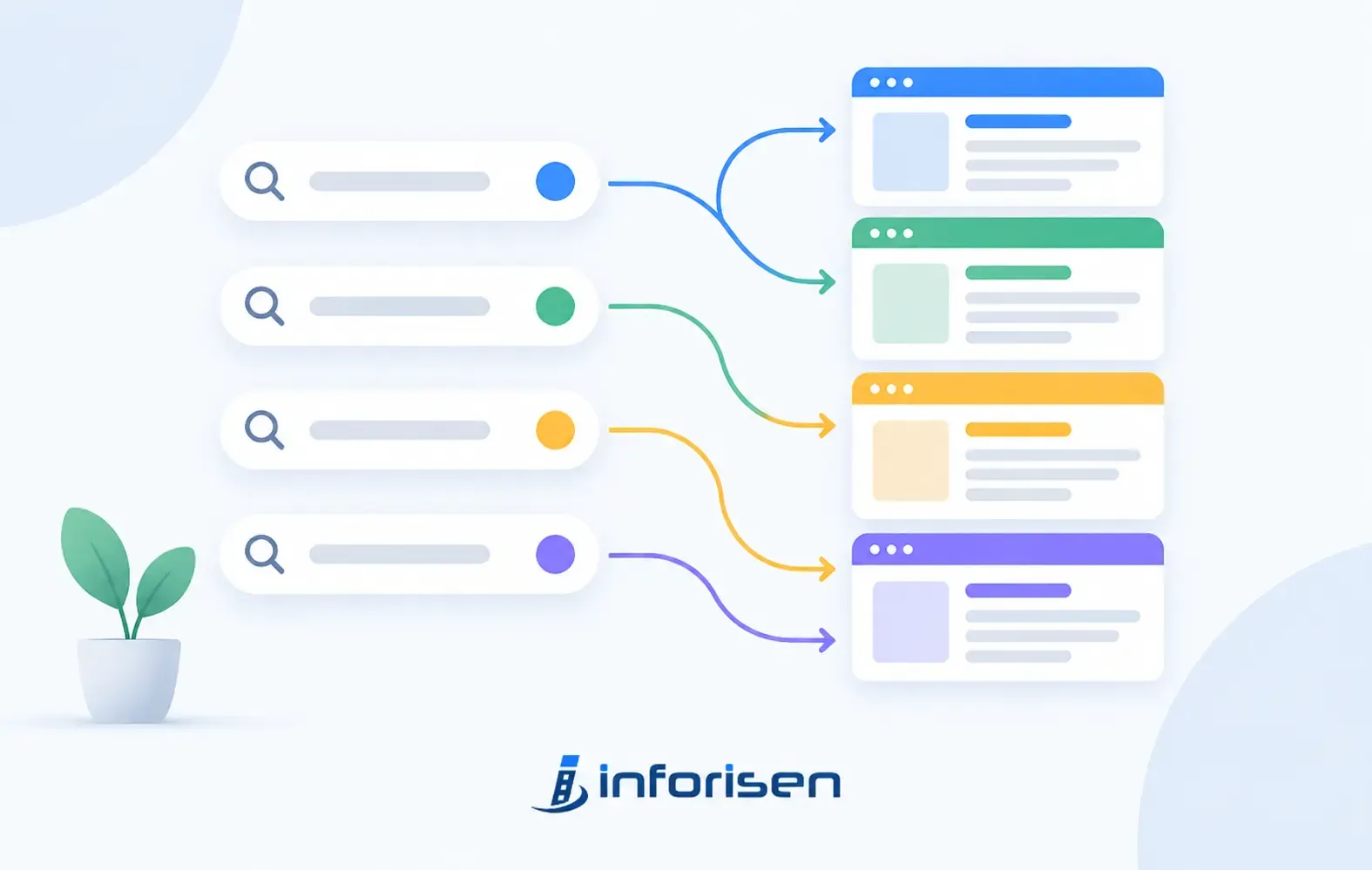
Once you've researched keywords, decide which page should target each topic. This prevents multiple pages from competing unnecessarily for the same search intent. For example:
A keyword should have a logical destination. If five different blog posts all target nearly the same question, consider whether they genuinely need to exist separately.
Step 7: Build Topic Clusters
Instead of treating every keyword independently, organize related subjects into topic clusters. For example, an SEO cluster could include:
Main topic: SEO Strategy
Supporting topics:
- How SEO works
- Keyword research
- Long-tail keywords
- SEO services
- SEO agency costs
- Choosing an SEO company
- SEO timelines
- Competitor analysis
- Technical SEO
- Content optimization
This creates a logical ecosystem of related information. Your Inforisen blog can be used as a useful example of how an educational content library can cover different questions around technology and digital solutions.
Step 8: Plan Content Around the Customer Journey
Not everyone searching for information is ready to become a customer. Your SEO content should support different stages.
Awareness
The user is trying to understand a problem.
Example:
"What is SEO?"
Consideration
The user understands the problem and is evaluating solutions.
Example:
"How much does an SEO agency cost?"
Decision
The user is ready to choose a provider.
Example:
"How to choose an SEO company"
Retention and Education
Existing customers may need additional guidance and resources. This approach helps prevent a website from becoming overly promotional while still creating opportunities for commercial pages to attract qualified visitors.
For businesses evaluating SEO investment, resources discussing how much an SEO agency costs and whether SEO is a waste of money can address common commercial concerns before a purchasing decision.
Step 9: Create High-Quality Content
After establishing your topics and keywords, develop content that genuinely satisfies the search intent. Good SEO content should:
- Answer the primary question clearly
- Provide useful supporting information
- Use logical headings
- Include practical examples
- Avoid unnecessary repetition
- Be easy to scan
- Address related questions
- Demonstrate subject understanding
- Provide original value
Do not create an article simply because a keyword exists. Instead, ask: Would this page still be useful if search engines did not exist? If the answer is yes, you are more likely to be building content around the reader rather than around ranking manipulation.
Google's spam policies specifically warn against scaled content created primarily to manipulate search rankings when it provides little value to users.
Step 10: Optimize On-Page SEO
Once the content is created, optimize the page itself. Important elements include:
Title Tag
Write a concise title that accurately represents the page.
H1
Use one clear main heading that communicates the topic.
H2 and H3 Headings
Organize information into logical sections.
URL
Keep the URL descriptive and readable.
Meta Description
Explain what the page offers and encourage relevant users to click.
Images
Use useful visuals where they improve understanding and provide descriptive alt text where appropriate.
Internal Links
Link naturally to related pages that provide additional value. On-page optimization should improve clarity rather than turn the page into a collection of keywords.
Step 11: Develop an Internal Linking Strategy
Internal linking is an important part of SEO because it connects related pages and helps visitors discover additional resources. For example, an article about SEO strategy can naturally link to resources about:
- SEO fundamentals
- Keyword research
- Long-tail keywords
- SEO services
- Choosing an SEO company
- SEO timelines
- Competitor research
Anchor text should describe the destination naturally. For example: "Before investing in an SEO campaign, it is useful to understand how long SEO takes to work." This is more useful to the reader than inserting an awkward exact-match phrase simply for SEO purposes. Google also identifies manipulative linking practices as a form of search spam, so internal links should serve a genuine navigational or informational purpose. (Google for Developers)
Step 12: Consider Technical SEO
Content is only one part of an SEO strategy. Your website also needs a technically sound foundation. Important areas include:
- Crawlability
- Indexability
- Mobile usability
- Page speed
- HTTPS
- XML sitemap
- Robots.txt
- Canonical URLs
- Redirects
- Broken links
- Structured data where appropriate
- JavaScript rendering
- Core Web Vitals
A technically strong website makes it easier for search engines to discover and process important pages. Technical SEO should ideally be considered during website development rather than treated as an emergency fix afterward.
Step 13: Connect SEO With Website Experience
SEO can bring visitors to a website, but the website experience influences what happens next. A visitor who lands on a slow, confusing, or poorly structured page may leave even if the page ranks well. Consider:
- Navigation
- Page speed
- Mobile usability
- Readability
- Visual hierarchy
- Content structure
- Calls to action
- Trust signals
- Accessibility
SEO and UX should therefore support each other. A strong SEO strategy attracts the right visitor, while a strong website experience helps that visitor find the information they need.
Step 14: Develop a Competitor-Outranking Strategy
"Outranking competitors" should not mean copying their content and adding more words. Instead, identify areas where you can provide greater value. Ask:
- What does the competing page answer?
- What does it fail to explain?
- Is the information current?
- Can you provide clearer examples?
- Can you answer related questions?
- Can you improve the page structure?
- Can you provide original data or experience?
- Can you create a better user experience?
For more practical considerations, see how to outrank competitors on Google. The objective is to become a better resource, not simply a more optimized page.
Step 15: Understand When Paid Search and SEO Are Different
SEO and paid search can work together, but they are not the same. Organic rankings are earned through a combination of relevance, content quality, technical accessibility, authority, and other search-system signals.
You cannot simply pay Google to purchase a higher organic ranking. For a clearer explanation, read whether you can pay Google to rank higher. Paid advertising can provide immediate visibility for selected searches, while SEO generally focuses on building sustainable organic visibility over time.
Step 16: Decide Whether You Need an SEO Agency
Not every business needs the same level of SEO support. An internal team may handle SEO effectively when it has sufficient:
- Time
- Experience
- Technical knowledge
- Content resources
- Analytics capability
- Development support
An agency may be useful when a business needs broader expertise or does not have enough internal resources. If you are evaluating providers, understanding how to choose an SEO company can help you assess experience, communication, strategy, reporting, and expectations. It is also useful to understand exactly what SEO services include before comparing providers.
Step 17: Set Realistic SEO Expectations
SEO is generally a long-term process. Results can vary considerably depending on:
- Website age
- Competition
- Industry
- Existing authority
- Technical condition
- Content quality
- Search demand
- Link profile
- Consistency of optimization
A new website in a highly competitive industry may require considerably more time and resources than an established website targeting a less competitive topic. Instead of promising a specific ranking within a fixed number of days, focus on measurable progress. Track changes in visibility, impressions, clicks, qualified traffic, leads, and conversions.
Step 18: Measure SEO Performance
A strategy without measurement is difficult to improve. Useful SEO metrics include:
Google Search Console is particularly useful for understanding a website's search performance and identifying how users discover its pages. The key is to connect SEO metrics with business outcomes. A large increase in low-quality traffic may be less valuable than a smaller increase in highly relevant visitors.
Step 19: Review and Update Your SEO Strategy
SEO should be treated as an ongoing process. Review your strategy regularly and look for:
- Declining pages
- New keyword opportunities
- Content gaps
- Outdated information
- Pages with high impressions but low CTR
- Pages with traffic but poor conversion rates
- Broken internal links
- Technical problems
- Overlapping content
- New competitor content
Updating an existing page can sometimes be more valuable than publishing another article. For example, if a page already receives impressions but does not generate many clicks, improving its title, description, content structure, and relevance may create a worthwhile opportunity.
Common SEO Strategy Mistakes to Avoid
Choosing Keywords Only by Search Volume
High-volume keywords are not automatically valuable. Relevance and intent matter just as much.
Publishing Content Without a Purpose
Every important page should have a clear role within the website.
Keyword Stuffing
Repeating keywords unnaturally can make content difficult to read and can violate Google's spam policies.
Ignoring Existing Content
A website can have hundreds of articles while still having important content gaps.
Treating SEO as Only a Content Problem
Technical SEO, UX, website architecture, and internal linking also matter.
Expecting Immediate Results
SEO generally requires time, testing, and consistent improvement.
Measuring Only Rankings
Ranking position is useful, but it does not tell you whether organic traffic is qualified or generating business results.
A Simple SEO Strategy Framework
If you need a practical starting point, use this framework:
1. Define the business objective
Know what SEO needs to achieve.
2. Research your audience
Understand their problems, questions, and search behavior.
3. Research keywords
Identify relevant topics and search intent.
4. Analyze competitors
Find content gaps and opportunities.
5. Map keywords to pages
Give each important topic a clear destination.
6. Build topic clusters
Connect related content into a logical structure.
7. Improve technical SEO
Make the website accessible, fast, and technically sound.
8. Create useful content
Prioritize people and search intent.
9. Strengthen internal linking
Connect relevant pages naturally.
10. Measure performance
Track both SEO and business metrics.
11. Update and improve
Use performance data to refine the strategy.
Frequently Asked Questions
How do I develop an SEO strategy?
Start by defining your business goals and target audience. Then research keywords and search intent, analyze competitors, map topics to pages, improve technical SEO, create useful content, build internal links, and measure performance regularly.
What are the main parts of an SEO strategy?
The main components include keyword research, search-intent analysis, content strategy, technical SEO, on-page optimization, internal linking, user experience, competitor analysis, and performance measurement.
How important are keywords in an SEO strategy?
Keywords are useful for understanding what people search for, but they should not be used unnaturally. A strong strategy focuses on search intent, relevance, topic coverage, and useful content rather than repeating exact phrases.
How long does an SEO strategy take to work?
There is no universal timeline. Results depend on competition, website condition, content quality, authority, technical factors, and the consistency of SEO work. New websites often need more time to establish organic visibility.
Is SEO still worth investing in?
SEO can be valuable when it attracts relevant users and supports business goals. However, the right investment depends on the market, competition, customer behavior, available resources, and expected return.
Should I hire an SEO agency?
It depends on your internal resources and expertise. Businesses with limited SEO, technical, or content capabilities may benefit from professional support, while organizations with experienced internal teams may manage many SEO activities themselves.
Can I pay Google to rank higher organically?
No. Paying for Google Ads can provide paid visibility, but it does not purchase a higher organic ranking. Organic search visibility and paid advertising operate differently.
Final Thoughts
Knowing how to develop an SEO strategy is ultimately about building a repeatable system rather than following a checklist of isolated SEO tactics. Start with business goals and audience needs. Then use keyword research and search intent to identify valuable topics, build a logical website structure, create genuinely useful content, strengthen technical SEO and internal linking, and measure results against meaningful business objectives.
The strongest SEO strategies are also flexible. They evolve when search behavior changes, competitors improve, new content opportunities appear, or performance data reveals a better direction. Most importantly, avoid shortcuts that prioritize rankings over users. Google's current spam guidance specifically emphasizes avoiding manipulative practices such as keyword stuffing, link spam, and scaled low-value content.
When SEO is approached as a long-term combination of strategy, content, technology, UX, and measurement, it becomes much more than a traffic-generation tactic—it becomes part of a sustainable digital growth system.
.webp&w=3840&q=75)
.webp&w=3840&q=75)
.webp&w=3840&q=75)