-1.webp&w=3840&q=75)
ByArian MahmudReviewed by:Shuman Chandra Das
Human WrittenHow SEO Helps Local Service Businesses Get Customers
Discover how local SEO, service pages, Google Business Profile, reviews, and conversion strategies can help service businesses attract more customers.
Imagine someone in your area suddenly needs a plumber, dentist, lawyer, cleaning company, electrician, or marketing agency.
What do they do?
Most likely, they search Google.
They might type something like “plumber near me,” “dentist in Dhaka,” “best cleaning service near me,” or even a specific service followed by their city name.
This is exactly where SEO can make a difference.
If your business appears when someone is actively looking for the service you provide, you are not just getting website visitors. You are getting an opportunity to talk to someone who may already be ready to call, book, request a quote, or ask a question.
So, how SEO helps local service businesses get customers is not simply about ranking higher. It is about becoming visible at the moment your potential customer needs you.
Why SEO Matters for Local Service Businesses
A local service business doesn't need thousands of visitors from around the world. It needs the right visitors from the areas it actually serves.
Think about a local dentist.
Would 10,000 visitors from countries where the dentist doesn't operate be useful? Probably not. Ten people from the same city who are actively searching for dental services could be far more valuable.
That's the difference between traffic and qualified local traffic.
SEO helps businesses focus on searches that actually matter to their service area, whether that's a city, neighborhood, region, or a specific group of local customers.
Local Searches Often Have Strong Intent
Someone searching for "what is dental care?" is probably still researching. Someone searching for "emergency dentist near me" has a very different reason for searching.
They may need help right now.
And that's where local SEO becomes closely tied to lead generation. The goal isn't simply to get someone onto your website. You want the right person to find the right service at the right time when they're ready to take action.
How Local Customers Find Service Businesses Through Google
Local search usually starts with a problem.
A customer needs something, opens Google, and searches for a solution.
For example:
Problem → Search → Local Results → Website/Profile → Contact → Customer
The important part is that your business needs to appear somewhere along that journey.
If your competitors appear while your business does not, the customer may never know that you exist.
This is why local SEO should be treated as part of customer acquisition rather than just another marketing activity.
Target the Keywords Your Customers Actually Search
One of the first steps is understanding what your potential customers type into search engines.
A service business should not blindly target keywords simply because they have high search volume.
Instead, think about the actual conversation a customer might have with Google.
A plumber might target searches such as:
- plumber near me
- emergency plumber in Perth
- bathroom plumbing service
- water heater repair
- residential plumbing company
A digital marketing agency might target:
- SEO agency near me
- local SEO services
- SEO company in Perth
- SEO services for small businesses
- affordable SEO services
The important thing is the connection between the keyword and the service.
Our guide on how important keywords are in SEO explains why modern keyword strategy is about relevance and search intent rather than simply repeating the same phrase.
Focus on Search Intent, Not Just Search Volume
This is where many businesses go wrong.
A keyword can have thousands of searches and still bring very few customers.
Another keyword may have much lower search volume but represent someone who is ready to hire.
For a local service business, that difference matters.
Your keyword strategy should therefore consider:
- What is the person searching for?
- What problem are they trying to solve?
- Are they looking for information, or are they looking for a service provider?
When you answer those questions properly, your SEO strategy becomes much more focused.
Create Service Pages That Match Customer Needs
.webp)
One generic "Services" page usually doesn't cut it.
Say a company offers web development, SEO, UI/UX design, and software development. If all of that sits on a single page, Google has a hard time working out what the company actually does, and so do visitors. Someone searching for "local SEO" doesn't want to dig through a long list to find one line about it.
A better approach is to give each important service its own page:
- SEO Services
- Local SEO
- Website Design
- Software Development
- UI/UX Design
On each page, cover what the service includes, who it's for, what problem it solves, and how to get started. That way, when someone searches for something specific, they land on a page that answers exactly that.
And if your own website needs work first, Inforisen's Website Design & Development Services can help you build a site with an SEO-friendly structure, a responsive layout, clear navigation, and a design that turns visitors into customers.
Optimize Your Google Business Profile
If you serve a specific area, your website is only part of the picture. Plenty of local customers will find you through your Google Business Profile first, so it's worth getting right.
Keep Your Business Information Accurate
Check that your details match what's true today and are the same everywhere they appear: business name, phone number, category, services, opening hours, website and so on.
Outdated or half-filled information costs you customers. If someone can't tell whether you're open or what you actually do, they'll just click on the next business.
Help Local Customers Understand Your Business
A person looking at your profile wants quick answers to a few simple questions. Who are you? What do you do? Where do you work? How do I reach you?
Add your services, some real photos and any other useful details, so people get a feel for your business before they ever visit your site or call. When someone finds you through local search, they should know right away what you offer and what to do next.
Reviews Help Customers Make Decisions
Picture two businesses showing up for the same search. One has a bunch of genuine reviews where customers describe their experience in detail. The other has almost nothing. Which one would you feel safer contacting?
That's what reviews do: they take away some of the doubt. It matters even more for service businesses, because people are often trusting you with a problem in their home, their business, their finances or their health.
So ask your happy customers to leave an honest review after you've helped them. And don't treat reviews as just a ranking trick. They're part of your sales process.
Build Location-Relevant Content
If your business serves multiple areas, your website should clearly communicate where you actually operate.
Instead of mentioning those locations randomly throughout the website, you can create useful location-focused content where there is a genuine reason for the page to exist.
A good one tells people:
- Which services you offer there
- Who those services suit best
- What customers in that area usually ask for
- How far your coverage goes
- How to get in touch
Just don't fall into the trap of copying the same page twenty times and swapping the city name. Visitors notice, and so does Google. Every location page should give people in that area something they'd actually find useful.
Make Your Website Easy to Convert
Getting someone to your website is only half the job.
Picture a customer landing on your page. They think, "Great, they do what I need. So how do I reach them?" If they have to hunt for the answer, there's a good chance they'll give up and go somewhere else.
So make the next step obvious. Depending on your business, it could be:
- Call Now
- Request a Quote
- Book an Appointment
- Get a Free Consultation
- Send an Enquiry
The button should fit what the visitor is trying to do. Someone with an emergency wants to pick up the phone right away. Someone comparing a few professionals would rather ask for a quote first and take their time.
SEO gets people through the door. Your website has to do the rest.
Internal Linking Can Connect Search Intent Across Your Website
Internal linking is often overlooked by local businesses.
But think about how a customer moves through your website.
Someone may first discover your article about local SEO.
From there, they may want to understand your SEO services.
Then they may want to contact your company.
That creates a natural journey:
Informational page → Service page → Contact/Conversion
This is also useful for search engines because internal links help connect related pages and clarify the relationship between different topics on your website.
Our guide on how to improve website SEO covers internal linking, search intent, technical SEO, page structure, and other areas that support stronger website SEO.
Local SEO Should Connect With Your Overall SEO Strategy
Local SEO should not operate separately from everything else.
Your technical SEO, content, on-page optimization, internal links, authority building, website experience, and local signals should support the same business goals.
For example, imagine a local law firm.
Its SEO strategy could connect:
Service pages → Location pages → Helpful legal guides → Internal links → Contact page
Each part supports the next.
This is why it helps to think about SEO as a complete system rather than a collection of individual tasks.
If you want to understand the broader process, our guide on what SEO strategy in marketing means explains how keywords, content, technical SEO, internal linking, and business goals work together.
Track Leads, Not Just Rankings
Ranking at position one can look impressive.
But ask yourself:
- Did that ranking generate a phone call?
- Did someone request a quote?
- Did the business receive a booking?
Those are much closer to the actual goal.
For a local service business, useful SEO metrics can include:
- Organic clicks
- Local search visibility
- Calls
- Contact form submissions
- Quote requests
- Bookings
- Qualified leads
- Conversion rate
- Revenue from organic customers
This gives you a better picture of whether SEO is contributing to business growth.
A website can receive thousands of visitors and generate almost nothing.
Another website can receive fewer visitors but consistently attract people who actually need its services.
That is why traffic quality matters more than traffic volume alone.
Why SEO Can Be Valuable for Small Local Businesses
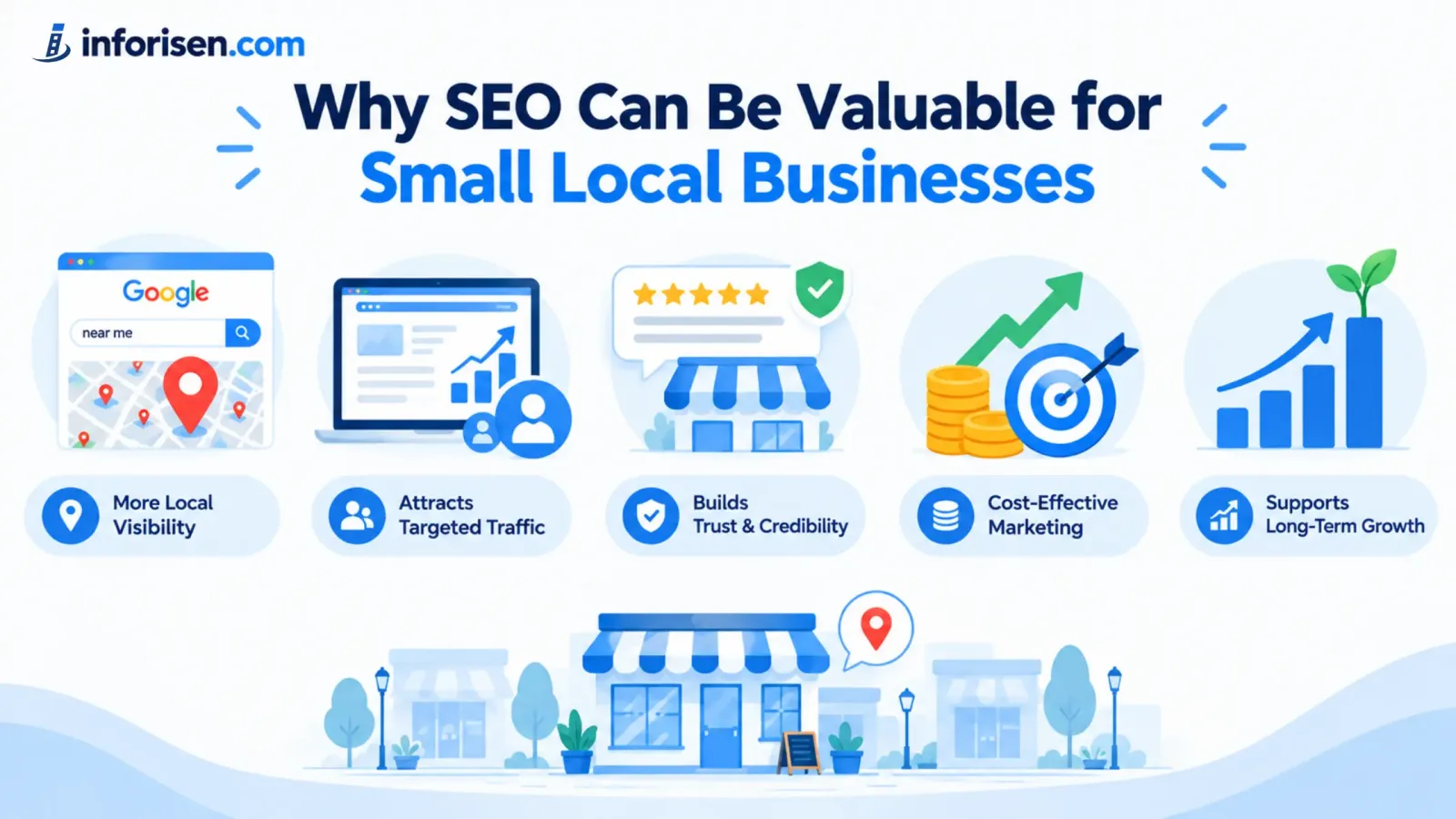
Small businesses often compete with companies that have bigger advertising budgets.
SEO provides another way to compete.
Instead of trying to reach everyone, a local business can focus on becoming highly relevant to a specific audience and service area.
A small dental clinic does not need to compete with every dental clinic in the world.
It needs to become visible to people searching for dental services in the areas it serves.
The same idea applies to plumbers, lawyers, accountants, repair companies, cleaning services, agencies, consultants, contractors, clinics, salons, and many other service businesses.
That focused approach can make SEO much more practical.
What an SEO Strategy for a Local Service Business Should Include
A strong local SEO strategy usually connects several areas rather than relying on one tactic.
Start With Research
Understand your customers, services, locations, competitors, and search behavior.
Build the Right Pages
Create dedicated service pages and useful location-focused pages where they genuinely serve a purpose.
Improve Technical SEO
Make sure search engines can crawl, understand, and index the important pages of your website.
Strengthen Local Signals
Keep business information accurate, maintain your Google Business Profile, and build genuine customer reviews and relevant local mentions.
Improve Conversion Paths
Make it easy for visitors to call, book, request a quote, or contact your business.
Measure Business Outcomes
Track leads and conversions alongside rankings, impressions, and organic traffic.
Inforisen's SEO Services combine keyword research, on-page SEO, technical optimization, content strategy, local SEO targeting, authority building, and performance tracking around business growth.
How Long Does Local SEO Take to Bring Customers?
This is probably one of the first questions a business owner asks.
And honestly, there is no universal number.
A new website competing in a difficult market may need considerably more time than an established website that already has authority and only needs technical or content improvements.
Your competition, website condition, target locations, search demand, content quality, authority, and implementation speed can all affect the timeline.
So instead of expecting customers immediately, look for progress across stages.
You may first see better indexing and impressions.
Then more keyword visibility.
Then more organic clicks.
And eventually, if the traffic is relevant and the website converts well, more enquiries and customers.
Our guide on how long SEO takes to work explains the timeline in more detail.
What If Your Website Gets Traffic but No Customers?
This is an important situation to watch.
Suppose your website is getting organic traffic, but nobody is calling or submitting forms.
Should you simply create more content?
Not necessarily.
The problem could be the wrong search intent, weak service pages, unclear messaging, poor calls to action, slow performance, difficult navigation, or a weak customer journey.
In other words, more traffic is not always the answer.
Sometimes the better move is improving what happens after the visitor arrives.
Our guide on why your website is not generating leads explores the common reasons traffic fails to turn into enquiries.
How Inforisen Can Help Local Service Businesses
if you understand that your local customers are searching online but your business is not getting enough enquiries from those searches, the next step is to look at the whole search journey.
- Where are you currently visible?
- Which services are people searching for?
- Which locations matter most to your business?
- Are your important service pages properly optimized?
- Can Google easily understand what your business does and where you operate?
And once visitors arrive on your website, can they quickly understand your offer and find an easy way to contact you?
These questions matter because local SEO is not just about getting your website to appear somewhere in search results. The real opportunity is to connect search visibility with the customer's next action.
For example, someone might search for a service in their city, discover your website, visit your service page, compare your offer with another business, and then decide whether to call or submit an enquiry. Every step in that journey can affect whether a search actually becomes a lead.
A More Connected SEO Approach
Inforisen approaches SEO around these connected questions rather than treating ranking as the only goal.
The strategy can involve keyword research, technical SEO, on-page optimization, content planning, internal linking, local search targeting, authority building, conversion-focused improvements, and ongoing performance analysis.
Each part has a role.
Keyword research helps identify what potential customers are searching for. Technical SEO helps search engines crawl and understand the website. Service pages connect those searches with your actual offerings, while internal linking helps users and search engines move between related pages.
Then, conversion-focused improvements make sure the traffic you earn has a clear path toward becoming an enquiry, booking, call, or other business action.
That matters because a local service business does not need SEO for the sake of SEO.
It needs SEO because there is a real business goal behind it: getting discovered by relevant people and turning that visibility into genuine enquiries.
If you want to explore how Inforisen approaches digital solutions for businesses, you can also visit Inforisen.
Final Words
So, how SEO helps local service businesses get customers comes down to one simple idea:
SEO puts your business in front of people who are already looking for what you provide.
But getting discovered is only the beginning.
You need the right keywords, useful service pages, strong local signals, a trustworthy website, clear calls to action, and a customer journey that makes contacting you easy.
Do not focus only on getting more traffic.
Focus on getting the right people to your website.
Because for a local service business, 100 relevant visitors who need your service can be far more valuable than thousands of visitors who will never become customers.
That is where SEO starts becoming a customer acquisition channel rather than just a ranking strategy.
Frequently Asked Questions
How does SEO help local service businesses get customers?
SEO helps local service businesses become visible when potential customers search for relevant services in their area. When the right people find the business, optimized service pages and clear contact options can help turn that visibility into enquiries, calls, bookings, or quote requests.
What is local SEO for service businesses?
Local SEO focuses on improving a business's visibility for geographically relevant searches. It can involve service pages, location-focused content, Google Business Profile optimization, reviews, technical SEO, internal linking, and other local search signals.
Does SEO really bring customers to local businesses?
SEO can bring relevant organic traffic and customer enquiries when the strategy targets appropriate services, locations, and search intent. Results vary depending on competition, website quality, search demand, implementation, and how well the website converts visitors.
What keywords should local service businesses target?
Local service businesses should focus on keywords that combine their services with customer intent and relevant locations. Examples include “SEO agency near me,” “emergency plumber in New York,” or “dentist in New York.” The exact keywords should come from customer research rather than assumptions.
Do local businesses need a Google Business Profile?
A Google Business Profile can be an important part of local search visibility for eligible businesses. It helps customers discover business information and can complement the website and broader local SEO strategy.
How long does local SEO take to generate customers?
There is no fixed timeline. A business's website authority, competition, technical condition, content quality, target locations, and implementation speed can all influence how quickly SEO produces meaningful results.


.webp&w=3840&q=75)