ByArian MahmudReviewed by:Yunus A. Polash
Human WrittenHealthcare AI Development Services Explained: Types & Applications
Explore healthcare AI development services, including machine learning, natural language processing, predictive analytics, and virtual assistants. Learn how these technologies support patient communication, clinical workflows, and hospital administration, along with their practical uses, benefits, limitations, and implementation considerations in practice.
AI applications in hospitals and clinics are changing their inner life and interactions with patients. The speed of information processing and automation of routine processes is becoming possible thanks to the use of AI technologies in healthcare.
Healthcare AI Development Support services talks about the way machine learning, natural language processing, and predictive analytics operate in the healthcare industry. These technologies can become handy in managing patient interactions, documentation, and other administrative processes.
How does it all happen in practice? It is important to understand how these technologies work in order to choose suitable solutions for healthcare organizations.
What Are Healthcare AI Development Services?
There are Healthcare Artificial Intelligence Development services where the development of the software is aimed at managing hospital or clinic processes. The most widespread approaches are machine learning, natural language processing, and predictive analytics.
This includes, for instance, pointing out the main attributes in medical pictures for the doctor, data organization, and answering users' questions with the help of chatbots.
The operation of data-driven software differs from conventional software by its ability to identify patterns and provide recommendations, while conventional software operates according to predetermined rules. Yet, the responsibility for decision making is taken by healthcare professionals.
What Are the Different Types of Healthcare AI Development Services?
These technologies include various techniques employed during information analysis, patient care and process optimization. Each of these technologies serves a particular purpose.
Here are six common types and practical examples of their use.
Machine Learning Solutions
Technology in machine learning uses artificial intelligence algorithms to detect patterns and predict outcomes using medical data.
In essence, machine learning can be used in hospitals to determine which patients are likely to be readmitted after treatment.
Common uses include:
- Prediction of patient readmissions
- Identification of trends in medical procedures
- Facilitating patient risk assessment
Practical suggestion: Begin with a problem that needs to be solved, like rehospitalization risks, and then validate your AI system on relevant patient data.
Natural Language Processing (NLP)
NLP assists computer systems to comprehend and structure natural language text and speech. Doctors, nurses, and other healthcare practitioners utilize NLP applications in order to manage clinical notes, medical reports, and patient comments.
In particular, an NLP application may recognize names of medications, diseases, and treatment procedures from doctors' reports.
Common uses include:
- Information extraction from clinical documents
- Management of medical records
- Patient feedback analysis
AI Chatbots and Virtual Assistants
Chatbots assist the healthcare sector in answering patients' queries via websites or messaging apps. For instance, chatbots on a clinic's website can provide information on appointments, operating hours, and services offered.
Common chatbot functions include:
- Answer frequently asked questions
- Help make appointments
- Offer information about services and locations
Helpful tip: Begin with admin queries and give the ability to get in touch with clinic staff when the chatbot is unable to assist.
Predictive Analytics Solutions
Predictive analytics is the use of past and present data for forecasting future trends. Hospitals can then make use of this information to optimize their operations.
This could mean using admission history information to forecast demand in times of high load at a hospital.
Common applications include:
- Predictions for patients admission
- Hospital staffing planning
- Bed and resource predictions
Such predictions help planning but need correct information and frequent evaluation.
Medical Imaging and Computer Vision
Computer vision allows software to analyze medical images such as X-rays, CT scans, and MRIs.
For instance, computer-implemented image analysis can identify regions that are worth examining on chest X-ray images.
Common applications include:
- Identifying abnormalities in medical images
- Highlighting areas requiring review
- Supporting medical image analysis
Automated findings require professional review and must not replace clinical judgment.
Healthcare Workflow Automation
Automated systems for healthcare reduce the time required to perform routine administrative tasks.
For example, the automated system would be able to extract all the required data from the insurance claims and identify the ones missing some information.
Common uses include:
- Processing insurance documents
- Organizing billing information
- Classifying administrative records
For companies looking at such workflows, AI and automation solutions provide an ideal starting point to help understand the capabilities of automation.
The best technology will depend on the objective of the health care facility, data, budget, and technology already in place. It is always better to solve one well-defined problem than to implement AI across departments.
How Is AI Used in Healthcare? Key Applications
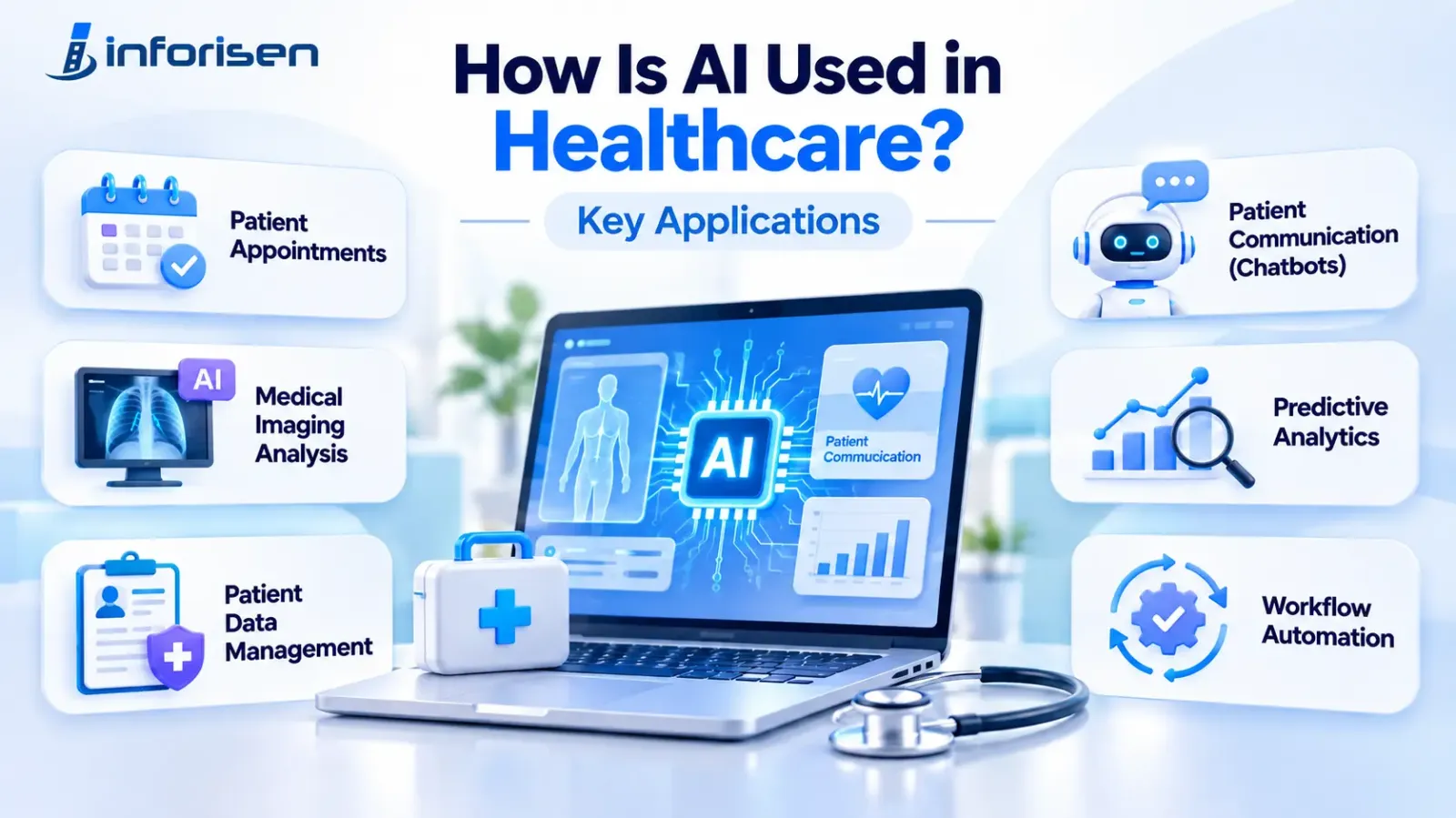
Software is used in hospitals, clinics, and other medical care businesses to run services for patients, manage information, and reduce paperwork. The following are six applications of software.
Patient Appointment Scheduling and Support
The scheduling system should have features allowing individuals to schedule, rearrange, and cancel their appointments at home through the Internet. Individuals can also receive automated reminders to prevent them from missing appointments. The chatbot at the clinic can inform about the availability of slots and help the patient make an appointment.
Medical Records and Documentation
Documentation tools aid in the process of managing patients’ documentation and summarizing clinical notes through the extraction of relevant data from medical documentation.
Certain documentation tools can be employed in preparing draft summaries of patient visits that are revised by the physician before being saved in the patient's record.
AI-Assisted Diagnosis
Modern diagnostics are based on the utilization of medical imaging, test results, and information about the patient to identify potential indicators of certain diseases.
For example, specific software can indicate abnormalities in the X-ray image, and then the X-ray image needs to be verified by a radiologist. Nevertheless, any conclusion has to be drawn in the context of other medical information.
Remote Patient Monitoring
Monitoring devices employ technology for capturing data about the health of an individual through the gadgets they use. These gadgets include the heart rate monitor and blood pressure monitor.
This ensures that the monitoring devices can detect irregularities and send alerts regarding patients who need attention. These alerts are then verified by the medical personnel.
Hospital Administration and Billing
Automation applications help hospitals in managing routine tasks such as billing, claims, and documentation.
In this regard, automation applications are able to identify the absence of information on the insurance claim forms prior to sending them out. Administrative personnel verify the identified issues so that any errors are not made during the billing process.
Personalized Patient Communication
Digital technology gives healthcare providers an opportunity to exchange relevant information concerning patients based on their appointments and directions.
This means that healthcare clinics can deliver appointments, directions, and other relevant information. The medical information needs to be approved by healthcare professionals, while at the same time, patients' privacy needs to be protected.
Such applications are relevant to healthcare institutions since they help them perform their daily activities effectively.
What Are the Benefits of Artificial Intelligence in Healthcare?
The application of AI technology assists health practitioners in carrying out their activities effectively while managing communication and information within the clinical environment.
Therefore, the effective use of such technology can benefit both the patients and the healthcare practitioners.
Here are six key benefits:
Improved Administrative Effectiveness: Automation facilitates the work of the staff by removing administrative procedures.
Efficient Patient Communication: Chatbots and virtual assistants give patients an opportunity to receive answers to common questions and appointment information.
Processing of Medical Data at Increased Speed: Intelligent systems process medical data, recognize crucial information and help healthcare professionals to operate big data volumes.
Decision Making Support: Predictive analytics and imaging technologies identify certain patterns that physicians can use in order to analyze the condition of patients.
Reduced Number of Repeated Actions: Automation can be used for sorting documents, entering information, scheduling appointments and other tasks.
Accessibility of Digital Health Care Services: Patients' portals, telehealth services and digital communication technologies make it easy to get health care information.
All of these advantages are available only in case of proper use, high-quality data and human control.
How Are Healthcare AI Solutions Developed?
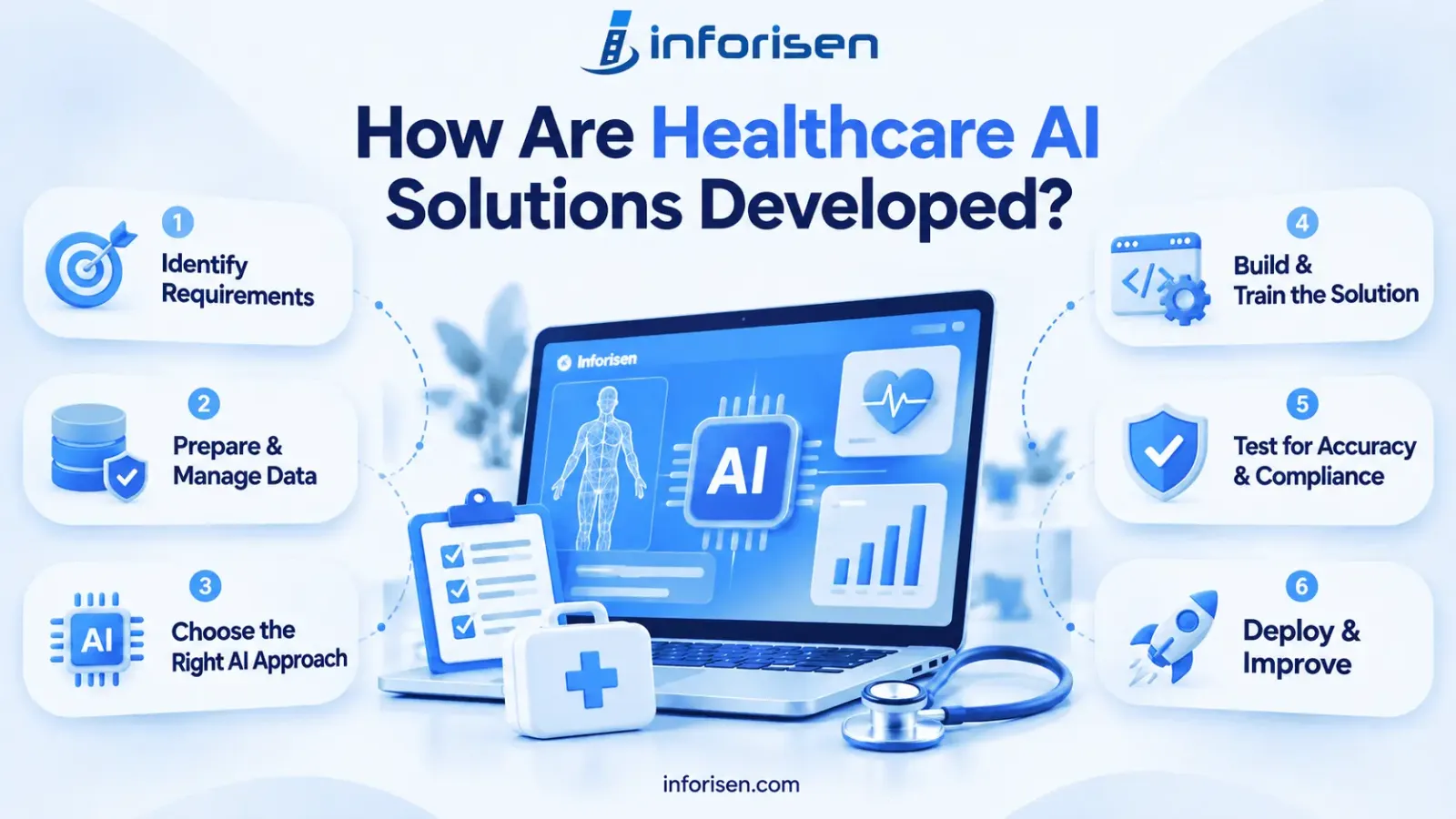
The development of AI solutions in the field of healthcare involves the following steps: planning, data preparation, technology choice, and testing. Every step makes it possible for the organization to create the appropriate solution.
Step 1: Identify Healthcare Requirements
Start with identifying a concrete problem, such as scheduling problems, paperwork, or ineffective patient communication. Goals need to be formulated first before embarking on development.
Step 2: Collect and Prepare Healthcare Data
Gather the necessary data from reliable sources. It should be high-quality and precise, with confidentiality maintained if any patient data is used.
Step 3: Select Appropriate AI Technologies
Choose the right technology, taking into account the requirements of the project, available information, and required functions of AI. Machine Learning may help to make predictions, while NLP can help in processing medical documents.
Step 4: Develop and Integrate the Solution
Develop the required features and add them to the healthcare system software if necessary. Consider whether the current artificial intelligence system infrastructure is able to handle the tasks of data processing, access control, and maintenance.
Step 5: Test Accuracy, Security, and Performance
Testing the AI technology will ensure that it is accurate, secure, and efficient before implementation. It would also be prudent to check the system's effectiveness in handling patient data and consult medical practitioners about using it.
Step 6: Deploy, Monitor, and Improve
Phase in the solution, train the staff, and keep track of performance. For healthcare organizations that wish to do more with their digitization, they can check out what Inforisen services offer.
What Are the Challenges of Healthcare AI Development?
There are challenges regarding patients' personal information, accuracy of the technologies, and regulations that need to be addressed beforehand.
- Privacy and Safety of Patients' Data: Healthcare systems involve confidential data. There is a necessity for proper storage and security of this data.
- Accuracy and Reliability of Results: Automatic systems might provide wrong results. Healthcare workers should check the most significant conclusions.
- Data Quality and Bias: Lack of complete and representative data might have an impact on the performance of the technologies.
- Compliance with the Regulations in the Healthcare Industry: There are different healthcare regulations, which developers should pay attention to.
- Integration with Other Technologies:Combining these technologies with electronic health records, hospital software etc. might need extra efforts.
- Human Supervision: Healthcare specialists should have their responsibilities in case of working with automated systems.
The World Health Organization's AI ethics guidance highlights the importance of responsible development, human oversight, and patient protection.
Addressing these challenges early helps healthcare organizations adopt technology more safely and effectively.
How Can Healthcare Websites Benefit From AI Features?
These intelligent capabilities can be used by healthcare websites for communicating with patients, navigation, and appointments. This will enable the visitor to get relevant information without having to rely on the employees of the organization.
AI Chatbots for Patient Questions
Answering FAQs on the schedule of the clinics, available treatments, procedures for consultation, and contacts falls under chatbots.
An example would be to direct patients to specific departments on a hospital website based on their questions.
AI-Assisted Appointment Scheduling
Appointment scheduling systems give patients the opportunity to schedule their appointment time and be reminded automatically.
For instance, a dentist can schedule appointments through his or her scheduling system automatically in case there are more important things to attend to.
Personalized Website Search and Navigation
Intelligent searches enable easy identification of appropriate health services and relevant health information.
For example, individuals searching for children's dental services can be given details on children's dental services and appointment scheduling.
However, intelligent searches work best if there is credible health information available on healthcare websites.
How Can Inforisen Help Businesses Build Better Healthcare Websites?
A website meant to aid healthcare patients must be able to provide patients with easy access to information, service offerings, and communication channels with the providers.
Inforisen offers website design and digital solutions to help healthcare establishments get an impressive online presence.
The key features of a healthcare website are:
- Responsive Design: Websites that work perfectly on mobile devices, tablets, and computers.
- Service pages: Information about the health services, treatments, and facilities.
- Easier navigation: User-friendly menus for easy searching for important information.
- Appointment Booking Options: Booking pages or ways of getting in touch.
- Readable Website Content: Good text, layout, and website control for easier use.
Healthcare establishments may start with the outlined fundamental characteristics before considering automation.
An appropriate website serves as an excellent platform for further digital innovations with patients being put first.
Frequently Asked Questions
What Are Healthcare Artificial Intelligence Development Services?
It requires creating intelligent software that can analyze health information, help patients, and process things in the healthcare industry.
What Types of AI Are Commonly Used in Healthcare?
Examples of popular AI technologies include machine learning, natural language processing, predictive analytics, computer vision, and virtual assistants.
How Is AI Used in Hospitals and Clinics?
Hospitals use intelligent software when booking appointments, recording data of the patients, monitoring the patients, diagnostics, and billing.
Can AI Improve Healthcare Website Functionality?
Of course, chatbots, scheduling, and personalized search results can improve the interaction of patients.
What Are the Main Risks of Healthcare AI?
Major risks include data privacy breaches, errors, bias in algorithms, and inadequate human control.
Does Inforisen Provide Healthcare Website Development Support?
Yes, Inforisen offers website development assistance to aid healthcare companies in developing responsive and accessible sites.
Final Thoughts
The AI development services for healthcare consist of the use of technologies like machine learning, predictive analytics, and automation, which help in patient services and operational processes.
But not every healthcare organization requires such advanced systems. Hospitals and clinics must select technologies according to their requirements and budget.
Before implementing AI solutions, it is necessary to consider the issues related to data privacy, accuracy, and security.