ByMd BaizidReviewed by:Yunus A. Polash
Human WrittenHow To Build A SaaS Roadmap For Startups
Learn how to build a practical SaaS roadmap for your startup, prioritize MVP features, plan development stages, connect product goals with technical requirements, and prepare your SaaS product for launch and future growth.
You have a SaaS idea. You know the problem you want to solve, and maybe you already have a list of features in your head.
But then comes the difficult question: what should you build first?
This is where a SaaS roadmap becomes useful. Instead of jumping from one feature to another, you can create a clear path from your initial idea to MVP, launch, and future growth.
If you're wondering how to build a SaaS roadmap for startups, the goal isn't to predict everything. A good roadmap helps you decide what deserves your attention now, what can wait, and why.
What Is a SaaS Roadmap?
A SaaS roadmap is a high-level plan that shows where your software product is going and what needs to happen to get there. Think of it as a bridge between your product vision and your development team. It helps answer a few important questions:
What are you building? Who are you building it for? What should come first? And how will you know whether the product is actually moving in the right direction? For a startup, that clarity can be valuable because your budget, development time, and team resources are usually limited.
A roadmap gives you direction without forcing you to predict every feature or decision years in advance. If you want to explore the concept further, Atlassian's Product Roadmap Guide provides additional guidance on connecting product vision, priorities, and development work through a roadmap.
Start With the Problem
Before you start filling your roadmap with features, take a step back.
Ask yourself: What problem am I actually solving?
It is easy to say, “I want to build a project management SaaS.” But that description does not tell you what the product really needs to do.
Maybe your target customers are small teams that find existing project management platforms too complicated. In that case, your product might need to focus on simplicity rather than trying to compete with every feature offered by larger platforms.
That is why your customer problem should come before your feature list.
Understand Your Users
Try to find out:
- Who experiences the problem?
- How are they solving it today?
- What frustrates them about existing solutions?
- How frequently does the problem occur?
- Is it important enough for them to pay for a solution?
These answers can completely change your roadmap—and that is a good thing.
It is much cheaper to change your roadmap after a few customer conversations than to discover six months into development that you built the wrong product.
Define Your Product Vision
Once you understand the problem, decide where you want your product to go.
Your product vision does not need to be a long business document. A few clear sentences can be enough.
Explain who your product is for, what problem it solves, and what outcome you want to create.
Use Your Vision to Filter Ideas
Then use that vision whenever a new feature idea appears.
Ask yourself:
Does this feature actually help us move toward the product we want to build?
If it does not, it may be something to consider later—or something you do not need at all.
This simple filter can stop your roadmap from becoming a long list of unrelated features.
Validate Before You Build
This is one of the most important steps for an early-stage SaaS startup.
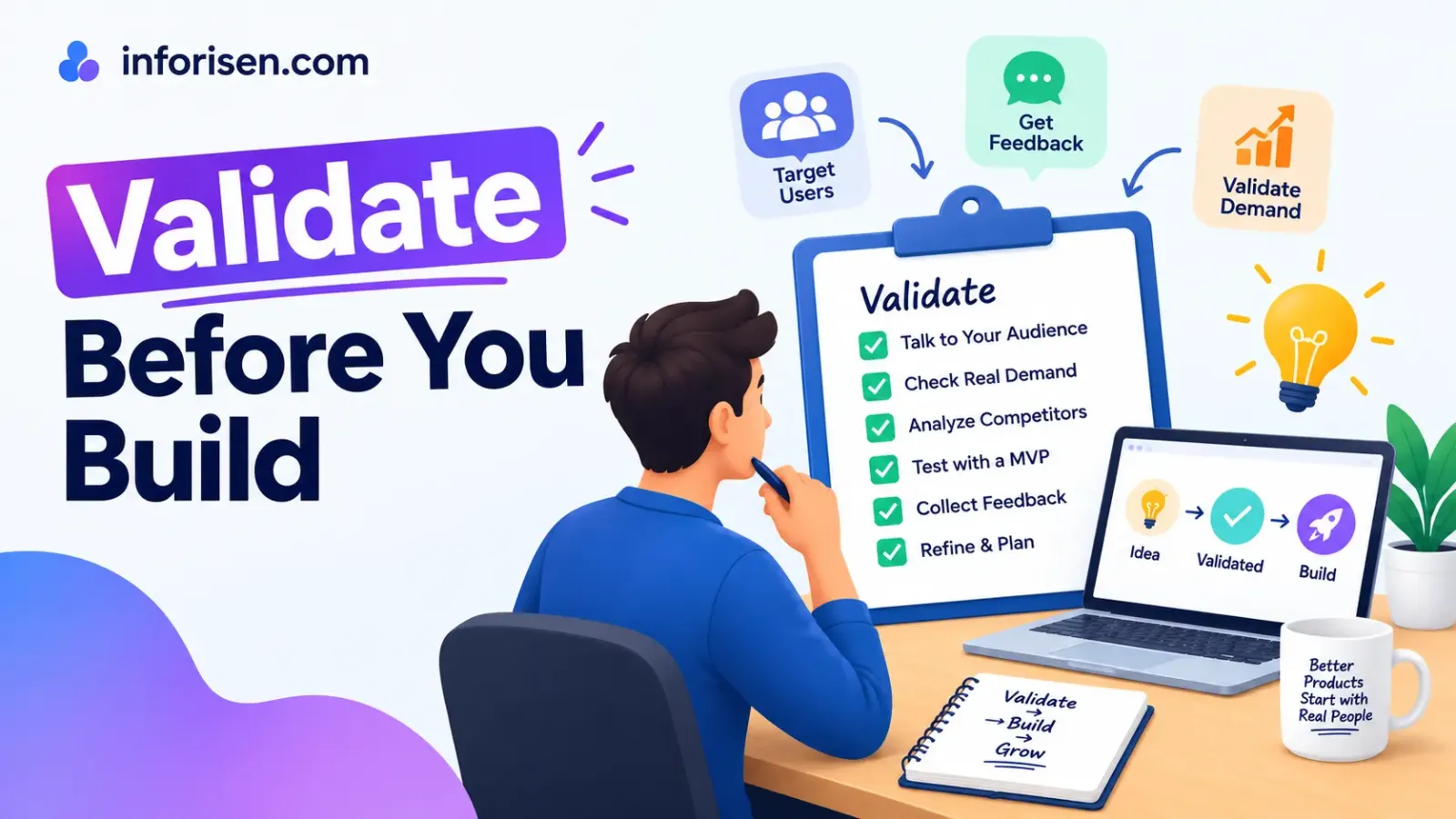
You may believe your idea is valuable, but your assumptions need to meet real customers before you commit serious development resources.
Talk to potential users. Show them your concept. Ask how they currently handle the problem. Pay attention to what they repeatedly complain about.
You are not looking for people to simply say, “That's a great idea.”
You want to discover whether the problem is real, frequent, and important enough to justify a better solution.
What Validation Can Reveal
Early research can help you understand:
- Which problem matters most
- Which features users actually expect
- What they already use
- What they are willing to pay for
- Where existing products fall short
This information gives your roadmap a stronger foundation.
Define the MVP
Now comes one of the hardest decisions: what should actually be in version one?
This is where startup founders often get carried away.
You might want AI automation, advanced analytics, multiple integrations, mobile apps, custom dashboards, team permissions, and dozens of other features.
But your first release does not need to do everything.
Keep the First Version Focused
Your MVP should focus on the smallest practical product that can deliver the core value to your target customer.
For example, an appointment-management SaaS might initially need user accounts, appointment booking, calendar management, notifications, and basic administration.
Advanced analytics and dozens of integrations can come after you understand how customers actually use the product.
The goal is not to make the MVP cheap or incomplete. The goal is to learn from the market before making the product unnecessarily complex.
Prioritize Your Features
Once your MVP is defined, you will probably still have more ideas than your team can build immediately.
Now you need to decide what deserves attention first.
Look at each feature through the lens of customer value, business impact, development effort, urgency, and technical dependency.
You can use prioritization frameworks such as RICE or MoSCoW, but you do not need a complicated system if your team is small.
Ask One Simple Question
Sometimes one question can help:
“If we don't build this now, what important thing will stop working?”
If the answer is “nothing,” that feature probably does not need to be at the top of your roadmap.
Map Technical Dependencies
Your roadmap should not only describe what customers will see.
Some product features depend on technical work happening behind the scenes.
For example, if you want to introduce SaaS subscriptions, you may first need user accounts, pricing plans, payment processing, billing logic, and subscription management.
If those dependencies are ignored, a feature that looked simple on paper can become much more complicated during development.
Don't Forget Technical Work
Your roadmap may also need room for:
- Architecture improvements
- Security
- API development
- Performance
- Testing
- Database optimization
- Technical debt
These tasks may not look exciting, but they can determine whether your SaaS remains reliable as the number of users increases.
Connect Features to Outcomes
A feature being launched does not automatically mean it was successful.
Imagine your roadmap says:
“Launch a new onboarding system.”
That tells your team what to build, but it does not explain what success should look like.
A stronger roadmap might say:
“Improve onboarding so more new users complete their first important action.”
Now the team has an outcome to measure.
Choose Meaningful Metrics
Depending on your SaaS model, you might track activation rate, trial-to-paid conversion, retention, churn, feature adoption, or revenue.
The exact metric will depend on your product. What matters is connecting development work to something meaningful.
Create a Flexible Timeline
Your roadmap should give your team direction without pretending that the future is completely predictable.
Startups change quickly. Customer feedback can change priorities. A technical issue can delay a release. A new market opportunity can suddenly become more important.
Instead of putting an exact date beside every future feature, you can organize your roadmap into broader stages.
Now, Next, and Later
Now — work the team is actively doing.
Next — important initiatives that are coming soon.
Later — ideas that are valuable but still need validation or planning.
This simple approach keeps the roadmap easy to understand while giving your team room to adapt.
Keep Customer Feedback in the Loop
Your first roadmap is not your final roadmap.
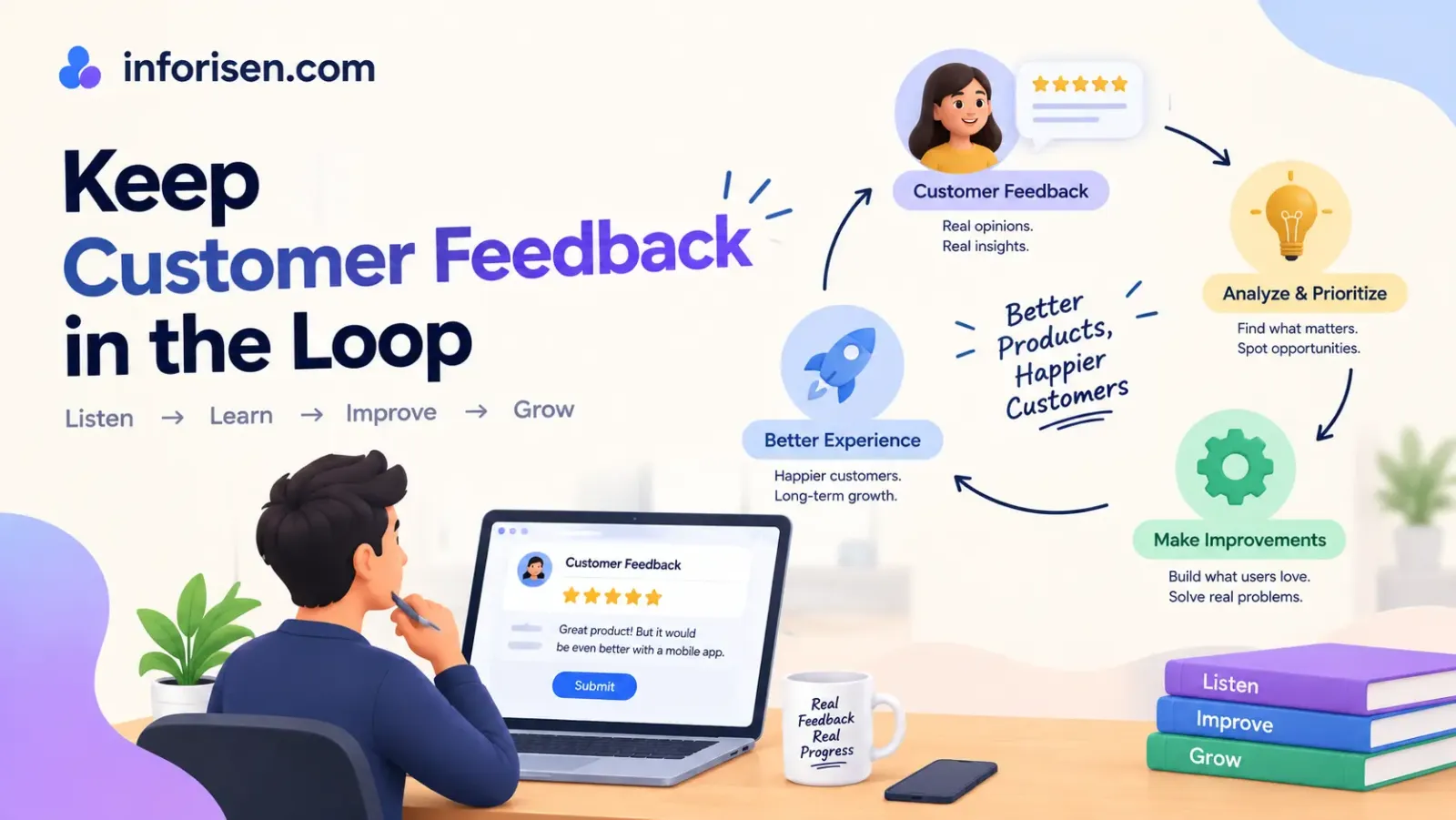
Once people start using your SaaS, you will learn things that no planning session could have predicted.
Maybe users struggle with onboarding. Maybe a feature you thought would be important barely gets used. Or perhaps customers keep asking for a workflow you did not originally consider.
Turn Feedback Into New Priorities
That information should affect your next priorities.
Think of the process as:
Build → Launch → Learn → Prioritize → Improve
This creates a product that evolves with its users instead of simply following an old feature list.
Review Your Roadmap Regularly
A roadmap becomes less useful when it is created once and forgotten.
You do not need to constantly rewrite it. Instead, review it at a regular interval and ask whether your priorities still make sense.
Know When to Change Direction
Look at what you have built, what customers are saying, which features are being used, and whether technical issues are becoming more important.
If something no longer supports your product direction, move it down or remove it.
A good roadmap is allowed to change.
Turn the Roadmap Into Development Tasks
A roadmap is still a strategic document. Developers and designers need more detail before they can start implementation.
Once an initiative becomes a priority, break it down into smaller development requirements.
From Strategy to Development
For example:
Product goal → Initiative → Feature → User story → Development task
This gives everyone a clearer connection between the business objective and the work happening inside the development team.
It also prevents developers from receiving a random list of tasks without understanding the reason behind them.
Turning Your SaaS Roadmap Into a Real Product
Creating a roadmap is only the beginning.
At some point, you need to turn those priorities into architecture, user flows, interfaces, code, integrations, testing, deployment, and a product that real customers can actually use.
This is where the connection between product planning and development becomes important.
How Inforisen Can Help
If you already have a SaaS concept but are unsure how to turn the roadmap into a working product, Inforisen can help connect the planning stage with the actual product development process.
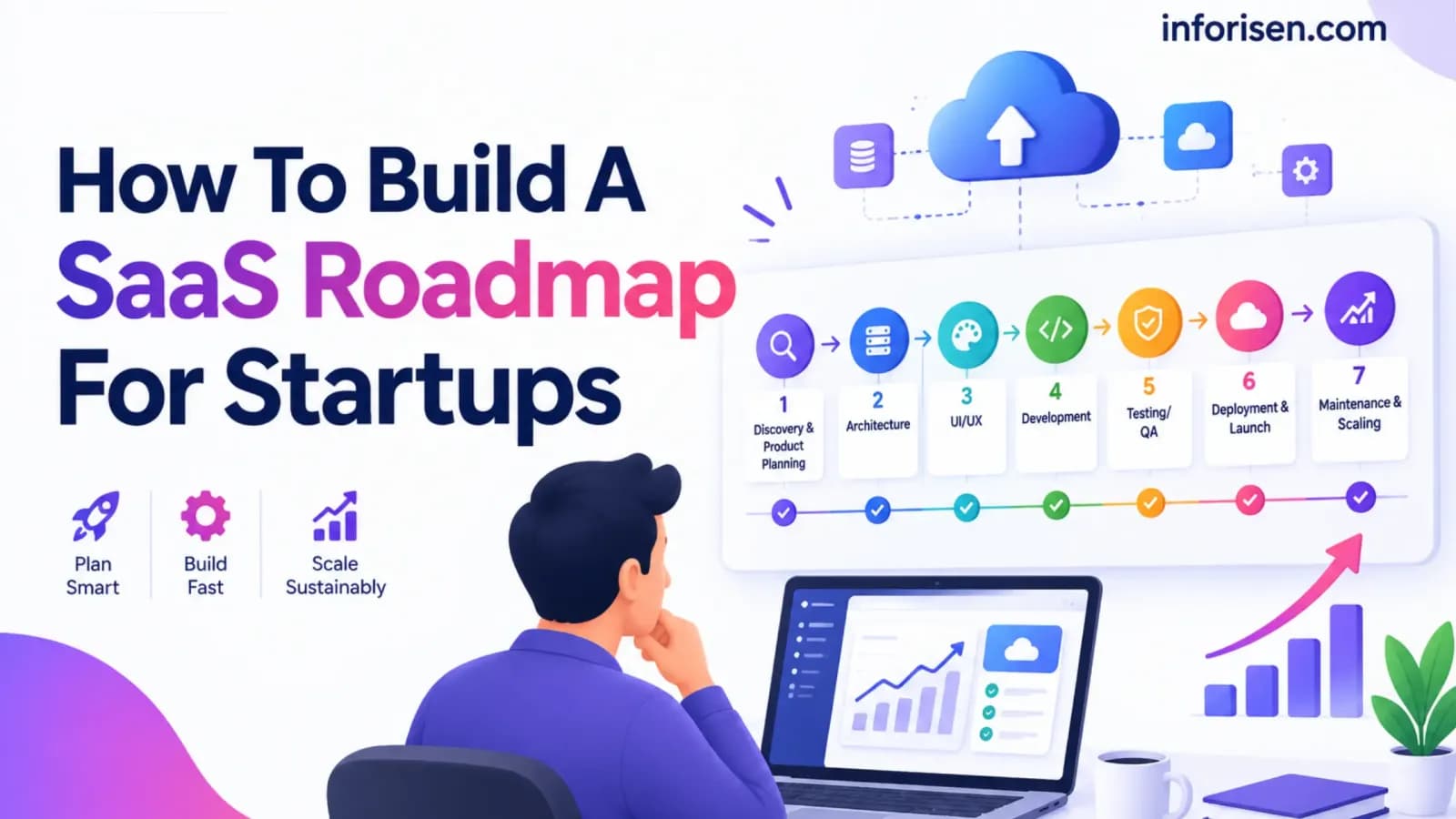
Inforisen's SaaS Product Development Services cover the product journey from discovery and product planning to SaaS architecture, UI/UX design, development, API and third-party integrations, testing, deployment, maintenance, and scaling.
That connection matters because your roadmap should not exist separately from development.
Imagine your roadmap says you want to launch a multi-tenant SaaS platform with subscription billing and several third-party integrations.
Those decisions affect architecture, database design, authentication, APIs, security, UI/UX, and testing.
If those technical requirements are considered early, your roadmap becomes much more practical.
From Roadmap to Execution
Instead of simply saying “build the billing system,” your team can understand what needs to happen before it, what depends on it, and how it fits into the larger product.
Inforisen's SaaS process starts with discovery and product planning, where the product idea, target users, business model, features, scope, and technical requirements are analyzed before moving into architecture and development.
For a startup, that can help turn a broad idea into a development plan that is easier to understand and execute.
Start With Product Discovery
Before development starts, you need clarity.
Who is the product for? What is the MVP? Which features are essential? What integrations are required? What technical challenges might appear later?
Answering these questions early can prevent unnecessary changes during development. It also gives your team a clearer understanding of what should be built now and what can wait.
Bring UI/UX Into the Roadmap
Your SaaS roadmap should not focus only on backend functionality.
Users experience the product through screens, navigation, forms, dashboards, onboarding, and workflows.
Design Around the Product Goal
That is why UI/UX decisions should be connected to the roadmap rather than treated as decoration added after development.
Inforisen also provides UI/UX Design Services for SaaS products, applications, and other digital products.
For example, if improving user onboarding is one of your roadmap priorities, the design team needs to understand that goal before creating the relevant user flows and screens.
That way, design supports the product objective instead of simply making the interface look attractive.
Plan for Future Growth
You may have only a small number of users when your SaaS launches.
But if the product starts gaining traction, your technical requirements will change.
Performance, security, infrastructure, integrations, analytics, and architecture may all need additional attention.
Scale Without Overbuilding
You do not need to over-engineer everything on day one. But your roadmap should leave room for the product to evolve.
Inforisen's SaaS development process includes maintenance and scaling alongside architecture, development, integrations, testing, and deployment.
That makes scaling part of the product journey, not something you wait until the product starts struggling to address.
Common SaaS Roadmap Mistakes
A roadmap can look impressive and still lead your startup in the wrong direction.
One common mistake is trying to build too much before validating the core idea.
Another is prioritizing features because they sound exciting rather than because customers actually need them.
You can also run into trouble by ignoring technical work, setting unrealistic deadlines, or refusing to remove features that no longer make sense.
The biggest lesson is simple:
Your roadmap should help you make decisions, not create more complexity.
A Simple SaaS Roadmap Example
Imagine you are building a SaaS platform that helps small businesses manage appointments.
Your roadmap could look like this:
Notice that the roadmap does not try to predict every feature for the next three years.
It gives the team a clear direction while leaving enough space to learn.
That flexibility is especially important for startups because your customers may change your priorities once they actually start using the product.
Final Words
A SaaS roadmap should make your startup feel more focused, not more complicated.
Start with the customer problem. Validate it before building. Keep the MVP focused, prioritize features based on real value, and remember the technical work happening behind the interface.
Then, once the product reaches real users, let their feedback influence what comes next.
If you are ready to turn your SaaS roadmap into a real product, explore Inforisen's SaaS Product Development Services to see how product planning can connect with architecture, UI/UX, development, testing, deployment, and ongoing scaling.
Your roadmap does not need to predict the future.
It simply needs to help you make the next right product decision.
Frequently Asked Questions
What is a SaaS roadmap?
A SaaS roadmap is a strategic plan that outlines a product's direction, priorities, major features, and development stages over time.
How do I build a SaaS roadmap for a startup?
Start by identifying the customer problem, defining your product vision, validating the idea, choosing the MVP features, prioritizing development work, and connecting important initiatives with measurable outcomes.
What should a SaaS roadmap include?
A practical roadmap can include product goals, customer problems, MVP features, technical requirements, dependencies, milestones, metrics, and future initiatives.
How should startups prioritize SaaS features?
Consider customer value, business impact, development effort, urgency, and technical dependencies. The framework matters less than having a clear reason behind each priority.
Should a SaaS roadmap have exact deadlines?
Not necessarily. Flexible timeframes such as Now, Next, and Later can work well for startups because priorities can change as the product develops.
How often should a SaaS roadmap be updated?
Review it regularly as you collect customer feedback and product data. The exact frequency depends on your product, team, and stage of development.
Should technical work be included in a SaaS roadmap?
Yes. Architecture, security, performance, testing, APIs, and technical debt can directly affect the product's reliability and ability to scale.
Can a SaaS development company help with roadmap planning?
Yes. A development partner can help translate a SaaS idea into product requirements, MVP scope, technical architecture, design, development stages, integrations, testing, and deployment. Inforisen's SaaS process covers discovery and product planning through deployment, maintenance, and scaling.