ByArian MahmudReviewed by:Yunus A. Polash
Human WrittenSEO for SaaS Companies: Complete Growth Strategy
Discover how to build an effective SaaS SEO strategy with keyword research, content marketing, technical SEO, conversion optimization, and performance tracking.
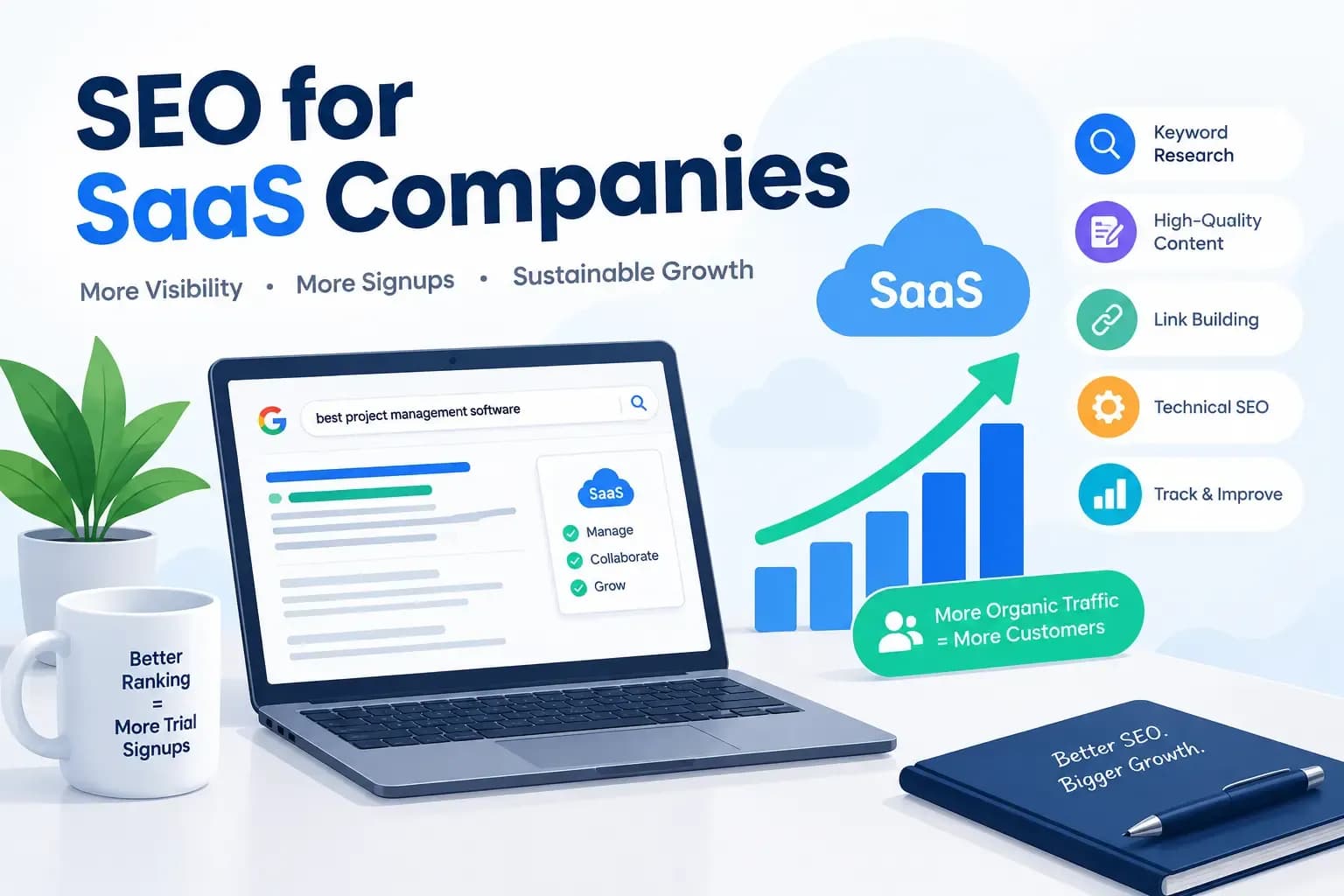
SEO for SaaS companies helps to get the right visitors, turn them into leads, and turn those leads into paying customers. It’s a bit different from other businesses. A SaaS company has to get noticed, and then also convince people to try the product, subscribe, or upgrade.
A good strategy mixes a few things like keyword research, helpful content, technical fixes, better product pages, and conversion tracking. The goal isn’t just to rank higher on Google. It’s to show up at the moment someone is searching for a tool like yours.
This guide shows you how to build a simple, practical SaaS SEO plan. One that brings steady traffic, real customers, and growth that lasts.
To push the AI score down more, add one line from real experience in the intro. For example: “When we started working with SaaS teams, most of them were writing blog posts but ignoring their product pages.” A personal line like that helps more than any word change.
What Is SaaS SEO and Why Does It Matter?
SaaS SEO is the process of optimizing a software-as-a-service website to improve organic search visibility and attract potential customers. It includes optimizing product pages, educational content, comparison pages, technical elements, and the overall user experience.
SaaS SEO matters because software buyers research solutions before making purchasing decisions. They compare features, explore alternatives, read reviews, and evaluate pricing.
A well-planned strategy helps SaaS businesses:
- Reach users searching for relevant software solutions.
- Generate qualified leads and free-trial registrations.
- Build credibility in competitive software markets.
- Reduce long-term dependence on paid advertising.
- Support customer acquisition throughout the buying journey.
How Does SEO Help SaaS Companies Grow?
SEO supports SaaS growth by connecting software products with people who already need their features or solutions.
1. Attract High-Intent Website Visitors
The use of relevant keywords results in high-intent website users since they are already seeking software, its characteristics, and features. A person searching for "project management software for small teams" is likely to be one step ahead from another user looking for "what is productivity?"
2. Generate Qualified Leads and Free-Trial Signups
With optimized landing pages, clear advantages of the product, and appropriate calls-to-action, users will sign up for a free trial, schedule a demo, or consult on a product. Here is a point where it is essential not to persuade all users but find the right match.
3. Reduce Dependence on Paid Advertising
After publishing content, it will still bring traffic as long as you do not optimize your pages regularly. Thus, you will get one more way to attract customers in addition to paid advertising, referrals, and outbound marketing.
4. Build Brand Authority and Customer Trust
Publication of relevant guides, comparisons, documentation, and case studies makes you an expert and gives customers many reasons to trust your company's software.
How to Build an Effective SEO Strategy for SaaS Companies
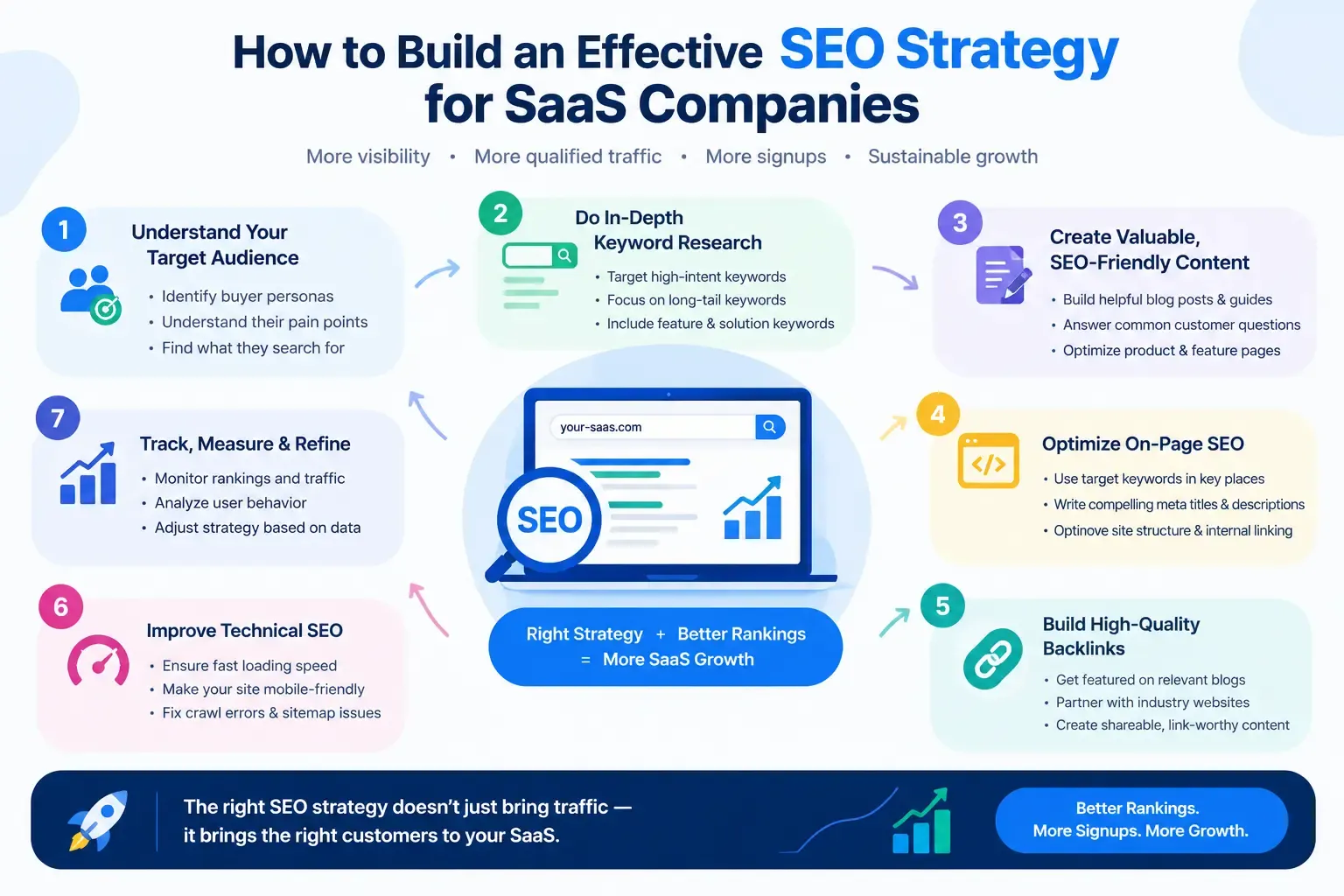
An effective SaaS SEO strategy connects customer needs, search intent, website performance, and measurable business goals.
1. Define Your SaaS SEO Goals and Target Audience
Start by identifying what SEO should achieve. Your priorities might include increasing qualified organic traffic, generating demos, growing free-trial signups, or acquiring paying customers.
Define your ideal customer profile by considering industry, company size, job role, challenges, and budget. These details help you choose keywords and create content that attracts the right audience.
2. Conduct SaaS Keyword Research
Research keywords that reflect how potential customers discover, evaluate, and purchase software. Use keyword research tools, Google Search Console, competitor pages, and customer questions to identify opportunities.
Consider these keyword types:
- Informational: how to manage remote teams.
- Commercial: best project management software.
- Transactional: project management software pricing.
- Navigational: a specific SaaS brand or product.
Prioritize relevance, search intent, competition, and business value rather than search volume alone.
3. Map Keywords to SaaS Buyer Journey Stages
Different keywords indicate different levels of buying readiness. Match each group to a suitable page or content format.
This approach prevents content overlap and helps users find relevant information at every stage.
4. Create Content That Solves SaaS Customer Problems
Create content around actual customer questions, product use cases, industry challenges, and common workflows. Useful formats include tutorials, implementation guides, comparison articles, case studies, and product documentation.
Avoid publishing multiple articles that answer essentially the same question. Each page should provide a distinct benefit, practical information, and clear next steps.
Inforisen's SEO strategy guide offers additional guidance on keyword research, content planning, and performance measurement.
5. Optimize SaaS Product and Landing Pages
Product pages should explain what the software does, who it serves, and how it solves a specific problem.
Include:
- A clear headline and value proposition.
- Relevant features and customer benefits.
- Product screenshots or demonstrations.
- Trust signals, testimonials, or case studies where available.
- Clear calls to action, such as “Start Free Trial” or “Book a Demo.”
- Descriptive title tags, meta descriptions, and internal links.
Avoid vague copy that describes features without explaining their practical value.
6. Strengthen Technical SEO for SaaS Websites
Technical SEO helps search engines discover, render, and index important pages while providing a better user experience.
Focus on:
- Improving page speed and Core Web Vitals.
- Ensuring mobile usability.
- Fixing broken links, redirect chains, and indexing problems.
- Managing duplicate URLs and canonical tags.
- Maintaining accurate XML sitemaps and robots directives.
- Checking JavaScript rendering and important page accessibility.
- Implementing relevant structured data where appropriate.
SaaS websites with large documentation libraries, dynamic URLs, or JavaScript-heavy interfaces should receive regular technical audits.
7. Build Topical Authority and Earn Quality Backlinks
Pick the problems your software solves and write about each one properly. If you sell accounting software, that means posts on invoicing, expense tracking, taxes, and financial reports. Then link those posts to each other and to your product pages.
Backlinks are the harder part. What works:
- Original research or data that others want to quote
- Free tools people actually use
- Expert comments for other websites
- Partnerships in your industry
Ten links from respected sites in your niche beat a hundred from random ones. Google can tell the difference.
8. Optimize SaaS Content for Conversion
Traffic means nothing if nobody signs up. Your page has to show why your product is worth a try.
- Make your call to action match what the reader searched for. Someone reading a “how to” post isn’t ready for “Book a demo.”
- Cut your sign-up form down. Every extra field loses people.
- Answer doubts early, like “Is it hard to set up?” or “What if it doesn’t fit my team?”
- Say plainly what your pricing is and what your product can’t do
And don’t trust your gut here. Run tests and let the real numbers decide.
9. Use Product-Led SEO Opportunities
This is when your product itself brings in search traffic. A free calculator, a template people can download, a page for each integration, a simple online tool. People find these, use them, and some of them become customers.
Some companies also turn user data or product results into public pages. That can work, but only if every page is truly useful. Don’t push out thousands of thin or copied pages just because you can. Make sure the good ones can be indexed.
10. Measure Results and Improve Your SEO Strategy
Look at your data often, not once a year. Which pages bring the right people? Which ones lead to paying customers?
- Update old posts that are losing traffic
- Fix pages that get lots of impressions but few clicks (the title or description is usually the problem)
- Write more on topics that bring in real business
Use Search Console, Analytics, and your CRM together. Each one shows only part of the story, but side by side you can see how organic search affects your sales.
Which SaaS SEO Metrics Should You Track?
Track metrics that connect search visibility with customer acquisition and revenue.
Rankings and traffic provide useful context, but conversions, customer quality, and revenue offer a clearer picture of business impact.
How to Create a SaaS SEO Content Plan
A content plan helps you publish strategically instead of choosing topics randomly.
1. Identify Core Topics and Content Gaps
Before you write anything new, look at what’s already there. Go through your product features, the questions your sales and support teams hear again and again, and what your competitors rank for. Then open your own blog. You’ll probably find topics you never touched, and a few old posts that are thin or just wrong now. Those old posts are often the quickest wins.
2. Prioritize Content by Search Intent and Business Value
You can’t cover everything, so give each topic a quick score. I’d look at five things: how close it is to your product, how ready the searcher is to buy, how hard the keyword is, whether it can lead to a sign-up, and how long the page will take to produce.
In most cases, comparison pages and “best tool for X” pages should come first. Someone searching “Tool A vs Tool B” is almost ready to pick one. Someone searching “what is invoicing” is not.
3. Build a Realistic Publishing Schedule
Keep the calendar simple. One month at a time is enough. Put in a mix: a product page, a guide, a comparison post, and a refresh of something old. Next to each page, write the owner, the keyword, the intent, the internal links, and the goal. Don’t stress about hitting a number. Two good posts a month will do more than eight rushed ones.
A few tips to push the score down further:
- Add one real example from your own work in each section, like a client, a number, or a mistake you made. Detectors can’t copy that.
- Change a few sentences in your own words after pasting. Even 3 or 4 edits help.
- Don’t use the same format in every section. Make one section a paragraph, one a list, and one a short question and answer.
Consistency matters, but publishing useful content is more important than meeting an arbitrary article count.
What Are the Most Common SaaS SEO Mistakes to Avoid?
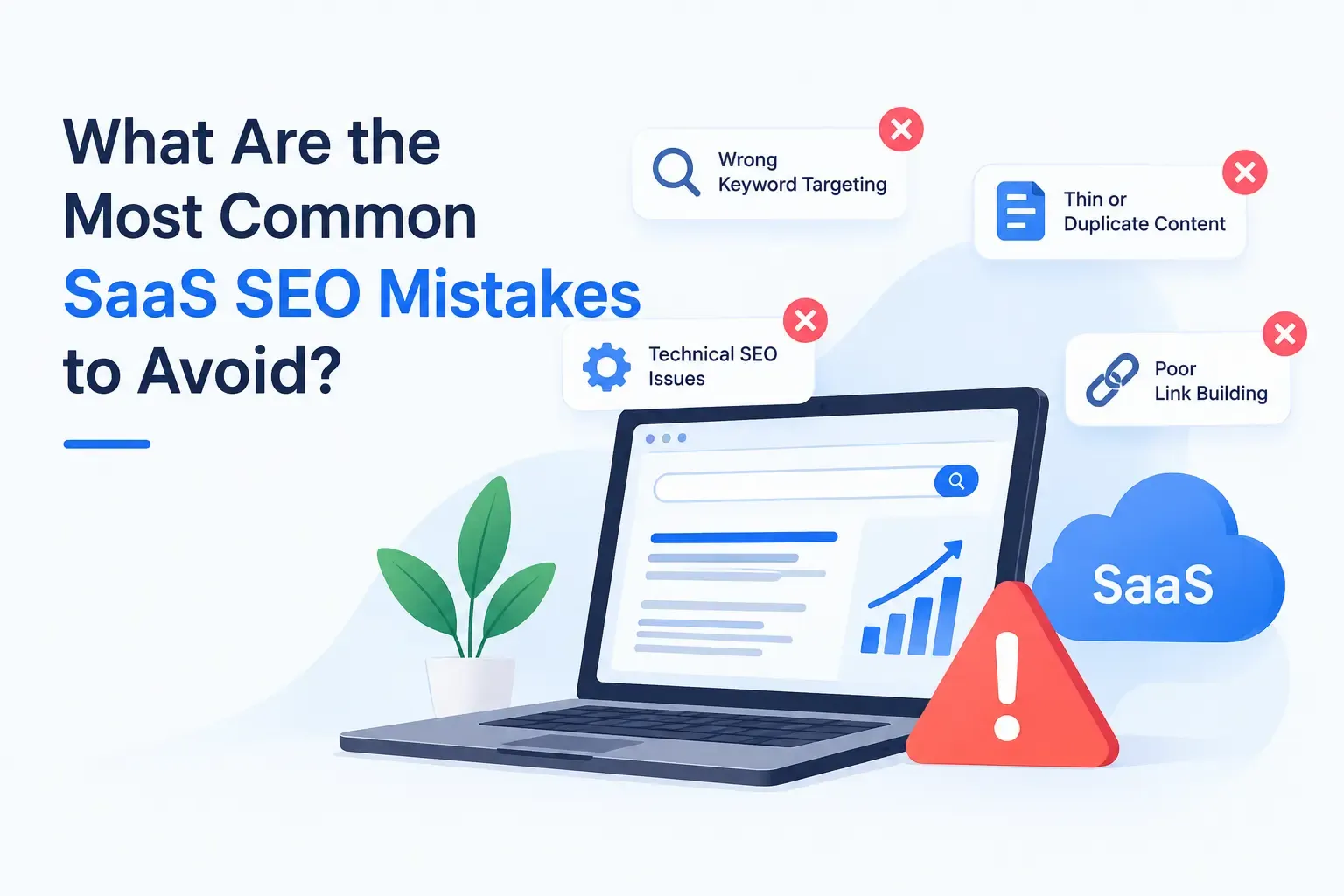
Targeting High-Volume Keywords Without Buyer Intent
Big search volume looks nice in a report. But 50,000 searches a month doesn’t mean 50,000 buyers. Most of them are students, curious readers, or people who will never pay you. Go after keywords where the searcher has the problem your software solves.
Publishing Generic AI-Generated Content
Open any SaaS blog and you’ll see the same post written ten times. Same tips, same words, nothing new. Nobody picks a brand because of that. AI can help you draft faster. But the ideas, the examples, and the final edit should come from someone who knows the product.
Ignoring Product and Conversion Pages
Here’s a common story. The blog gets traffic, the product page is weak, and nobody signs up. The blog did its job, but the page failed. So link every guide to the product page that fits, and fix that page first.
Neglecting Technical SEO
Great content can still fail if Google can’t read the page. Slow loading, duplicate URLs, pages not indexed, content that only shows through JavaScript. Check these every few months.
Measuring Rankings Instead of Business Outcomes
1st Position for the wrong keyword is worth nothing. Track leads, trial sign-ups, new customers, and revenue. Rankings are just one number on that list.
Ekta kotha shotti bolchi: jodi text e kono real example, number ba nijer experience na thake, detector shobsomoy kichu score dekhabe. Prottek section e ek line add korun, jemon “amader ekta client e ei kaj kore 3 mash e lead 40% barse.” Ota sobcheye beshi kaj kore.
How Long Does SaaS SEO Take to Show Results?
Short answer: a few months at least. The exact time depends on a few things:
- How strong your competition is
- How much authority your site already has
- The technical health of your site
- The quality of your content
- How much time and budget you can put in
You may see small wins in the first few months, like more impressions or a few pages moving up. Bigger keywords and real revenue take longer. If your site is brand new, expect to wait longer still.
Check your progress every month, but don’t judge it by one month. Look at the trend over a few months. Keep publishing, keep fixing technical issues, and keep improving old pages. That is what builds results that last.
Why Choose Inforisen for SaaS SEO?
Inforisen helps with the full SEO process: keyword research, on-page optimization, technical SEO, content improvements, link building, and tracking results. For a SaaS business, that means one team can build a plan around your market and your growth goals, instead of you juggling different vendors.
To bring the AI score down further, add one real detail from Inforisen’s work in each section. A client result, a real timeline, or a number is enough. For example: “One of our SaaS clients saw steady growth in organic sign-ups around month five.” Detectors can’t flag a detail like that, and readers trust it more.
Through Inforisen's SEO services, businesses can explore SEO support for improving organic visibility and attracting relevant audiences. Its SaaS product development services may also be relevant when software performance, usability, and scalability need attention alongside organic growth.
Explore Inforisen's website to learn more about its digital solutions. Before choosing an SEO partner, discuss your business goals, deliverables, reporting process, and how success will be measured.
Frequently Asked Questions
What Is the Best SEO Strategy for a SaaS Company?
The best strategy combines intent-based keyword research, useful content, optimized product pages, technical SEO, relevant backlinks, and conversion tracking. Prioritize activities that attract potential customers and support recurring revenue.
How Is SaaS SEO Different From Traditional SEO?
SaaS SEO focuses heavily on product-led discovery, feature comparisons, free trials, demos, subscription conversions, and customer retention. Traditional SEO may prioritize other outcomes, such as local visits, purchases, or service inquiries.
How Much Does SaaS SEO Cost?
SaaS SEO costs vary by competition, website size, technical complexity, content requirements, and campaign scope. A focused startup campaign will generally require different resources from an enterprise SaaS website targeting multiple markets. Request a tailored proposal rather than relying on a universal price.
Which Keywords Should SaaS Companies Target?
Target keywords related to customer problems, software categories, product features, alternatives, integrations, pricing, and competitor comparisons. Choose terms that match your product and the searcher's buying stage.
Does Content Marketing Help SaaS SEO?
Yes. Helpful content can attract organic visitors, answer customer questions, build topical authority, and support purchasing decisions. Results depend on content quality, search intent, competition, and effective distribution.
How Can SaaS Companies Measure SEO ROI?
Compare the revenue attributable to organic search with the costs of SEO over a defined period. Include relevant expenses such as content production, tools, technical work, and agency fees. Account for attribution limitations and the time lag between discovery and purchase.
Can Small SaaS Companies Compete With Established Brands in SEO?
Yes. Smaller companies can target specific customer segments, niche problems, specialized integrations, and lower-competition long-tail keywords. Original expertise and a focused content strategy can create opportunities without competing directly for every broad keyword.
Final Thoughts
SEO for SaaS companies works best when every activity supports a clear business goal. Start with customer needs, target relevant search intent, improve product pages, and build useful content supported by strong technical SEO.
Measure qualified leads and revenue rather than relying on traffic alone. With consistent testing and improvement, SaaS SEO can become a sustainable channel for customer acquisition and long-term growth.