ByShuman Chandra DasReviewed by:Yunus A. Polash
Human WrittenHow to Outrank Competitors on Google SEO: 10 Strategies That Work
Learn 10 proven SEO strategies to outrank competitors on Google, improve search visibility, build topical authority, and attract more organic traffic.
Ranking above competitors on Google requires more than adding keywords or publishing longer articles. The real advantage comes from understanding search intent, covering a topic better, building authority, improving technical performance, and continuously optimizing based on search data.
For businesses like Inforisen, the goal should not be to manipulate rankings but to build pages that are more useful, trustworthy, and relevant than competing results.
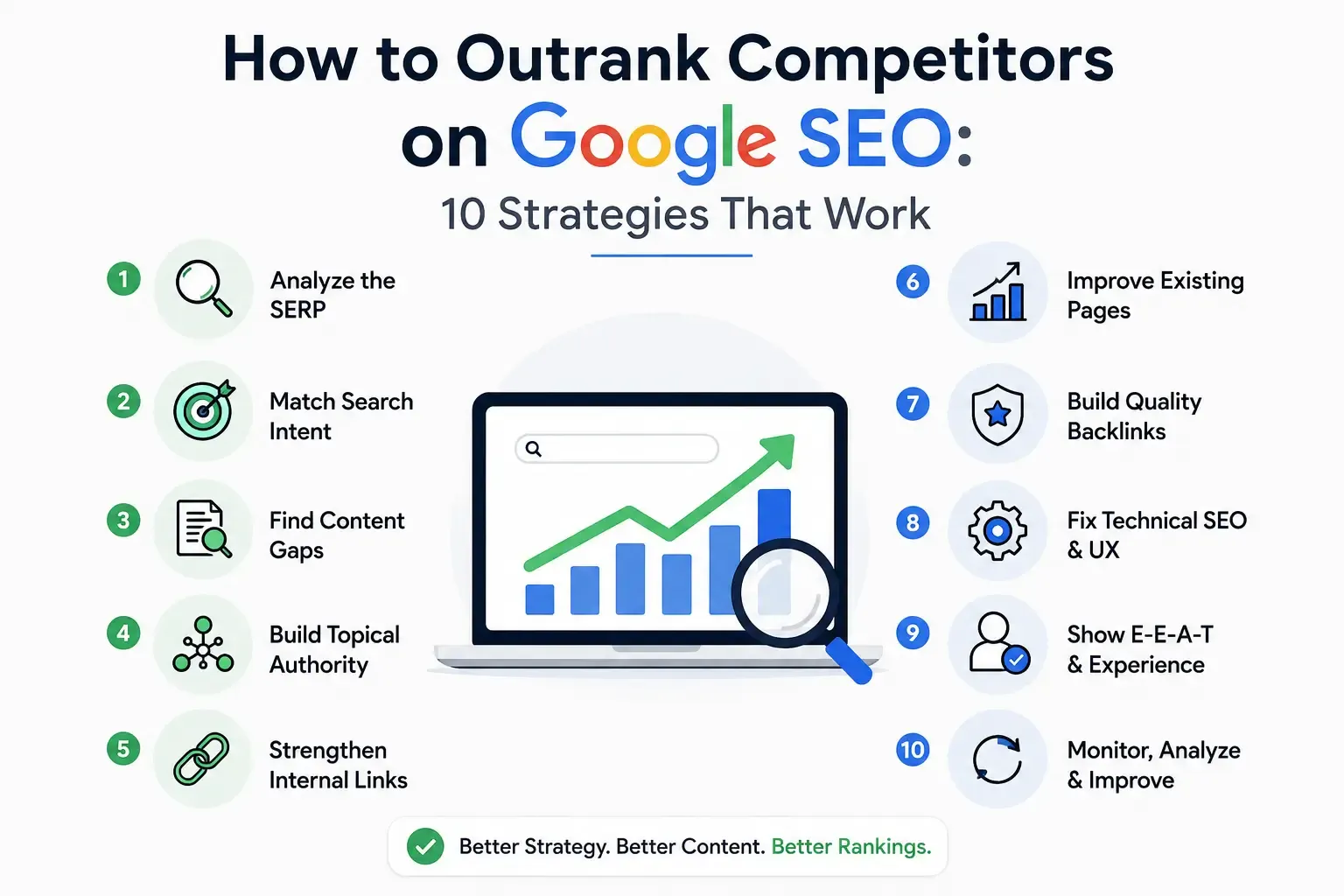
10 SEO Strategies to Outrank Competitors on Google
To outrank competitors on Google, start by analyzing the SERP and understanding search intent before creating content. Identify competitor content gaps, build topical authority through relevant content clusters, and focus on creating useful, high-quality content rather than simply increasing word count.
Optimize your pages for traditional search, AEO, GEO, and AI search while strengthening internal linking across your website. Improve pages already ranking on positions 11–30, earn relevant and authoritative backlinks, and fix technical SEO issues that affect crawling, indexing, page speed, and user experience.
1. Start With What Already Ranks
Before creating content, analyze the current Google results for your target keyword. The top-ranking pages reveal what Google considers relevant for that search.
Analyze the SERP Before Writing
Check:
- Search intent
- Content format
- H2 and H3 topics
- Content depth
- Featured snippets
- People Also Ask questions
- Ranking competitors
- Missing information
- Content freshness
- Page experience
If the SERP is dominated by service pages, an informational blog may struggle to rank. If comprehensive guides dominate, a short article may not satisfy the query.
The SERP should determine your content strategy.
2. Match Search Intent Better Than Competitors
Search intent is one of the most important factors in competitive SEO.
A person searching “SEO services for small businesses” may want providers, pricing, deliverables, and recommendations. Someone searching “what is technical SEO” wants an explanation.
Build the Page Around the User's Goal
Ask three questions before writing:
- What does the user want?
- What information do they need to make their next decision?
- What are the existing results failing to provide?
Then structure the content around those answers.
Don't force an informational keyword onto a sales page simply because it has search volume. The page type must fit the intent.
3. Find Competitor Content Gaps
Your competitors don't have to be completely weak for you to outrank them. Even strong pages usually leave opportunities.
Look for What They Miss
A content gap could be:
- An unanswered question
- An outdated statistic
- A missing use case
- A weak explanation
- No examples
- Poor comparisons
- Missing original data
- Weak FAQs
- Limited geographic relevance
- Poor internal linking
For example, if competing pages explain what SEO services are but don't explain how to choose an SEO provider, pricing factors, expected deliverables, and warning signs, those missing areas become opportunities.
The objective isn't to copy competitors.
It is to make your page more complete and useful.
4. Build Topical Authority, Not Isolated Articles
One article rarely establishes strong authority around a competitive topic.
If your primary service is SEO, create supporting content around the entire subject.
Build a Strong Topic Cluster
For example:
SEO Services
→ Technical SEO
→ Local SEO
→ On-Page SEO
→ Competitor Analysis
→ Link Building
→ Content Optimization
→ Semantic SEO
→ AEO
→ GEO
→ SEO Audits
→ Enterprise SEO
Connect these pages through relevant internal links.
This helps users discover related information while giving search engines clearer context about your website's expertise.
5. Make Your Content Better, Not Just Longer
Long-form content can rank well, but word count itself is not a ranking advantage.
A 1,500-word article with useful information can outperform a 4,000-word article filled with repetition.
Increase Information Density
Every section should provide something useful:
- A clear answer
- A practical example
- Original insight
- Data
- A comparison
- A process
- A recommendation
- A useful warning
Remove paragraphs that simply repeat the previous point.
Write until the topic is properly covered—not until you reach an arbitrary word count.
6. Optimize for AEO, GEO, and AI Search
Search is no longer limited to traditional blue links. Users increasingly interact with AI-generated answers and conversational search experiences.
Your content should therefore be easy for both users and search systems to understand.
Give Direct Answers
Use question-based headings where appropriate and answer them clearly.
For example:
What Is Technical SEO?
Technical SEO is the process of improving a website's crawlability, indexability, architecture, performance, and technical accessibility so search engines can properly discover and understand its content.
Then expand with supporting information.
This structure helps users find answers quickly and gives AI systems clearly defined information to interpret.
Cover Related Questions Naturally
Don't repeat the primary keyword throughout the page.
Instead, use related concepts and entities naturally:
- Search intent
- Organic traffic
- Keyword research
- SERP analysis
- Content gap
- Internal linking
- Topical authority
- Technical SEO
- Backlinks
- User experience
Semantic coverage is stronger when these concepts are genuinely connected to the subject.
7. Strengthen Internal Linking
Internal links help search engines understand relationships between your pages and help users move through your website.
Use Contextual Anchor Text
Avoid excessive use of generic anchors such as:
- Click here
- Read more
- Learn more
Instead, connect pages naturally within relevant sentences.
For example:
A technical SEO audit can identify crawlability, indexing, canonical, and Core Web Vitals issues affecting organic performance.
The anchor should describe the destination rather than interrupting the reader.
A strong structure is:
Pillar page → Supporting page → Detailed subtopic → Relevant service page
8. Improve Pages Already Ranking on Page 2
One of the biggest SEO opportunities is often sitting inside your existing website.
Pages ranking around positions 11–30 already have some relevance and authority. Improving them can be more efficient than creating an entirely new page.
Prioritize High-Opportunity Keywords
Use Google Search Console to identify pages with:
- High impressions
- Relevant queries
- Positions 11–30
- Low or average CTR
- Strong business relevance
Then improve the page based on the actual query data.
You may need to:
- Expand missing sections
- Improve search intent
- Add internal links
- Update outdated information
- Improve the title
- Add better examples
- Strengthen topical coverage
Don't automatically create another article for every keyword opportunity. Sometimes the existing page simply needs to become better.
9. Build Authority With Relevant Backlinks
Content quality can get you into the competition, but competitive keywords often require stronger authority as well.
Focus on Quality and Relevance
Instead of chasing hundreds of random backlinks, prioritize links from websites relevant to your industry.
Effective approaches include:
- Digital PR
- Original research
- Industry studies
- Expert contributions
- Case studies
- Data-driven content
- Resource-worthy guides
- Genuine partnerships
A relevant editorial backlink can contribute more strategically than a large number of unrelated links.
The goal is to earn authority, not manufacture it.
10. Fix Technical SEO and User Experience
Even excellent content can struggle when a website has technical problems.
Focus on the Essentials
Prioritize:
- Indexability
- Crawlability
- HTTPS
- Canonical tags
- XML sitemap
- Robots.txt
- Redirects
- Broken links
- Duplicate pages
- Mobile usability
- Core Web Vitals
- Page speed
- Clear site architecture
Technical SEO doesn't need to become an endless checklist.
Focus on issues that can actually prevent Google from crawling, indexing, understanding, or effectively serving your pages.
How to Know Why a Competitor Is Ranking Higher
When a competitor outranks your page, don't immediately assume they have more backlinks.
Compare the two pages across five areas:
This gives you an actionable SEO gap instead of simply saying, “Their domain authority is higher.”
Create Content Competitors Cannot Easily Copy
The strongest competitive advantage comes from original information.
Add First-Hand Experience
Consider including:
- Original research
- Case studies
- Campaign results
- Screenshots
- Industry observations
- Proprietary data
- Experiments
- Unique frameworks
- Expert opinions
Competitors can rewrite generic SEO advice.
They cannot easily reproduce your actual experience, data, or research.
This is particularly valuable for E-E-A-T, because experience and expertise become visible through the content itself rather than through claims alone.
Don't Ignore Geographic SEO
If your business targets specific markets, geographic relevance can strengthen both traditional search and AI-driven discovery.
Create Real Local Value
For location-specific SEO, include information that actually relates to the market:
- Local search behavior
- Regional competition
- Local customer expectations
- Market-specific examples
- Location-based case studies
- Relevant local industries
Avoid creating dozens of identical pages where only the city name changes.
Local SEO works better when the local information is genuinely useful.
Keep Improving After You Rank
SEO isn't finished when a page reaches the first page.
Competitors publish new content. Search behavior changes. SERPs evolve. Your own pages can become outdated.
Monitor the Right Metrics
Track:
- Impressions
- Clicks
- CTR
- Average position
- Ranking queries
- Organic conversions
- Organic leads or revenue
- Indexed pages
If impressions increase but CTR remains low, improve the title and description.
If rankings stagnate around positions 8–15, investigate content depth, intent, internal links, and authority.
If traffic increases but conversions don't, the problem may be the page's commercial intent or user journey rather than rankings.
The Real Formula for Outranking Competitors
There is no single SEO trick that consistently beats competitors.
A stronger approach is:
Search Intent → Better Content → Topical Authority → Internal Links → Technical SEO → E-E-A-T → Relevant Backlinks → Continuous Optimization
The key is to combine these elements instead of obsessing over one metric.
The Question to Ask Before Publishing
Don't ask:
“Have I used the keyword enough?”
Ask:
“Why should Google rank this page above the existing results?”
If you have a clear answer, you're moving in the right direction.
Frequently Asked Questions About Outranking Competitors on Google
1. How can I outrank my competitors on Google?
To outrank competitors on Google, analyze the search results, understand search intent, identify content gaps, create better content, build topical authority, improve internal linking, fix technical SEO issues, and earn relevant backlinks. Consistent optimization is also important because search results and competitors constantly change.
2. How long does it take to outrank competitors in SEO?
The time required depends on keyword competition, website authority, content quality, backlinks, and technical SEO. Some low-competition keywords may improve within a few months, while highly competitive keywords can take significantly longer. SEO should be treated as a long-term strategy rather than an instant result.
3. Is better content enough to outrank competitors?
Better content is important, but it may not always be enough. Competitive keywords can also require strong topical authority, relevant backlinks, technical optimization, and a better overall user experience. The strongest SEO strategy combines multiple ranking factors.
4. How do I find SEO content gaps in competitor websites?
Analyze competitor pages and look for unanswered questions, outdated information, missing examples, weak explanations, limited comparisons, missing data, and poor internal linking. These gaps can help you create content that provides more value than existing results.
5. Should I create longer content than my competitors?
Not necessarily. Longer content does not automatically rank higher. Focus on covering the topic completely and providing useful information without unnecessary repetition. A concise and valuable 1,500-word article can outperform a repetitive 4,000-word article.
Final Takeaway
To outrank competitors on Google SEO, focus on becoming the most useful and credible result for the search—not simply the page with the most keywords or words.
Analyze the SERP, match intent, identify content gaps, build topical authority, strengthen internal links, improve technical SEO, earn relevant backlinks, demonstrate first-hand expertise, and continuously optimize existing pages.
For a business like Inforisen, this approach creates something more valuable than individual rankings: a website with the topical depth, authority, and trust needed to compete consistently across organic search and emerging AI search experiences.
.webp&w=3840&q=75)
.webp&w=3840&q=75)
.webp&w=3840&q=75)
.webp&w=3840&q=75)