What Is SEO and How It Works: A Beginner’s Guide
Discover how search engines rank websites and how beginners can build a strong, sustainable SEO strategy.
If you are trying to understand what is SEO and how it works, the simple answer is this: SEO helps search engines understand your website and helps the right people discover it when they search for information, products, or services.
Good SEO is not about forcing keywords into pages. It combines useful content, website structure, technical performance, authority, and user experience so search engines can confidently connect a page with a relevant search.
What Is SEO in Digital Marketing and How Does It Work?
SEO stands for Search Engine Optimization. It is the process of improving a website so that its pages can become more visible in unpaid, or organic, search results.
In digital marketing, SEO connects customer demand with website content. Someone searches for a problem, question, product, or service, and the search engine tries to provide the most relevant and useful results.
For example, a business may offer software development services but receive very little organic traffic. SEO helps that business identify what potential customers search for, create pages that satisfy those searches, and make those pages easier for search engines to discover and understand.
Google describes SEO as helping search engines understand content while also helping users decide whether they should visit a website from search results.
Unlike paid advertising, organic visibility is not purchased each time someone clicks. SEO focuses on building long-term visibility by improving the quality, relevance, accessibility, and authority of a website.
That leads to the most important part of the process: understanding what happens between publishing a page and seeing it appear in Google.
How SEO Works: Crawling, Indexing, and Ranking Explained
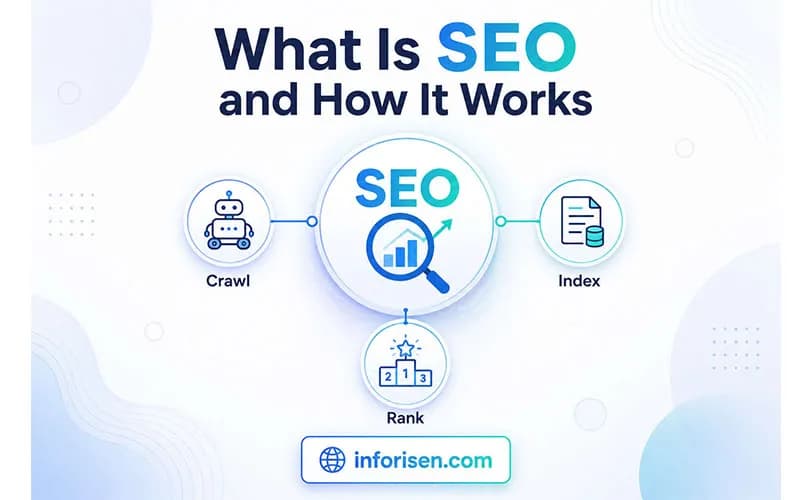
To understand how do search engines crawl index and rank websites, think of Google Search as a large discovery and information-retrieval system.
A page generally needs to pass through three important stages:
Google explains that its crawlers regularly explore the web and that most pages appearing in Search are discovered automatically rather than manually submitted.
1. Crawling Helps Search Engines Discover Your Pages
Crawling happens when search engine software visits pages and follows links to discover additional URLs.
Google's main web crawler is commonly referred to as Googlebot. If an important page has no internal links pointing toward it, sits inside a confusing site structure, or is accidentally blocked from crawling, search engines may have difficulty discovering it.
Internal links are therefore more than navigation tools. Google says links help it discover new pages and understand relationships and relevance between pages.
A clear website structure allows both visitors and crawlers to move naturally from broad topics to more specific information. After discovery comes indexing.
2. Indexing Helps Google Understand the Page
Finding a URL does not automatically mean the page will rank. During indexing, Google processes the content it can access and attempts to understand what the page represents. Titles, headings, body content, images, links, structured information, and other signals can help provide context.
Duplicate pages, weak content, incorrect canonical settings, no-index directives, or technical problems may prevent important pages from being indexed correctly.
A sitemap can also help search engines discover URLs, particularly on larger websites, although Google makes clear that submitting a sitemap does not guarantee crawling or indexing.
Once a page is eligible and indexed, ranking systems determine when it deserves to appear.
3. Ranking Determines Where a Page Appears
Ranking happens when someone enters a search query and Google evaluates relevant pages from its index.
This happens extremely quickly. Google says its automated ranking systems evaluate many factors and signals across hundreds of billions of pages and other indexed content to provide useful and relevant results.
SEO therefore does not involve optimizing for one secret ranking factor. Successful pages usually perform well across several areas at the same time.
How Does Google Decide Which Websites Rank First?

People often ask how does Google decide which websites rank first, but there is no single score that determines every search result.
Different searches require different types of results. Someone searching "how to change a car tire" needs educational instructions. Someone searching "emergency tire repair near me" probably needs a local service provider. The words may be related, but the intent is completely different.
Google's systems attempt to understand that intent before selecting results.
Search Intent and Topical Relevance
The first requirement is relevance. Your page should answer the actual reason behind the search rather than simply repeat the keyword.
Search intent is commonly divided into areas such as:
- Informational intent
- Commercial research
- Transactional intent
- Navigational intent
- Local intent
A page explaining SEO should therefore explain the process clearly rather than immediately pushing visitors toward purchasing a service. Once relevance is established, content quality becomes more important.
Helpful and Reliable Content
Google's guidance emphasizes content created primarily to benefit people instead of content created mainly to manipulate rankings. Its systems aim to reward helpful and reliable information.
Strong content usually answers the main question early, explains important supporting topics, gives useful examples, and avoids unnecessary repetition.
Original experience, expert knowledge, accurate information, clear sourcing, and useful analysis can also strengthen a page.
This is where modern semantic SEO becomes important. Instead of repeating one phrase twenty times, a page can naturally discuss related concepts such as organic traffic, search intent, crawling, indexing, backlinks, site architecture, user experience, and search visibility.
Website Authority and Links
Links can help search engines discover content and understand relationships between websites and pages.
However, quality matters more than collecting large numbers of random links.
Editorially earned links from trustworthy and relevant websites can support authority. Manipulative link schemes, irrelevant backlinks, or large-scale spam can create the opposite effect.
Internal links are equally useful because they connect related pages and help visitors continue exploring a topic.
Technical Accessibility and Page Experience
Excellent writing cannot perform at its full potential if the website creates technical obstacles. Search engines need to access important content, while visitors need pages that load properly and work across devices.
Google uses mobile-first indexing, meaning the mobile version of a site's content is used for indexing and ranking.
Website owners should therefore pay attention to mobile usability, HTTPS, navigation, page performance, intrusive elements, accessibility, and overall usability.
That naturally brings us to the different parts of SEO responsible for these improvements.
What Are the Main Types of SEO and How Do They Work?

The three core areas are generally on-page SEO, off-page SEO, and technical SEO. Local SEO is also important for businesses serving customers within specific geographic areas.
Each area solves a different part of the search visibility problem.
What Is On Page SEO and Why Is It Important?
On-page SEO involves improvements made directly to individual website pages.
It includes elements such as:
- Search intent
- Page titles
- Heading structure
- Content quality
- Keyword placement
- Images and alt text
- Internal links
- URL relevance
- Content depth
Good on-page optimization helps users quickly understand the page while giving search engines clear contextual signals.
For example, an article about SEO and web performance should not randomly link to unrelated topics. A contextual resource about how UI UX design affects SEO and website ranking fits naturally because usability, navigation, page experience, and website structure can influence overall search performance. That type of connection strengthens topical relationships without interrupting the reader.
Technical SEO Makes the Website Accessible
Technical SEO focuses on whether search engines can efficiently discover, render, understand, and index a website.
Important areas include site architecture, XML sitemaps, robots directives, canonical tags, redirects, HTTP status codes, mobile compatibility, JavaScript rendering, page performance, structured data, and crawlability.
Technical SEO becomes especially important as websites grow. A five-page website may be simple to manage, while an ecommerce store containing thousands of category, product, filter, and parameter URLs can develop serious crawling and duplication problems. Technical improvements create the foundation that content depends on.
What Is Off Page SEO and How Does It Improve Rankings?
Off-page SEO refers to signals and activities occurring beyond the website itself. Backlinks are the best-known example, but brand reputation, legitimate mentions, digital PR, industry visibility, reviews, and other external signals can also influence how people discover and trust a business.
The objective should not be to manufacture hundreds of links.
A better approach is to create content, tools, studies, resources, services, or insights that relevant people genuinely want to reference.
Strong on-page content gives others something worth linking to, while off-page authority can make that content more competitive.
Local SEO Connects Businesses With Nearby Customers
Local SEO focuses on location-sensitive searches. Restaurants, clinics, agencies, repair services, legal practices, stores, and many other businesses depend on searches containing geographic intent.
Local optimization may involve a Google Business Profile, accurate business information, local landing pages, reviews, relevant categories, citations, and location-focused content.
Now that the major SEO areas are clear, we can put them into an actionable sequence.
How Does SEO Work Step by Step for Beginners?
Beginners often make SEO feel complicated by trying to optimize everything at once. In reality, SEO becomes much easier when the process is divided into clear stages and handled one step at a time.
The goal is not to make every page perfect from the beginning. It is to first make sure search engines can access the website, then understand what the audience is searching for, create useful content, optimize important pages, and gradually build authority.
For a new website, following a structured SEO process also helps prevent common mistakes such as targeting the wrong keywords, publishing content without search intent, ignoring technical issues, or focusing on backlinks too early. A consistent step-by-step approach makes it easier to measure what is working and improve the strategy over time.
A more practical process is:
- Check whether Google can access the website. Review indexing, important URLs, robots directives, sitemaps, redirects, and major technical errors.
- Understand the audience. Identify what potential customers ask before they are ready to buy.
- Research topics and search intent. Choose keywords according to what users actually expect from the search results.
- Create genuinely useful content. Answer the main question clearly and cover the related information required to satisfy the visitor.
- Optimize the page naturally. Improve the title, headings, URL, introduction, supporting terms, images, and internal links without keyword stuffing.
- Strengthen website usability. Make navigation simple, improve mobile layouts, reduce unnecessary friction, and help visitors find important information.
- Build authority. Earn relevant links, mentions, reviews, partnerships, and industry exposure.
- Measure performance. Use tools such as Google Search Console and analytics data to evaluate impressions, clicks, queries, landing pages, engagement, and conversions.
SEO is therefore a continuous improvement process rather than a task completed immediately after publishing. That is especially important for new domains.
How Does Google SEO Work for a New Website?
A new website usually begins without established authority, historical performance, strong backlink signals, or a large library of indexed content.
The first priority should be creating a strong foundation rather than chasing highly competitive keywords immediately.
Start with a logical site architecture. Important services should be accessible from navigation, related articles should connect through contextual internal links, and no important page should be hidden several levels deep without a clear reason. Then publish content around well-defined topics.
For example, instead of creating dozens of unrelated articles, a software company might build clusters around software development, UI/UX design, web development, SEO, ecommerce development, and related business problems.
A company offering several digital services can also use its main website to establish the broader entity behind those topics. Inforisen, for example, presents its work across design, development, software, SEO, marketing, and other digital solutions.
New websites should also use Search Console to monitor discovery and indexing rather than assuming every published URL automatically enters Google.
SEO takes time because search engines need to discover pages, understand the website, evaluate signals, and continually reassess results as the web changes.
Why User Experience and SEO Need to Work Together
Ranking is valuable only when search visitors can successfully use the website after clicking.
Poor navigation, unreadable pages, confusing menus, weak mobile layouts, intrusive elements, or unclear conversion paths can reduce the value of otherwise strong content.
Website design should therefore support the same goal as SEO: helping users find what they need efficiently.
This relationship becomes even more important on commercial websites because users may compare several providers before contacting one.
For B2B websites, clear information architecture, intuitive navigation, persuasive page structure, and strong usability can make complex services easier to evaluate. Professional UI/UX design for B2B companies can therefore support both the customer journey and the overall effectiveness of organic traffic.
The next evolution of that search journey involves AI-generated search experiences.
How SEO Works With AEO, GEO, and AI Search

Search behavior is changing as people use AI-generated answers, conversational search, AI Overviews, and other generative discovery experiences. That does not make traditional SEO irrelevant.
Google's current guidance says its generative AI Search features remain connected to core Search ranking and quality systems. Google also describes AEO and GEO as terms used for optimization around AI search experiences, while emphasizing that strong foundational SEO practices continue to apply. For website owners, that means the practical priorities remain familiar.
Create pages with a clear main topic. Give direct answers where users expect them. Support claims with trustworthy information. Use descriptive headings. Maintain crawlable website architecture. Demonstrate genuine expertise or experience where relevant. Add useful original information rather than simply rewriting what already exists.
Structured data can still support eligible rich-result features, but Google says there is no special schema markup required specifically for its generative AI Search features.
The strongest AEO, GEO, and AI-search strategy is therefore not creating unnatural content for machines. It is publishing information that both people and retrieval systems can understand, verify, and use.
Common SEO Mistakes That Can Slow Growth
SEO usually fails because of a combination of small strategic problems rather than one missing keyword.
One common mistake is publishing content without identifying search intent. An article may be well written but still struggle if Google consistently shows product pages or service pages for the target query.
Another problem is keyword stuffing. Repeating the same phrase unnaturally does not make an article more useful. Search systems can understand related words, entities, concepts, and context.
Weak internal linking also creates problems. Important pages should not become isolated from the rest of the site.
Businesses sometimes focus heavily on backlinks while ignoring their actual website. Building authority will not solve thin content, broken navigation, indexation problems, or pages that fail to answer searchers' questions.
The better strategy is balance: technical accessibility, helpful content, topical relevance, good usability, contextual links, external authority, and continuous measurement.
How to Know Whether Your SEO Strategy Is Working
SEO performance should not be judged using rankings alone. Rankings can change by query, device, location, competition, personalization, and search-result format.
Instead, monitor a combination of metrics:
The most valuable metric depends on the purpose of the website. A publisher may prioritize readership. An ecommerce business may focus on organic revenue. A B2B company may care most about qualified inquiries.
SEO should ultimately contribute to meaningful business outcomes, not simply produce reports containing more keywords.
Final Thoughts
SEO works best when every part of the website supports the same goal: helping the right audience discover trustworthy information and complete what they came to do.
Search engines must first discover and process your pages. Your content must then match real search intent, provide meaningful value, work properly across devices, and build enough relevance and authority to compete with other results.
Once you understand what is SEO and how it works, SEO becomes much easier to approach as a long-term digital growth system rather than a collection of isolated ranking tricks.
Frequently Asked Questions About SEO
What is SEO in simple words?
SEO is the process of improving a website so search engines can understand its pages and people can discover them through relevant organic searches. It includes content optimization, technical improvements, website usability, links, and authority building.
How does SEO work on Google?
Google discovers pages through crawling, processes eligible pages for its index, and then uses automated ranking systems to choose useful and relevant results for individual searches. Different signals can matter depending on the query.
Can a new website rank on Google?
Yes. A new website can rank when its pages are accessible, useful, relevant, properly indexed, and competitive for the searches being targeted. Starting with focused topics and realistic search intent can make early SEO growth easier to manage.
What are the three main types of SEO?
The three core types are on-page SEO, technical SEO, and off-page SEO. On-page SEO improves content and individual pages, technical SEO improves accessibility and website infrastructure, while off-page SEO helps strengthen external authority and reputation.
How long does SEO take to work?
There is no universal timeframe. Results depend on competition, website condition, content quality, authority, technical issues, search demand, and the difficulty of the target keywords. SEO should usually be treated as an ongoing growth channel instead of an instant ranking method.
Do backlinks still matter for SEO?
Links remain useful because search engines can use them to discover pages and understand relationships and relevance. However, relevant and legitimate links are more valuable than large numbers of low-quality or manipulative backlinks.
Is SEO still important with AI search?
Yes. Google's guidance states that foundational SEO practices remain relevant to its generative AI Search features. Crawlable content, technical accessibility, helpful information, clear structure, originality, and strong user value can support visibility across both traditional and AI-assisted search experiences.