ByShuman Chandra DasReviewed by:Yunus A. Polash
Human WrittenHow to Improve Website SEO: A Practical Guide for Better Rankings
A practical guide to improving website SEO through technical optimization, search intent, content updates, internal linking, page speed, mobile usability, and authority building.
Improving website SEO means making your pages easier for search engines to discover, understand, and rank while giving visitors a faster, clearer, and more useful experience.
The process does not require chasing every new SEO trick. Focus first on search intent, useful content, technical health, internal linking, page experience, and authority. These fundamentals also support visibility in Google AI Overviews, AI Mode, and other AI-powered search experiences.
How to Improve Website SEO
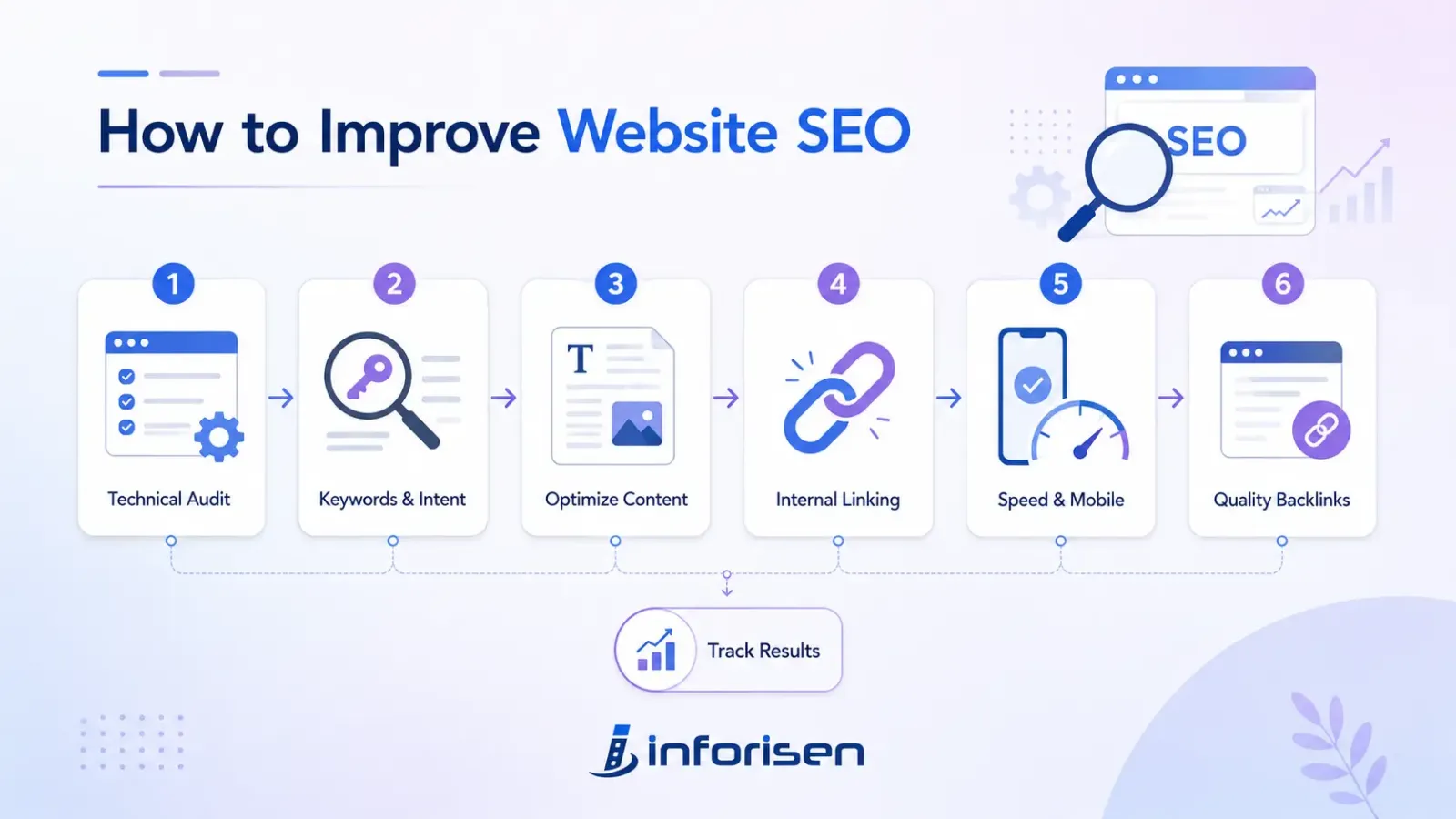
To improve website SEO, focus on the factors that directly influence crawlability, relevance, user experience, and authority. The steps below cover the most effective improvements you can make to increase rankings, organic traffic, and overall search visibility.
1. Start With the SEO Fundamentals
Before changing titles, publishing more articles, or building backlinks, understand how your website currently performs.
Search engines generally need to crawl, index, and then evaluate a page before it can rank. If Google cannot properly access or understand an important page, better keywords alone will not solve the problem.
If you need to understand this process first, Inforisen's guide on what SEO is and how it works explains crawling, indexing, ranking, content relevance, and website authority in practical terms.
Start by checking:
- Whether important pages are indexed
- Broken internal links
- 404 pages
- Incorrect redirects
- XML sitemap issues
- Robots.txt restrictions
- Canonical tags
- Duplicate content
- Mobile usability
- Page loading problems
Use Google Search Console to identify indexing errors, declining pages, search queries, impressions, and pages that already have ranking potential.
What is the fastest way to improve website SEO?
Fix major technical problems first, then optimize pages that already receive impressions or rank between positions 5 and 20. Improving an existing page with better search intent, content, internal links, and user experience can often be more efficient than continuously publishing new pages.
2. Target the Right Keywords and Search Intent
SEO improves when each page has a clear purpose. Do not select keywords only because they have high search volume. Ask what the searcher actually wants.
For example:
Inforisen's guide on how important keywords are in SEO explains why modern keyword optimization depends on relevance, intent, topical coverage, and natural placement rather than keyword repetition. Use your primary keyword naturally in:
- SEO title
- H1
- Introduction
- Relevant H2 headings
- URL
- Image alt text where appropriate
- Meta description
- Internal anchor text
Then strengthen semantic SEO with closely related concepts. For how to improve website SEO, relevant terms may include: website optimization, organic traffic, Google rankings, technical SEO, on-page SEO, keyword research, search intent, content optimization, internal links, backlinks, page speed, Core Web Vitals, crawlability, indexing, user experience, and topical authority. Avoid forcing all of them into every section.
3. Improve Existing Content Before Publishing More
One of the most overlooked SEO opportunities is updating pages that already exist. A website may have dozens of articles but still receive little organic traffic because those pages:
- Give weak or outdated answers
- Do not match current search intent
- Have poor introductions
- Target several unrelated topics
- Lack useful examples
- Have weak internal links
- Repeat competitors instead of adding value
Review existing pages and ask:
Does this page answer the main query within the first few paragraphs?
Then look for missing questions, outdated statistics, unclear explanations, weak headings, thin sections, and opportunities to add original experience or practical examples. Google recommends creating helpful, reliable, people-first content instead of producing pages mainly to influence search rankings.
Make Each Page More Useful Than a Generic Summary
Instead of writing: Improve your website speed because speed is important for SEO.
Explain what the reader should actually do:
- Compress oversized images
- Use modern image formats
- Reduce unnecessary JavaScript
- Remove unused plugins
- Improve server response time
- Enable browser caching
- Test important templates separately
Specific information gives readers something they can act on.
4. Optimize Titles, Headings, and Page Structure
Search engines and users should understand the purpose of a page quickly. Use one clear H1 and organize supporting information with descriptive H2 and H3 headings.
A strong page structure could look like:
H1: How to Improve Website SEO
H2: Fix Technical SEO Problems
H2: Improve Keyword Targeting
H2: Optimize Existing Content
H2: Improve Website Speed
H2: Build Internal Links
H2: Earn Relevant Backlinks
Avoid headings such as “Learn More,” “Things to Know,” or “Important Information” when a more descriptive heading is possible. Clear headings are particularly useful for AEO and AI search because individual sections can answer specific questions without losing the context of the full article.
5. Strengthen Internal Linking
Internal links connect related pages within your website. They help:
- Users discover useful information
- Search engines discover URLs
- Build relationships between related topics
- Distribute internal authority
- Reduce orphan pages
Google specifically recommends making links crawlable so it can discover other pages on a website. Use descriptive anchor text.
Instead of:
Click here
Use:
technical SEO services
or:
long-tail keyword research
For example, websites targeting less competitive search terms can use Inforisen's guide to long-tail keywords in SEO as supporting information within a keyword research content cluster. Do not add internal links simply to increase the number of links. Every link should help the reader continue their journey.
6. Improve Page Speed and Core Web Vitals
Website performance affects both usability and SEO. Google recommends achieving good Core Web Vitals and currently defines the following targets:
These metrics measure loading performance, responsiveness, and visual stability. Start with pages that receive the most organic traffic, leads, or sales. Improving high-value pages first usually produces more business value than optimizing every low-priority URL equally.
7. Make the Website Mobile-Friendly
Google uses the mobile version of website content for indexing and ranking through mobile-first indexing. Check your website on an actual smartphone, not only through a desktop preview.
Look for:
- Text that is difficult to read
- Buttons placed too closely together
- Horizontal scrolling
- Oversized popups
- Slow images
- Broken menus
- Missing desktop content
- Difficult forms
- Layout shifts
A responsive website should provide the same important content and functionality across devices.
8. Improve Content for AEO, GEO, and AI Overviews
Traditional SEO and AI search optimization are becoming increasingly connected. Google's 2026 guidance confirms that its generative AI features, including AI Overviews and AI Mode, remain rooted in Google's existing Search ranking and quality systems. You therefore do not need to create awkward “AI SEO” content.
Instead:
- Answer important questions directly
- Use clear headings
- Explain entities and relationships
- Support factual claims
- Add original experience or insight
- Use descriptive internal links
- Keep important information in crawlable text
- Add useful images and videos
- Maintain strong technical SEO
- Avoid mass-producing near-identical pages
Google also states that there are no special technical requirements or special schema markup required simply to appear in AI Overviews or AI Mode. For additional guidance, Google's official guide to optimizing websites for generative AI Search is a useful external resource.
9. Build Topical Authority Instead of Random Articles
Publishing unrelated articles can make a website larger without making it more authoritative. Build clusters around subjects connected to your business. For an SEO agency, one cluster might include:
SEO
- What is SEO?
- How does SEO work?
- How to improve website SEO
- Keyword research
- Long-tail keywords
- On-page SEO
- Technical SEO
- Link building
- Local SEO
- SEO audits
- SEO measurement
Each page should have a distinct search intent while naturally connecting to relevant supporting pages. This creates stronger topical relationships for users, search engines, and AI systems.
10. Earn Relevant Backlinks
Backlinks can strengthen authority, but relevance and quality matter more than raw volume. Useful ways to earn links include:
- Original research
- Industry statistics
- Data studies
- Expert commentary
- Digital PR
- Useful tools
- Detailed tutorials
- Case studies
- Partnerships
- Resource pages
Avoid purchasing large quantities of unrelated links simply to increase a backlink metric. The goal is to earn mentions from websites that are relevant and trustworthy within your market.
11. Improve Local SEO If You Serve Specific Locations
Businesses targeting geographic markets should optimize for local intent. Important actions include:
- Complete your Google Business Profile
- Keep your business name, address, and phone information consistent
- Select accurate business categories
- Collect genuine customer reviews
- Create useful location-specific pages when necessary
- Add locally relevant information
- Earn links and mentions from local websites
Do not create hundreds of near-identical city pages with only the location name changed. Each location page should provide genuine value for people in that area.
12. Measure SEO Results That Matter
Rankings alone do not determine whether SEO is successful. Monitor:
- Organic clicks
- Impressions
- Average rankings
- Indexed pages
- Non-branded traffic
- Organic conversions
- Leads
- Revenue
- Engagement
- Important landing pages
- Keyword groups
- Core Web Vitals
Google's published SEO case studies demonstrate how significant the business impact can become when SEO improvements work together. Saramin reported roughly 2× organic Search traffic and a 93% increase in new sign-ups, while MX Player reported more than 3× growth in Google organic traffic after implementing relevant Search improvements.
The important lesson is not that every website will achieve those exact numbers. It is that SEO should ultimately be measured against business outcomes, not vanity metrics.
Website SEO Improvement Checklist
Before considering a page fully optimized, check:
- Search intent is clear
- Primary keyword is naturally targeted
- Title and H1 accurately describe the page
- Important questions receive direct answers
- Content provides original value
- Relevant semantic terms are included naturally
- Internal links connect related pages
- Images are compressed and properly described
- Page works well on mobile
- Core Web Vitals are reviewed
- Page can be crawled and indexed
- Canonical tags are correct
- Structured data is accurate where applicable
- Sources support factual claims
- The page has a useful next step for visitors
- Performance is tracked in Search Console
Final Thoughts
The best way to improve website SEO is to stop treating SEO as a collection of isolated tricks. Make sure search engines can access your pages. Understand what your audience searches for. Create the best page for that intent. Connect related content through internal links. Improve speed and mobile usability. Build genuine authority. Then measure what actually produces traffic, leads, and revenue.
The same fundamentals also prepare your website for AI Overviews, AI Mode, answer engines, and other evolving search experiences.
SEO improves when your website becomes easier to find, understand, trust, and use.
Frequently Asked Questions
How can I improve my website SEO?
Start with a technical SEO audit, fix crawling and indexing problems, research search intent, optimize existing pages, improve internal links and website speed, publish genuinely useful content, and earn relevant backlinks.
How can I improve SEO without paying?
You can use Google Search Console, improve existing content, optimize titles and headings, create internal links, fix broken pages, improve website usability, target relevant long-tail keywords, and publish original information without paying for advertising.
How long does it take to improve website SEO?
There is no fixed timeline. Google says some SEO changes may appear within hours, while others can take several months to be reflected fully in Search.
Does website speed improve SEO?
Website speed supports user experience and page experience. Google recommends maintaining good Core Web Vitals, including LCP within 2.5 seconds, INP under 200 milliseconds, and CLS below 0.1.
Does adding more content improve SEO?
Not automatically. Publishing content helps when the new page satisfies genuine search demand, provides unique value, supports your topical authority, and does not duplicate existing pages.
Are keywords still important for SEO?
Yes. Keywords help communicate relevance, but modern optimization should focus on search intent and semantic context rather than repeatedly using an exact phrase.
How do I improve SEO for AI Overviews?
Follow strong SEO fundamentals, publish unique and reliable information, answer questions clearly, support claims with evidence, make content crawlable, use logical internal links, and provide a good page experience. Google says no special AI Overview schema or separate technical optimization is required.
.webp&w=3840&q=75)
.webp&w=3840&q=75)
.webp&w=3840&q=75)