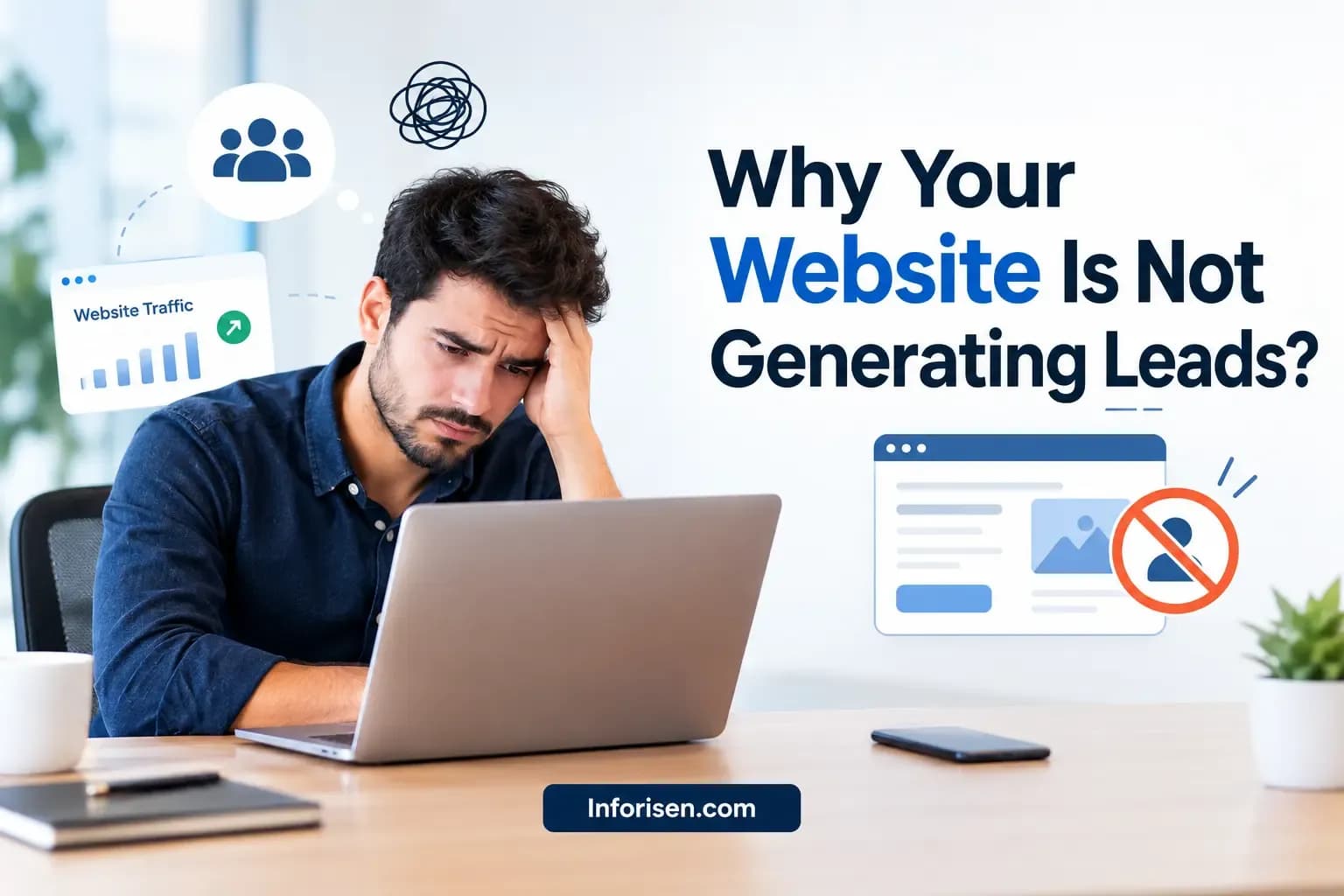
Why Your Website Is Not Generating Leads? (And What Actually Fixes It)
Traffic isn't the problem conversion is. This guide breaks down the real reasons your website isn't turning visitors into leads and the practical fixes that actually work.
Why Your Website Is Not Generating Leads? This is a common problem for businesses that invest in a website, publish content, attract visitors, and still struggle to turn that traffic into real inquiries or potential customers. A website can look professional and receive consistent traffic, yet fail to generate leads when the messaging does not match what visitors are looking for or when the user journey creates unnecessary friction.
Sometimes, the issue is a weak value proposition that does not clearly explain why someone should choose your business. In other cases, visitors may not know what action to take because the calls to action are unclear, difficult to find, or poorly positioned. Slow loading times, complicated navigation, lack of trust signals, weak landing pages, poor mobile experience, and content that does not address customer concerns can also reduce conversions.
The good news is that a low lead-generation rate does not always mean your website needs a complete redesign. By identifying where visitors lose interest, understanding their intent, and improving the key elements that influence their decisions, you can create a smoother path from website visitor to qualified lead. In this guide, we will explore the most common reasons websites fail to generate leads and what you can do to improve their conversion potential.
What Is a Lead, and Why Is Lead Generation Important?
lead is a person or business that shows interest in your products or services and may become a customer. This can happen when someone fills out a form, requests a quote, books a consultation, or contacts your business.
Lead generation is the process of attracting potential customers and encouraging them to take action. It is important because qualified leads create more opportunities for sales and business growth.
However, not every lead has the same value. Businesses should focus not only on generating more leads but also on attracting leads with genuine interest and a higher chance of becoming customers.
6 Reasons Your Website Isn't Turning Visitors Into Leads
Most business owners assume the fix is simply more traffic, more ads, more blog posts, more social shares. But if you're already asking “why is my website not converting visitors into leads?” pumping more volume into a leaky funnel just means more people are watching the leak happen. Visitors show up with a specific question in mind, and if your page doesn't answer it within the first few seconds, they leave just as quickly as they arrived. The problem was never visibility. It's what happens once someone actually lands on the page.
1. More Traffic Won't Fix a Broken Funnel
Sending extra visitors to a page that's already failing to convert just multiplies the failure. If 1 out of 200 visitors currently takes action, doubling your traffic still leaves you with that same 1 in 200 ratio; you're just paying more to get there. Nothing actually shifts until the page itself does.
2. What Visitors Are Really Looking For
Nearly every visitor lands on your site carrying an unspoken question: can this business actually solve my problem, and can I trust them enough to reach out? A page that leads with company history or vague, generic claims never gets around to answering that, so the visitor moves on to whoever answers it faster.
3. What This Gap Is Actually Costing You
Every visitor who leaves without converting isn't just a lost lead it's wasted ad spend, wasted content effort, and SEO rankings that produced a click and nothing else. Treating this conversion gap as something urgent, rather than a problem to "get to later," is usually what separates sites that bounce back quickly from ones that keep quietly bleeding traffic month after month.
That distinction matters, because it changes where you should look first. Before touching your design or your ad budget, it helps to understand what your traffic is already telling you, which is exactly where the next issue tends to show up.
4. The Traffic Volume Trap
Pouring more money into ads or content feels productive, mostly because the numbers move. Sessions climb, impressions climb, the dashboard looks healthier week over week. But volume only amplifies whatever's already happening on the page. If 1 visitor in 200 was converting before, more traffic just gives you more visitors stuck in that same losing ratio. The spreadsheet gets busier. The pipeline doesn't.
5. What "The Experience" Actually Means
This has nothing to do with how nice the site looks. The experience is everything that happens between the click and the decision whether the headline actually matches what the visitor searched for, whether the page loads before they lose patience, whether the next step is obvious instead of hidden three clicks deep. None of that shows up in a traffic report, which is exactly why it's so easy to overlook.
Two sites can pull in the same number of visitors and walk away with completely different results, purely because of what happens after the click.
6. Why This Gap Keeps Getting Missed
Traffic is easy to measure and easy to act on, so it naturally becomes the default lever people reach for. Conversion problems are quieter; they don't show up as a dramatic dip on a graph; they show up as a slow, steady flatline that's easy to write off as "the market" or "seasonality." Owners end up chasing the metric they can see and control, even when it isn't the one actually holding their leads back.
Traffic Without Leads: What That Pattern Actually Means
A website has traffic but no leads more often than most owners expect, and it's rarely because the product is wrong. It usually means the visitors arriving aren't the ones ready to act, or the page they land on doesn't move them any closer to a decision. Steady sessions with a flat inquiry count is a signal worth reading carefully rather than dismissing.
If the traffic itself is the weak link, it's worth checking whether your pages are set up to improve website SEO for the right search terms, not just any terms. Once the right visitors arrive, the next question is what's stopping them from taking action.
How to Fix a Website That Isn't Converting
Knowing how to fix a website that isn't converting starts with treating it as a diagnosis exercise instead of a redesign project. Small, targeted changes usually move the number faster than starting over.
These changes are usually enough to shift the numbers within a few weeks, which naturally raises the next question: how do you know when a bigger overhaul is actually necessary instead of a set of small tweaks?
Signs Your Website Needs a Redesign to Actually Generate Leads
Not every conversion problem gets fixed by tweaking a headline, adding a stronger CTA, or rewriting a paragraph or two. Sometimes the issue runs deeper; it's baked into the website's overall structure, layout, or the journey visitors have to take. When that's the case, a full redesign often gets you further than a handful of small edits ever could.
1. There's No Clear Path to Conversion
A website built to generate leads should walk visitors naturally from "here's what you need to know" to "here's the action you want them to take." If people have to dig through several pages just to understand what you offer, find your contact info, or figure out what to do next that's your structure working against you, not for you.
A redesign lets you fix this properly: reorganizing content, simplifying navigation, cleaning up the page hierarchy, and placing calls to action exactly where visitors are likely to need them.
2. The Site Looks Outdated or Just Doesn't Perform
An outdated design costs you more than good looks. Slow load times, a mobile experience that feels clunky, confusing navigation, broken elements, or an interface that feels a few years behind your competitors all of it chips away at visitor confidence.
Even if what you're selling is genuinely good, a site that feels unreliable makes people hesitate before reaching out. And if these problems are baked into the current design or the underlying tech, patching them one at a time usually isn't enough. A redesign gives you a stronger foundation to actually build performance and usability on.
3. Your Competitors Keep Beating You
If businesses offering similar or honestly weaker solutions are pulling in more leads, ranking higher, or holding visitors' attention longer, your website might be part of the problem.
That alone doesn't mean you need a redesign. But if their messaging is clearer, their page structure is stronger, and their user experience just works better, tweaking a few lines on your existing pages probably won't close that gap.
When it's the structure itself standing between visitors and action, a redesign gives you the chance to rebuild the whole experience around what your audience actually needs.
Website Conversion Rate Optimization Tips That Actually Move the Needle
Here's what most CRO advice gets wrong: it tells you to change a dozen things at once- headline, button, form, layout, images, copy, all in one go. Sounds efficient. Except now you have no idea what actually moved the number. Your conversion rate shifts, up or down, and you're left guessing which change caused it.
The smarter play is slower: pick one change, get a baseline first, make the change, wait long enough to get real data, then move on. Less exciting, but at least you end up knowing something.
1. Your Headline Needs to Match Why People Clicked
This is usually the first thing anyone sees, so it's doing more work than you'd think. It needs to explain, fast, what the page is about and why it matters to the person reading it right now.
Ditch anything vague enough to belong to a competitor's site too. Say what problem you fix, what you actually deliver, or what changes for the customer once they work with you.
2. Stop Making People Guess What to Do
If a visitor has to figure out what action you want them to take, you've already lost some of them. Say it directly: book a call, get a quote, start a trial, whatever it is. And don't tuck one lonely button at the bottom of the page. Put it where someone's actually ready to click it, as they're reading through.
3. Your Form Is Probably Too Long
If a name, email, and a line about what they need is genuinely enough, stop there. Every extra field past that is a reason for someone to close the tab instead of finishing it.
Ask for what your team actually needs to follow up. The rest can come later, once there's a real conversation happening.
4. Put Trust Signals Right Where the Decision Gets Made
Hesitation kills conversions. If someone's not sure they can trust you, they won't fill out the form doesn't matter how good your offer is. Reviews, testimonials, logos, case studies, guarantees these help, but only if people actually see them at the right moment. Don't bury them on an "About Us" page nobody visits. Put them next to the CTA.
5. Change One Thing, Test It, Then Move On
You only learn something if you isolate the variable. Pick one thing like headline, CTA, form length, layout and test just that against your baseline. Give it time. Then, and only then, move to the next thing.
None of this is a one-time fix. It's a habit, check what your data's telling you, find where people are dropping off, fix the worst offender, measure it, repeat. Do that consistently and your site gets better at converting, a little at a time.
DIY Fixes or Hiring a Lead Generation Agency Near You
Some of these fixes are genuinely doable in an afternoon. Others need dedicated time and testing most business owners don't have. That's usually the point where searching for a lead generation agency near me starts to make more sense than trying to patch things alone.
Agencies like Inforisen typically combine conversion audits with the broader website and SEO services needed to fix both the traffic and the conversion side at once, rather than treating them as separate problems. If you're unsure what that kind of partnership actually involves, it helps to understand what an SEO agency does before reaching out, since the scope varies a lot between providers.
For businesses that want outside help but aren't ready for a full engagement, it's also worth exploring what it means to hire a website conversion optimization expert on a smaller, project-based scope first, then expanding once the early results are visible.
Website Conversion Rate Optimization Services and What They Cost
.webp)
The cost of website conversion rate optimization services depends on your website size, project scope, and whether you need a one-time audit or ongoing optimization. In general, CRO services can cost around $500 to $5,000+, while larger or ongoing programs may cost more.
A basic CRO audit typically costs $500–$1,500 and covers website performance, user behavior, landing pages, CTAs, forms, and conversion barriers.
A more comprehensive CRO project can range from $1,500–$5,000+, including landing page optimization, UX improvements, copy changes, form optimization, analytics, and implementation.
For ongoing CRO, businesses may spend around $1,000–$5,000+ per month depending on their traffic, website complexity, testing needs, and optimization goals.
Businesses should also track how visitors interact with their website before deciding which areas need improvement. Tools such as Google Analytics conversion reporting can help businesses measure conversion-related data and better understand which traffic sources and user interactions are contributing to their goals.
These are general estimates, and actual CRO costs depend on the website size, research, testing, development, and implementation required. A small business website will typically need a smaller budget than a large ecommerce site.
CRO can often improve an existing website without a full rebuild. However, if the site's structure is outdated, a conversion-focused redesign may be more cost-effective.
Skepticism about the investment is understandable. Many business owners have wondered whether SEO is a waste of money after working with agencies that promised fast results but delivered little value. CRO should be approached with the same realistic mindset: results depend on the quality of the strategy, implementation, traffic, offer, and testing process.
The key question is whether CRO can generate enough additional leads or customers to justify the investment. Even a small conversion improvement can add significant value when a website already receives quality traffic.
For SEO-driven businesses, SEO brings qualified visitors while CRO helps turn more of them into leads. Continuous testing may cost more, but it can deliver greater value over time.
Skepticism here is fair. Plenty of business owners have wondered whether SEO is a waste of money after a bad experience with an agency that promised fast results and delivered none. The realistic answer is that results take time to show, and understanding how long SEO takes to work sets expectations correctly before the first invoice arrives.
Why Inforisen Is Worth Considering for Fixing This

Not every digital agency looks at website traffic and conversion problems as connected issues. A website can receive consistent organic traffic, paid visitors, or referrals and still generate very few leads. In many cases, the problem is not simply that the business needs more visitors. The real issue may be what happens after those visitors arrive.
This is where Inforisen takes a more practical approach. Instead of automatically recommending a complete redesign, the focus is on understanding why the existing website is failing to turn visitors into meaningful business opportunities. This means looking at the user journey, messaging, page structure, calls to action, content, technical performance, and other factors that can influence whether a visitor decides to take the next step.
A Clearer Understanding of What Is Holding Your Website Back
The real value of bringing in a professional team isn't a redesign it's clarity. Instead of guessing and making changes based on hunches, the site gets properly evaluated to find where visitors are actually dropping off and what's costing you conversions.
That alone saves money, because it stops you from throwing budget at changes that won't move the needle. The question shifts from "do we need more traffic?" to "which parts of the journey are killing our conversions right now?"
Better Alignment Between SEO and Lead Generation
Ranking well is great, but rankings don't pay the bills; leads do. If people land on your pages and leave without reaching out, requesting a quote, or booking anything, that traffic was essentially wasted.
Inforisen treats SEO and site performance as one connected process, not two separate jobs. The point isn't just getting people to the site; it's giving them a real reason to stick around and actually take action once they're there.
A Website Experience Built Around Your Customers
Nobody visits a website to admire the design. People want answers, proof, and a clear next step. If the info they need is buried or the value of what you offer isn't obvious, even a genuinely interested visitor will bail.
A conversion-focused approach means cleaning up how information is organized and presented, clearer messaging, easier navigation, stronger CTAs, better landing pages, a smoother path from "just looking" to "ready to reach out."
More Value From the Traffic You Already Have
Here's the part that often gets missed: you don't necessarily need more traffic to see better results. Fixing conversion issues means the traffic you're already paying for and earning through SEO starts working harder for you.
Say your site already pulls in a few thousand relevant visitors a month, but only a small slice of them ever convert. Even a modest bump in conversion rate can generate real additional opportunities without spending a dollar more on traffic.
Prioritized Improvements Instead of Unnecessary Changes
Not every website needs to be torn down and rebuilt. Sometimes a handful of targeted, high-impact changes beat a full redesign.
A good optimization process prioritizes based on actual impact; maybe that's a landing page rewrite, strengthening a CTA, or fixing mobile usability and technical friction points. It keeps you from blowing your whole budget on changes that look impressive on a slide deck but don't actually generate leads.
A Long-Term Approach to Website Growth
Conversion optimization isn't a one and done project. Visitor behavior shifts, competitors adjust, your offers evolve, and new traffic sources bring in different kinds of people. What's working today won't necessarily hold up six months from now. By staying on top of performance and continuing to find new opportunities, a website gets better over time at turning the right visitors into real leads.
For businesses that have already put real money into driving traffic, this distinction actually matters. The goal was never a nicer-looking site or a bump in sessions; it's making the site work harder for the business, converting more of the relevant visitors already showing up.
That's where the right partner makes a real difference. With a focus on SEO, web development, and user experience, Inforisen helps businesses improve both the traffic coming into the site and what happens once people actually get there.
Final Words
There's rarely one broken thing causing a quiet contact form. It's usually a combination of unclear messaging, a weak call-to-action, and traffic that isn't quite the right fit, and fixing even one of those tends to move the number. If you're still asking why your website is not generating leads after reading this, the next step isn't a bigger budget. It's a closer look at the exact page your visitors land on first.
Frequently Asked Questions
Why is my website getting traffic but no leads?
This usually means the visitors arriving aren't the right audience, or the page they land on doesn't give them a clear reason or way to take action. Traffic and conversion are separate problems and need separate fixes.
How long does it take to fix a website that isn't converting?
Small changes like a clearer call-to-action or a shorter form can show results within a few weeks. Structural issues, like a full redesign, typically take a few months to show their full impact.
Do I need a redesign, or can small changes fix my conversion problem?
Most conversion problems are fixable with targeted changes to headlines, forms, and calls-to-action. A redesign only becomes necessary when the site's underlying structure has no clear conversion path built in.
Is a low conversion rate always a bad sign for B2B websites?
Not always. B2B buyers often research anonymously for a long time before converting, so a flat form-fill rate doesn't automatically mean the website has failed.
What's the fastest fix for a website that isn't generating leads?
Rewriting the headline and call-to-action around the visitor's actual problem, rather than the company's description of itself, tends to produce the fastest visible change.
Should I hire an agency or try to fix this myself?
Simple fixes like copy and form changes are usually doable in-house. Ongoing testing, technical performance issues, and structural redesigns are where outside help typically pays for itself faster.
How much should I expect to spend on conversion optimization?
Costs vary by scope. A single audit with a prioritized fix list is the lower-cost entry point, while continuous testing and optimization programs cost more but tend to compound in results over time.

.webp&w=3840&q=75)
.webp&w=3840&q=75)
.webp&w=3840&q=75)