.jpg&w=3840&q=75)
How Is C# Used in Web Development? A Complete Guide for 2026
Learn how C# is used in web development with ASP.NET Core for APIs, backend systems, databases, cloud apps, ecommerce platforms, and enterprise software.
C# powers modern web development through ASP.NET Core. It helps developers build secure websites, APIs, cloud apps, and enterprise systems.
If you ask, how is C# used in web development? It handles server-side logic. It also manages databases, authentication, payments, and communication between the frontend and backend.
C# is known for desktop and game development too. But it is also a strong choice for web projects. It has strong typing, rich .NET libraries, and cross-platform support. It works well for both small and complex applications. It also supports clean code and fast deployment.
What Is C# in Web Development?
C# is a modern, object-oriented programming language developed as part of the Microsoft .NET ecosystem. In web development, it is commonly used on the server side to process user requests, manage application data, apply business rules, and return information to a browser or mobile application.
For example, when a customer submits an order on an ecommerce website, C# code can validate the order, calculate the total price, communicate with a payment gateway, update the database, and send an order confirmation.
C# is strongly typed and type-safe, which helps developers identify many errors before an application is deployed. It also includes features such as asynchronous programming, automatic memory management, dependency injection, generics, and exception handling.
Microsoft describes C# as a modern, open-source, cross-platform language supported by the .NET platform. This means developers can build and run applications on Windows, Linux, and macOS instead of being limited to Windows-based servers.
Can C# Be Used for Web Development?
Yes, C# can be used for web development. It is one of the primary programming languages used with ASP.NET Core, Microsoft’s open-source framework for creating modern web applications and services.
Developers can use C# to build:
- Business websites
- Ecommerce platforms
- Customer portals
- SaaS applications
- Content management systems
- Online banking applications
- Booking platforms
- REST APIs
- Cloud-based services
- Real-time communication systems
- Internal company dashboards
- Healthcare and education platforms
C# is most commonly used for backend development, but technologies such as Blazor also allow developers to create interactive frontend interfaces with C#. Blazor supports server-side rendering and browser-based interactivity within a unified .NET development model.
The exact technology stack should still depend on the project requirements. Businesses evaluating C#, PHP, Node.js, Python, or another technology should consider scalability, security, budget, integrations, and future maintenance when choosing the right web development company.
How ASP.NET Core Web Development Works
ASP.NET Core is the main framework used for modern C# web development. It provides the tools and structure required to build web pages, APIs, backend services, authentication systems, and cloud applications.
Microsoft defines ASP.NET Core as a cross-platform, open-source, high-performance framework designed for modern web applications. It supports different development approaches, including MVC, Razor Pages, Web API, Minimal APIs, and Blazor.
A typical ASP.NET Core web application follows this process:
- A user sends a request by visiting a page or clicking a button.
- The ASP.NET Core server receives the request.
- C# code processes the request and applies business rules.
- The application retrieves or updates information in a database.
- The server returns HTML, JSON, or another response format.
- The browser displays the final result to the user.
This structured request-and-response process helps development teams organize complex application features and maintain them over time.
Main Ways C# Is Used in Web Development
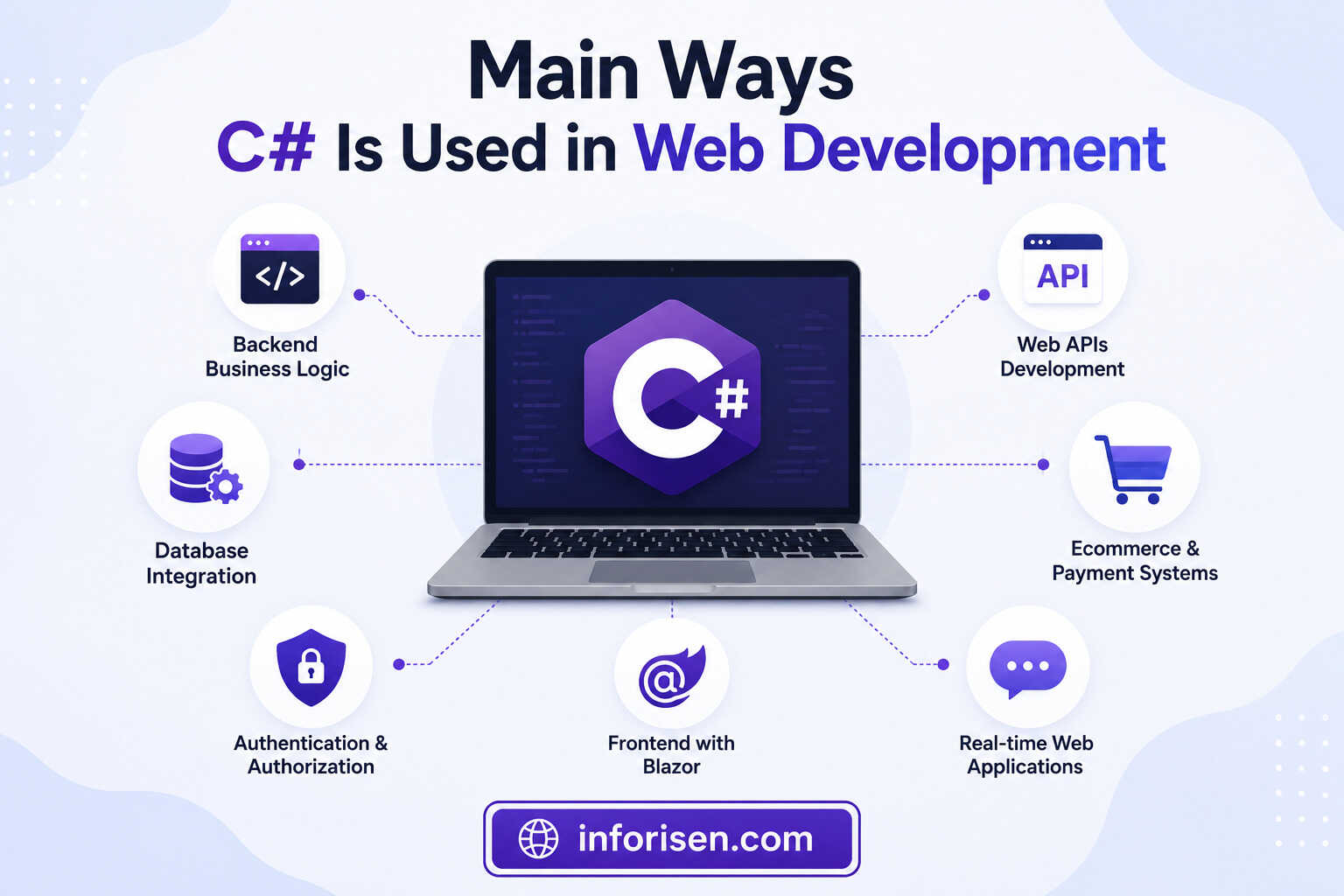
C# supports several important areas of modern website and application development. Understanding these use cases helps businesses determine whether it is suitable for their project.
Building Backend Business Logic
The backend controls how a web application operates behind the visible interface. C# backend web development allows programmers to create rules for registrations, product pricing, subscriptions, bookings, account permissions, order processing, and other important functions.
Suppose an insurance application needs to calculate premiums based on customer age, location, plan type, and previous claims. C# can process these conditions consistently and return the correct result to the user.
Its object-oriented structure also allows developers to divide complex systems into reusable classes, services, and modules. This can make large applications easier to test, improve, and maintain.
Creating Web APIs
C# and ASP.NET Core are widely used to develop REST APIs and other web services. An API allows different applications to exchange information securely.
For example, a mobile shopping application may send a request to a C# API to retrieve products. The API communicates with the database and returns product details in JSON format.
Businesses use ASP.NET Core APIs to connect:
- Websites with mobile applications
- Ecommerce stores with payment gateways
- CRM systems with marketing platforms
- Applications with cloud storage
- Dashboards with analytics services
- Business software with third-party tools
ASP.NET Core includes dedicated support for building web APIs, routing requests, validating data, handling errors, and returning structured responses.
Connecting Applications to Databases
Most web applications need databases to store users, orders, messages, products, reports, and other information. C# applications can connect to SQL Server, PostgreSQL, MySQL, SQLite, Oracle, and various cloud databases.
Entity Framework Core is a common .NET data-access technology. It allows developers to work with database information through C# objects rather than manually writing every database query.
Developers can also use raw SQL or lightweight data-access libraries when a project requires more direct control. The best choice depends on application size, query complexity, performance requirements, and development standards.
Managing User Authentication and Authorization
Websites must verify who users are and determine which features they can access. C# can be used to create registration, login, password recovery, email verification, two-factor authentication, and role-based permission systems.
Authentication confirms a user’s identity, while authorization controls what that user can do. For example, a customer may view personal orders, but only an administrator should be able to change product prices or manage staff accounts.
ASP.NET Core includes security features and identity-management tools that help developers implement these processes. However, secure configuration, testing, data protection, and regular maintenance are still essential.
Developing Ecommerce and Payment Systems
C# can power ecommerce stores, subscription platforms, marketplaces, and online payment applications. It can manage product catalogs, customer accounts, shopping carts, discount rules, tax calculations, inventory, shipping, and payment confirmation.
Developers can integrate C# applications with payment providers through APIs. The backend can send payment requests, verify transaction results, update order records, and handle failed payments.
Strong backend performance alone does not guarantee commercial success. User-friendly design, technical SEO, conversion-focused landing pages, and a clear customer journey are also needed to drive traffic with web development.
Building Real-Time Web Applications
Some web applications must update information immediately without requiring users to refresh the page. Examples include live chats, online collaboration tools, dashboards, delivery tracking, multiplayer features, and real-time notifications.
ASP.NET Core SignalR allows developers to add real-time communication between a server and connected clients. When information changes, the server can automatically send the update to the browser or application.
This capability makes C# suitable for interactive platforms where users expect immediate information and fast responses.
Creating Frontend Interfaces With Blazor
C# has traditionally been used mainly for backend web development. Blazor extends its role by allowing developers to create interactive web interfaces using C#, HTML, and CSS.
Blazor components can run on the server or in the browser through WebAssembly. It also allows teams to share some code and development skills between frontend and backend systems.
This approach can be valuable for companies that already have experienced .NET developers. However, JavaScript frameworks still have larger frontend ecosystems, so the right choice depends on the interface requirements and available development talent.
C# Web Development Architecture
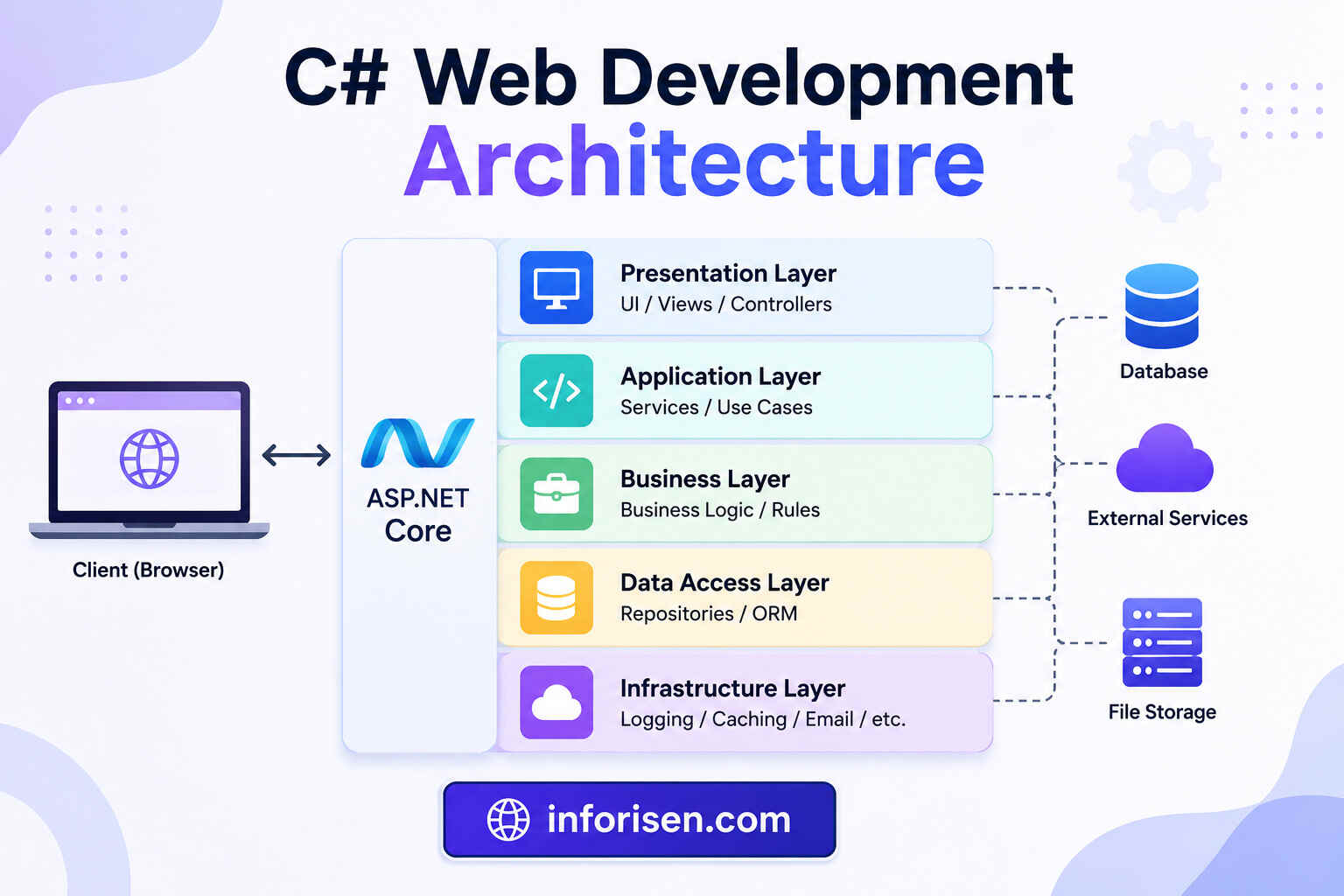
Well-structured C# applications usually separate different responsibilities. This prevents presentation code, database logic, and business rules from becoming mixed together.
A common architecture includes:
Smaller applications may use a simple structure, while enterprise systems may follow Clean Architecture, layered architecture, domain-driven design, or a microservices model.
The architecture should match the project rather than adding unnecessary complexity. A professional web development company can evaluate the expected number of users, integrations, security risks, business workflows, and future expansion before recommending a technical structure.
Is C# Good for Web Development in 2026?
Yes, C# is a strong option for web development in 2026, particularly for enterprise platforms, SaaS products, APIs, cloud services, and applications that require long-term maintainability.
.NET 10 is a long-term support release with three years of support, while Microsoft continues developing future .NET and C# versions. This ongoing development indicates that C# remains an actively supported technology rather than a legacy-only language.
Important advantages include:
- Cross-platform development
- Strong type safety
- High backend performance
- Built-in dependency injection
- Mature development tools
- Extensive libraries
- Cloud and container support
- Strong testing capabilities
- Long-term Microsoft support
- Suitability for large development teams
AI coding assistants can now generate code, suggest fixes, explain errors, and automate repetitive tasks. However, developers are still needed to understand business requirements, design system architecture, protect sensitive data, review generated code, and maintain production applications. The discussion around whether web developers will be replaced by AI is therefore more accurately viewed as a change in development workflows rather than the immediate removal of developers.
C# vs JavaScript for Web Development
C# and JavaScript serve different purposes, although both can now be used across multiple parts of a web application.
C# vs JavaScript for web development is not always an either-or decision. Many applications use C# and ASP.NET Core for the backend while using JavaScript, TypeScript, React, Angular, or Vue for the frontend.
C# may be preferable when a company already uses Microsoft technologies or requires a structured enterprise backend. JavaScript may be more convenient for teams that want one language across browser and server environments.
ASP.NET Core vs PHP
ASP.NET Core and PHP can both power dynamic websites, APIs, ecommerce applications, and content platforms. Their ecosystems and common project types are different.
ASP.NET Core may be more appropriate for complex business systems requiring long-term architecture and Microsoft integrations. PHP can be a practical choice for content-driven websites, WordPress projects, and businesses seeking widely available hosting.
Neither technology is automatically better for every project. Development quality, architecture, hosting, security practices, and maintenance have a greater effect than the language name alone.
ASP.NET Core vs Node.js
ASP.NET Core and Node.js are frequently compared for APIs, SaaS applications, real-time systems, and cloud-based platforms.
ASP.NET Core may suit teams that value strong typing, structured architecture, and mature enterprise tools. Node.js may suit teams with strong JavaScript skills, rapid product-development requirements, or a JavaScript-based frontend stack.
Performance should be tested against the real application workload. Database queries, caching, network latency, architecture, hosting, and code quality can influence results more than framework comparisons alone.
Why Choose C# for Enterprise Web Applications?

Enterprise applications often contain complex workflows, sensitive information, numerous integrations, and multiple user roles. C# is suitable for these environments because it encourages structured development and offers mature tools for testing, security, monitoring, and deployment.
Businesses may choose C# for enterprise web applications when they need:
- Long-term maintainability
- Role-based access controls
- Complex business rules
- Integration with Microsoft services
- Large development teams
- Cloud deployment
- Automated testing
- Detailed logging and monitoring
- Reliable API development
- Modular or microservices-based architecture
C# is also useful when one organization manages several connected applications. Shared .NET libraries and common development standards can reduce duplicated work and improve consistency between systems.
However, enterprise success still depends on clear requirements, experienced developers, quality assurance, security reviews, and an ongoing maintenance plan.
What Websites Are Built With C#?
C# can be used to build almost any type of data-driven website or web application. It is particularly common in projects where backend logic, security, integrations, and scalability are important.
Common examples include:
- Banking and financial portals
- Government service platforms
- Healthcare management systems
- Ecommerce marketplaces
- Business intelligence dashboards
- Customer relationship management systems
- Learning management platforms
- Subscription-based SaaS products
- Logistics and delivery applications
- Employee management portals
- Booking and reservation systems
- Large-scale web APIs
Some projects use C# for the entire application through ASP.NET Core and Blazor. Others use C# only for backend services while combining it with a JavaScript frontend.
The most important question is not whether a popular website uses C#. The better question is whether C# matches the application’s users, features, budget, security needs, available developers, and expected growth.
Final Words
So, how is C# used in web development? It is used to build backend logic, web APIs, databases, authentication systems, ecommerce functions, real-time applications, cloud services, and enterprise platforms. Through ASP.NET Core, developers can create secure and cross-platform applications that run on Windows, Linux, macOS, cloud servers, and containers.
C# is especially valuable for structured applications that require scalability, maintainability, complex business rules, and long-term support. However, the best technology should always be selected according to the project’s goals rather than popularity alone.
Frequently Asked Questions
Can C# be used for both frontend and backend web development?
Yes. C# is commonly used for backend development with ASP.NET Core. It can also be used to create interactive frontend interfaces through Blazor, although many projects combine a C# backend with JavaScript or TypeScript on the frontend.
Is C# difficult to learn for web development?
C# has a structured syntax and strong type system, which may require some initial learning. However, its clear documentation, development tools, error checking, and organized approach can make larger applications easier to manage.
Which framework is used with C# for web development?
ASP.NET Core is the primary framework used for modern C# web development. Developers can use MVC, Razor Pages, Web API, Minimal APIs, SignalR, and Blazor depending on the project.
Is C# better than PHP for web development?
C# is often preferred for structured enterprise applications, APIs, and Microsoft-based systems. PHP remains a strong choice for WordPress, content websites, Laravel applications, and projects requiring widely available hosting. The better option depends on the project.
Can C# create REST APIs?
Yes. ASP.NET Core provides extensive support for creating REST APIs. Developers can define endpoints, validate requests, connect databases, manage authentication, and return JSON responses to websites, mobile applications, and third-party services.
Is ASP.NET Core suitable for small businesses?
Yes. Small businesses can use ASP.NET Core for company websites, booking systems, customer portals, ecommerce stores, and custom management tools. Its suitability depends on the required features, budget, hosting, and maintenance plan.
Does C# work on Linux servers?
Yes. Modern .NET and ASP.NET Core applications are cross-platform and can run on Linux, Windows, and macOS. They can also be deployed through Docker containers and major cloud platforms.
.webp&w=3840&q=75)


.jpg&w=3840&q=75)