.jpg&w=3840&q=75)
How to Drive Traffic with Web Development for More Visitors?
A well-developed website loads fast, works on mobile, supports SEO, and gives users a better experience. These improvements help search engines rank your website higher and bring more visitors.
Many businesses publish a website and wait for visitors. But traffic does not grow only because a website exists. If you want to know how to drive traffic with web development, you need to build a website that search engines can understand and real users can enjoy.
Good web development brings design, speed, SEO, mobile use, content, and conversion together. When these parts work well, your website is easier to find, use, and trust.
Google also values a good page experience, mobile-friendly pages, and Core Web Vitals because they help users browse websites smoothly.
Why Web Development is Necessary for Website Traffic?
Website traffic starts before people even land on your page. Search engines first need to crawl, understand, and index your website. If your site has poor structure, slow loading, broken pages, or weak mobile design, it becomes harder for search engines to read it and harder for users to stay.
That is why SEO-friendly web development is not only a technical task. It is part of business growth. Google explains that SEO helps search engines understand content and helps users find the right website for their needs.
A well-developed website can support traffic growth in many ways:
- It helps search engines crawl important pages.
- It improves page speed and user experience.
- It makes content easier to read.
- It guides visitors toward service pages, forms, calls, and purchases.
- It builds trust through clean design and clear navigation.
When these things are missing, even good content may fail to perform. Next, let’s look at how development directly affects SEO ranking and user behavior.
How to Drive Traffic with Web Development for More Visitors: 9 Expert Tips
Many businesses invest in content marketing and SEO but still struggle to grow their website traffic. One common reason is that the website itself is holding them back. A slow, outdated, or poorly structured website can reduce your visibility in search engines and create a poor experience for visitors.
Good web development builds the foundation for long-term traffic growth. A well-developed website loads faster, is easier to navigate, works on every device, and helps search engines understand your content. Businesses that invest in professional website design and development services often see better performance because their websites are built with SEO, user experience, and conversions in mind.
1. Build a Clear Website Structure
A clear website structure helps both visitors and search engines understand your website. When every page has a purpose and the navigation is simple, users can find information quickly.
Your website should include:
- A simple navigation menu
- Separate pages for each service
- Easy-to-read URLs
- Proper H1, H2, and H3 headings
- Internal links between related pages
- A logical page hierarchy
A well-organized website also makes it easier for Google to crawl and index your pages, which can improve your search visibility.
2. Improve Website Speed
Website speed is one of the biggest factors that affects user experience. Most visitors expect pages to load within a few seconds. If your website is slow, many users will leave before viewing your content.
Developers can improve speed by:
- Compressing images
- Using modern image formats
- Reducing unnecessary CSS and JavaScript
- Enabling browser caching
- Choosing reliable hosting
- Loading important content first
A faster website encourages visitors to stay longer and visit more pages.
3. Make Your Website Mobile-Friendly
Most website traffic now comes from smartphones and tablets. Your website should work smoothly on every screen size.
A mobile-friendly website should have:
- Responsive layouts
- Readable text
- Buttons that are easy to tap
- Fast loading pages
- Simple navigation
- Mobile-friendly forms
When visitors enjoy using your website on mobile devices, they are more likely to stay and interact with your business.
4. Build Your Website with SEO in Mind
SEO begins during website development. A technically strong website gives search engines clear signals about your pages.
Make sure your website includes:
- Clean HTML code
- SEO-friendly URLs
- Proper heading structure
- XML sitemap
- Canonical tags
- Optimized images
- HTTPS security
- Schema markup
If your business requires both frontend and backend optimization, working with a professional full-stack web development service can help you build a website that is scalable, secure, and optimized for long-term SEO growth.
5. Focus on User Experience (UX)
Bringing visitors to your website is only the first step. The next goal is to keep them engaged.
A better user experience includes:
- Short paragraphs
- Clear section headings
- Easy navigation
- Plenty of white space
- Readable fonts
- Clear call-to-action buttons
- Visible contact information
When visitors can easily find what they need, they spend more time on your website and are more likely to become customers.
6. Use Internal Linking
Internal links help visitors move from one page to another while also helping search engines understand your website structure.
Follow these best practices:
- Link related blog posts
- Connect service pages
- Use descriptive anchor text
- Remove broken links
- Update older articles with new links
Strong internal linking keeps visitors engaged and distributes SEO value across your website.
7. Create Pages That Encourage Action
Website traffic has little value if visitors leave without contacting you. Every important page should guide users toward the next step.
Include:
- Clear CTA buttons
- Dedicated service pages
- Simple contact forms
- Customer testimonials
- Trust badges
- FAQ sections
A conversion-focused website helps turn visitors into leads instead of losing them after one page.
8. Add Structured Data (Schema Markup)
Schema markup helps search engines understand your content more clearly. It can also improve how your pages appear in search results.
Useful schema types include:
- Organization Schema
- Service Schema
- FAQ Schema
- Article Schema
- Local Business Schema
- Breadcrumb Schema
Although users rarely notice schema markup, search engines use it to better understand your website.
9. Keep Your Website Updated
Website development is an ongoing process. Regular maintenance keeps your website secure, fast, and fully functional.
Your maintenance checklist should include:
- Updating plugins and software
- Checking website speed
- Fixing broken links
- Backing up your website
- Monitoring mobile usability
- Testing contact forms
- Reviewing technical SEO issues
The aforementioned tips will help you use web development to attract more visitors and improve your website's overall performance.
| Tip | Main Benefit |
|---|---|
| Build a clear website structure | Helps search engines and users navigate your site |
| Improve website speed | Reduces bounce rate and improves user experience |
| Make your website mobile-friendly | Reaches more mobile visitors |
| Build with SEO in mind | Makes pages easier to crawl and index |
| Improve user experience | Keeps visitors engaged longer |
| Use internal linking | Helps users discover more pages |
| Create conversion-focused pages | Turns visitors into leads |
| Add structured data | Improves search visibility |
| Maintain your website regularly | Keeps performance and security strong |
Regular updates help your website continue performing well as search engines and user expectations change.
Growing website traffic requires more than publishing new content. Your website needs a strong technical foundation, fast performance, mobile-friendly design, and a great user experience. These elements work together to improve search visibility and keep visitors engaged.
How to Build a Website That Gets Traffic?
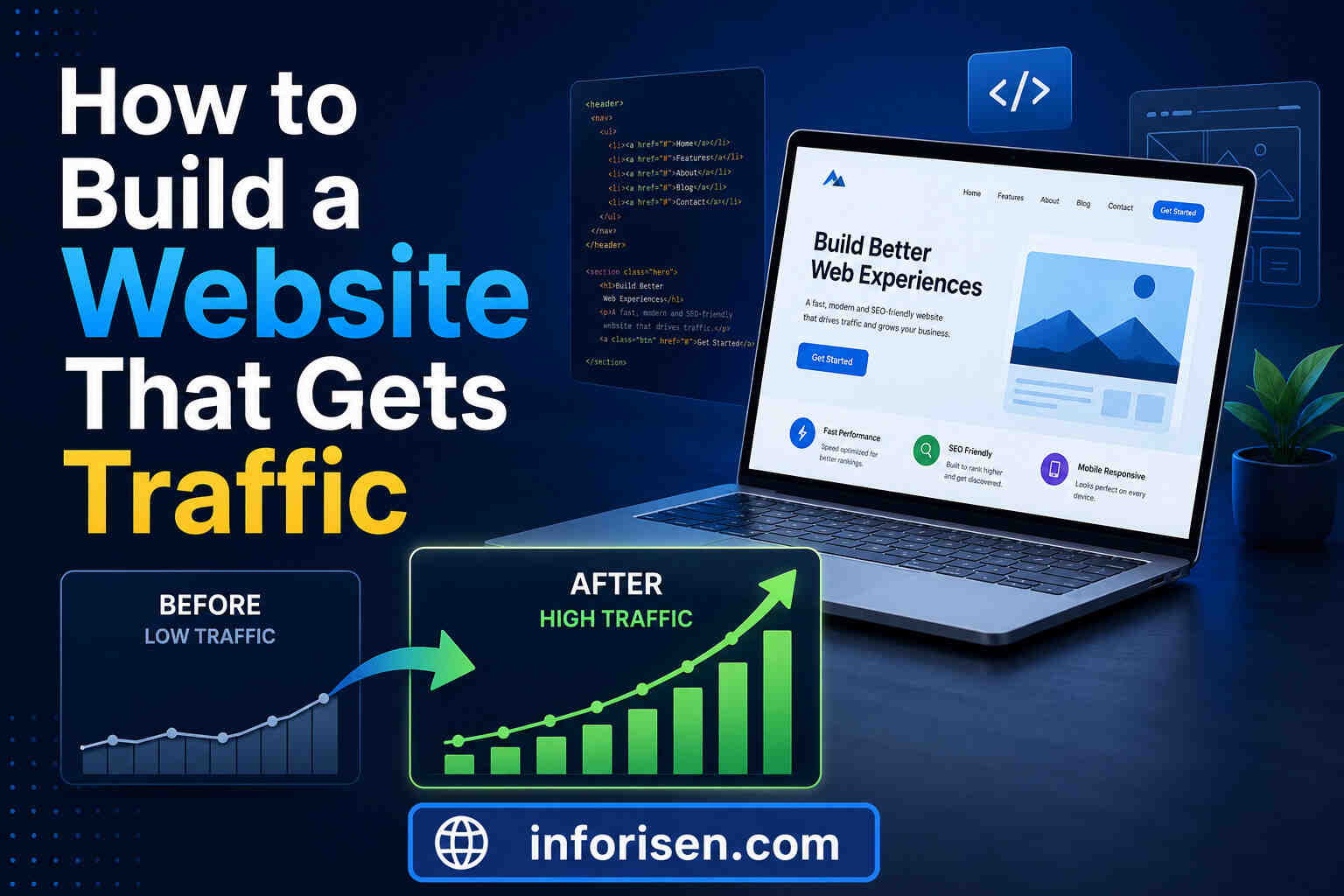
If you want to know how to build a website that gets traffic, start with search intent. A website should answer what your customers are already searching for.
For example, a service business should not depend only on a homepage. It should have pages for each service, location, customer problem, and important question. These pages create more chances to appear in search.
Step-by-Step Traffic-Ready Website Plan
- Research your audience and their search intent.
- Build a clear website structure.
- Create separate service pages.
- Optimize technical SEO.
- Improve page speed.
- Design for mobile users first.
- Add helpful blog content.
- Use internal links naturally.
- Add schema markup.
- Track traffic, clicks, and conversions.
This plan helps your website become more useful for search engines and more helpful for visitors. But if your website already exists and still has no visitors, you need to find the real problem.
Why Is My Website Not Getting Traffic?
Many business owners ask, why is my website not getting traffic even after publishing content. The reason is usually not one thing. It may be a mix of weak SEO, poor development, slow speed, thin content, and bad user experience.
Common Reasons a Website Gets Low Traffic
Your website may not get enough visitors because:
- Search engines cannot crawl important pages.
- Pages are not indexed.
- The content does not match search intent.
- The website is too slow.
- The mobile experience is poor.
- There are not enough service pages.
- Internal linking is weak.
- Blog topics are not planned.
- Technical SEO is missing.
- The design does not build trust.
This is why a website audit is important before redesigning. You need to know whether the problem is content, technical SEO, design, speed, or conversion flow.
Does Website Redesign Increase Traffic?
A redesign can increase traffic, but only when it is done correctly. A visual redesign alone may not improve SEO. In some cases, a bad redesign can even reduce traffic if URLs, headings, metadata, content, or internal links are changed without planning.
A successful redesign should protect existing rankings and improve weak areas. It should keep important URLs when possible, redirect old pages properly, improve content structure, and make the website faster and easier to use.
A Traffic-Safe Redesign Should Include
- SEO audit before redesign.
- URL mapping.
- 301 redirects where needed.
- Metadata review.
- Internal link update.
- Mobile testing.
- Speed testing.
- Schema setup.
- Content improvement.
- Analytics and Search Console tracking.
So, does website redesign increase traffic? Yes, it can. But only when SEO and development work together.
How to Make a Website SEO Friendly
To understand how to make a website SEO friendly, think about both search engines and users. A website should be easy to crawl, easy to understand, easy to read, and easy to use.
Google’s SEO Starter Guide explains that SEO helps search engines understand content and helps users find your site. That means your website should not be built only for design. It should be built for discovery.
SEO-Friendly Website Checklist
A strong SEO-friendly website should have:
- One clear H1 per page.
- Relevant H2 and H3 headings.
- Clean URL structure.
- Optimized title tags and meta descriptions.
- Fast loading speed.
- Mobile-friendly design.
- Helpful content.
- Image alt text.
- Internal links.
- Schema markup.
- Secure HTTPS.
- Clear navigation.
- No broken links.
This checklist helps both new websites and redesign projects. It also supports long-term organic growth.
Best Web Development Company to Increase Website Traffic
The best web development company to increase website traffic is not only the company that creates a beautiful website. It should understand SEO, speed, UX, content structure, conversion, and business goals.
A traffic-focused development company should ask questions like:
- Who is the target audience?
- What services need dedicated pages?
- What keywords match buyer intent?
- How will users move through the site?
- What pages should be linked together?
- What technical SEO setup is needed?
- How will leads be tracked?
This kind of approach helps a website become more than an online brochure. It becomes a growth system.
Frequently Asked Questions
Yes, web development can improve SEO ranking by making a website faster, mobile-friendly, crawlable, and easier for search engines to understand. It also improves user experience, which helps visitors stay longer and interact with the site.
Website speed affects traffic because slow pages can make users leave before they read the content. Faster pages create a better experience and help users move smoothly from one section to another.
Mobile-friendly website development is important because many users browse from mobile devices. Google also uses mobile-first indexing, which means the mobile version of a website is very important for search visibility.
A business website can get more visitors by using SEO-friendly structure, helpful service pages, fast loading speed, mobile design, blog content, internal links, and technical SEO improvements.
Yes, website design affects traffic because design influences trust, readability, and engagement. If users like the experience, they are more likely to stay and explore more pages.
Technical SEO helps search engines crawl, index, and understand a website. It includes site speed, sitemap, robots.txt, schema markup, canonical tags, mobile usability, and clean code.
A redesign can help if your current website has poor structure, slow speed, weak UX, or bad SEO setup. But the redesign should include SEO planning, URL mapping, redirects, content improvement, and performance testing.
Final Words: How to Drive Traffic with Web Development
The real answer to how to drive traffic with web development is simple: build a website that search engines can understand and users can trust.
Traffic grows when your website has strong technical SEO, fast speed, mobile-friendly design, clear structure, helpful content, and conversion-focused pages.
A better website does not only bring more visitors. It helps the right visitors stay, read, click, and become leads.
That is why web development should never be treated as only design or coding. It should be treated as a complete traffic growth strategy.



.webp&w=3840&q=75)