How to Choose the Right Web Development Company? 7 Tips!
A well-developed website loads fast, works on mobile, supports SEO, and gives users a better experience. These improvements help search engines rank your website higher and bring more visitors.
Choosing the wrong team can cost more than money. It can slow your launch, damage your brand, and create a website that does not bring leads. If you are wondering how to choose a web development company, start by checking their strategy, portfolio, technical skills, pricing clarity, communication, timeline, and after-launch support.
A good company does not just build pages. It understands your business goal, your customers, your content, your sales process, and your future growth needs. That is why the selection process should be careful, practical, and based on evidence.
Why Picking the Right Web Development Company Is Important
Your website is often the first place where people judge your business. A slow, confusing, or outdated website can make visitors leave before they contact you. A strong website can build trust, explain your offer, and turn visitors into customers.
Many business owners look for an affordable web development company first. Price matters, but it should not be the only reason to hire a team. A cheap website that needs rebuilding after six months can become more expensive than a well-planned website from the start.
The right agency will help you with structure, design, speed, mobile experience, security, SEO, and conversion. This is where a professional website design and development service can make the full process easier for business owners.
Next, let’s look at the main things you should check before choosing a company.
How to Choose the Right Web Development Company: 7 Tips
Choosing the right web development company is an important decision for your business. A professional team can build a website that attracts visitors, generates leads, and supports long-term growth.
The wrong company can cause delays, hidden costs, poor performance, and expensive redesigns. Follow these seven practical tips before making your decision.
1. Choose a Company That Understands Your Business
A good web development company should first learn about your business. They should ask about your goals, target audience, products or services, and competitors before discussing the design.
Ask yourself:
- Do they ask about your business goals?
- Do they understand your target audience?
- Do they ask how your website will generate leads or sales?
- Do they recommend features based on your business needs instead of selling unnecessary services?
A company that understands your business can build a website that helps you achieve your goals, not just a website that looks attractive.
2. Review Their Portfolio Carefully
A portfolio helps you understand the company's design style and development skills. However, don't judge a company by screenshots alone.
Visit the live websites and check:
- Website loading speed
- Mobile responsiveness
- Navigation and user experience
- Overall design quality
- Contact forms and other interactive features
Also, check whether they have worked with businesses similar to yours. Industry experience can help them build a website that matches your business needs.
3. Read Their Case Studies
Case studies tell you how a company handled real projects. They show how the team solved problems and delivered results.
Look for case studies that include:
- The client's business challenge
- Project goals
- Design and development process
- Technologies used
- Results after launch
- Support provided after delivery
A detailed case study shows that the company focuses on solving business problems, not just creating attractive websites.
4. Verify Their Technical Expertise
Every website has different technical needs. The company should recommend the right technology based on your project instead of offering the same solution to every client.
Ask questions like:
- Which CMS or framework do you recommend?
- Will I be able to update the website easily?
- Can the website grow as my business grows?
- How do you protect the website from security risks?
- Will the website load quickly on mobile devices?
A skilled development team builds websites that are reliable, secure, and easy to maintain.
5. Make Sure They Follow SEO Best Practices
A website should be built for both users and search engines. Good SEO starts during website development.
Ask whether they include:
- Clean website structure
- Fast loading speed
- Mobile-friendly design
- Proper heading structure
- SEO-friendly URLs
- Image optimization
- Schema markup
- XML sitemap
- Crawlable pages
These features help search engines understand your website and improve your chances of ranking higher.
6. Compare Pricing and Project Timeline
The lowest price is not always the best choice. Ask for a detailed proposal before you start the project.
The proposal should clearly explain:
- What is included in the price
- Any extra costs
- Number of design revisions
- Payment schedule
- Project timeline
- Project milestones
Clear pricing and realistic deadlines help you avoid misunderstandings and unexpected expenses.
7. Check Their Maintenance and Support Services
A website needs regular maintenance after it goes live. Ongoing support keeps your website secure and working properly.
Ask whether they provide:
- Security updates
- Website backups
- Bug fixes
- Performance monitoring
- Content updates
- Technical support
- Emergency assistance when needed
A company that offers long-term support can help you keep your website fast, secure, and up to date.
Questions to Ask a Web Development Company Before Hiring

The questions you ask can save you from poor communication, hidden costs, and weak delivery. Many business owners skip this step because they feel the agency knows better. That is a mistake.
Here are some practical questions to ask a web development company.
| Question | What a Good Answer Should Include |
|---|---|
| What is your process from planning to launch? | Discovery, wireframe, design, development, testing, launch, support |
| Who will work on my project? | Designer, developer, project manager, QA, SEO or content support if needed |
| What platform or technology do you recommend? | A clear reason based on business needs, not just personal preference |
| How do you handle mobile responsiveness? | Mobile-first testing across devices and screen sizes |
| Will the website be SEO-friendly? | Clean structure, fast loading, metadata, schema support, crawlable pages |
| How many revisions are included? | Clear revision limits and approval stages |
| What happens after launch? | Maintenance, updates, bug fixes, security checks, and support options |
These questions to ask before hiring a web development agency help you understand how organized the team is. If they avoid clear answers, that is a warning sign.
Now, let’s talk about the process behind a successful project.
Understand the Web Development Process for Clients
A professional web development process for clients should be simple to follow. You should never feel lost about what is happening or what comes next.
Most successful projects follow a clear path. First, the company studies your business, competitors, audience, and website goals. Then they plan the sitemap and page structure. After that, they create wireframes or design layouts. Once you approve the design, developers build the website and test it.
A clean process usually looks like this:
- Discovery and goal setting
- Website structure and sitemap planning
- UI/UX design
- Content placement and page layout
- Front-end and back-end development
- Mobile, speed, and browser testing
- SEO setup and launch preparation
- Website launch
- Maintenance and support
This process protects both sides. You know what to expect, and the agency knows what to deliver.
The next thing to check is timeline because a rushed website can create long-term problems.
Ask About the Web Development Project Timeline
A web development project timeline depends on the size and complexity of the website. A small business website may take a few weeks. A custom website, ecommerce store, or web application can take longer.
The timeline should include planning, design, development, testing, revision, and launch. If an agency promises a complex website in an unrealistically short time, ask how they will handle quality control.
Here is a simple timeline example.
| Website Type | Estimated Timeline | Best For |
|---|---|---|
| Basic business website | 2–4 weeks | Small service businesses, consultants, local companies |
| Custom business website | 4–8 weeks | Growing brands that need better design and conversion |
| Ecommerce website | 6–12 weeks | Product-based businesses with payment and inventory needs |
| Custom web platform | 10–20+ weeks | SaaS, portals, dashboards, or advanced features |
A clear timeline also helps you prepare content, images, approvals, and launch plans. Good companies will explain what they need from you to keep the project moving.
After timeline, pricing is the next big decision point.
Understand Web Development Company Pricing
Web development company pricing can vary a lot because every project is different. A simple website is not priced the same as a custom platform. Design quality, number of pages, features, integrations, content needs, and support all affect the final cost.
The website development cost for business website projects usually depends on these factors:
- Number of pages
- Custom design or template-based design
- CMS setup
- Ecommerce features
- Booking or payment system
- Blog or content section
- SEO setup
- Copywriting and image support
- Speed optimization
- Maintenance after launch
Do not choose a company only because they are the cheapest. Also, do not assume the most expensive agency is always the best. The right choice gives you clear scope, fair pricing, and business value.
Before paying, ask for a written proposal. It should explain deliverables, timeline, payment schedule, revision policy, and support terms.
Next, you should decide whether you need an agency or a freelancer.
Web Development Agency vs Freelancer: Which One Should You Choose?
The web development agency vs freelancer decision depends on your project size, budget, and support needs. A freelancer can be a good choice for a small task, landing page, or simple website update. An agency is often better when your project needs strategy, design, development, SEO, testing, and long-term support.
| Option | Best For | Main Advantage | Main Risk |
|---|---|---|---|
| Freelancer | Small updates, simple websites, fixed tasks | Lower cost and direct communication | Limited capacity if the project grows |
| Agency | Business websites, ecommerce, custom platforms | Team support, process, quality control | Higher cost than a solo freelancer |
| In-house developer | Ongoing product development | Full-time control | Salary, management, and hiring cost |
If your website is important for lead generation, sales, or brand trust, an agency usually gives more stability. A team can handle design, development, content structure, and technical issues together.
Now, let’s look at technology because it affects performance and future flexibility.
Check Their Technical Skills and Website Stack
You do not need to be a developer to hire a web development company. But you should understand whether they can choose the right technology for your project.
For example, some websites are best built with WordPress. Others need React, Laravel, Shopify, Webflow, or a custom stack. The right technology depends on your content needs, features, budget, and future plans.
If your project needs advanced back-end logic, it may help to know whether Python can be used for web development. If your website needs a fast, interactive front end, the team may discuss whether React is good for web development.
A good agency will not push one technology for every client. They will explain the pros, cons, cost, maintenance needs, and future scalability.
The next important point is SEO because a website should be built to be found.
Make Sure the Website Is Built for SEO, AEO, GEO, and AIO
Modern website development should include search visibility from the beginning. Google recommends helpful, reliable, people-first content, and its current guidance says optimization for AI search features still depends on strong SEO foundations.
This means your website should be easy for users and search engines to understand. The development company should care about page speed, mobile usability, clear headings, clean URLs, internal links, schema markup, image optimization, and logical page structure.
For AEO, your pages should answer clear questions. For GEO and AIO, your content should be well-structured, factual, and easy to extract into answer-based search results. That is why service pages, FAQ sections, comparison tables, and concise answer paragraphs are useful.
A web development company that ignores SEO may still build a nice-looking website. But it may not perform well in search. The best team builds with design, content, technical SEO, and conversion in mind.
Next, you need to protect your business after launch.
Website Maintenance and Support After Launch
A website is not finished forever after launch. Plugins need updates. Security needs monitoring. Forms need testing. Speed may need improvement. Content may need changes. That is why website maintenance and support after launch should be discussed before the project starts.
Ask the company what support is included. Some agencies offer a short bug-fix period after launch. Others provide monthly maintenance plans. You should know the difference.
A good maintenance plan may include:
- Website backups
- Security checks
- CMS and plugin updates
- Speed monitoring
- Bug fixes
- Content updates
- Uptime checks
- Technical support
This is especially important for business websites that collect leads, sell products, or run paid ads. A broken form or checkout issue can cost real revenue.
Now, let’s look at warning signs you should not ignore.
Red Flags When Hiring a Web Development Company
Some red flags are easy to miss during the sales call. A company may sound confident, but their process may be weak. You should slow down if you notice unclear pricing, poor communication, or no proof of past work.
Common red flags when hiring a web development company include:
- They cannot show real portfolio examples
- They avoid questions about process
- They promise instant results
- They offer very low pricing without clear scope
- They do not explain who will work on the project
- They ignore SEO, speed, and mobile experience
- They have no testing process
- They do not offer support after launch
- They use too much technical language without explaining it
- They pressure you to pay quickly
A reliable agency will educate you before selling to you. They will explain the project clearly and help you make a confident decision.
Next, let’s turn everything into a practical hiring checklist.
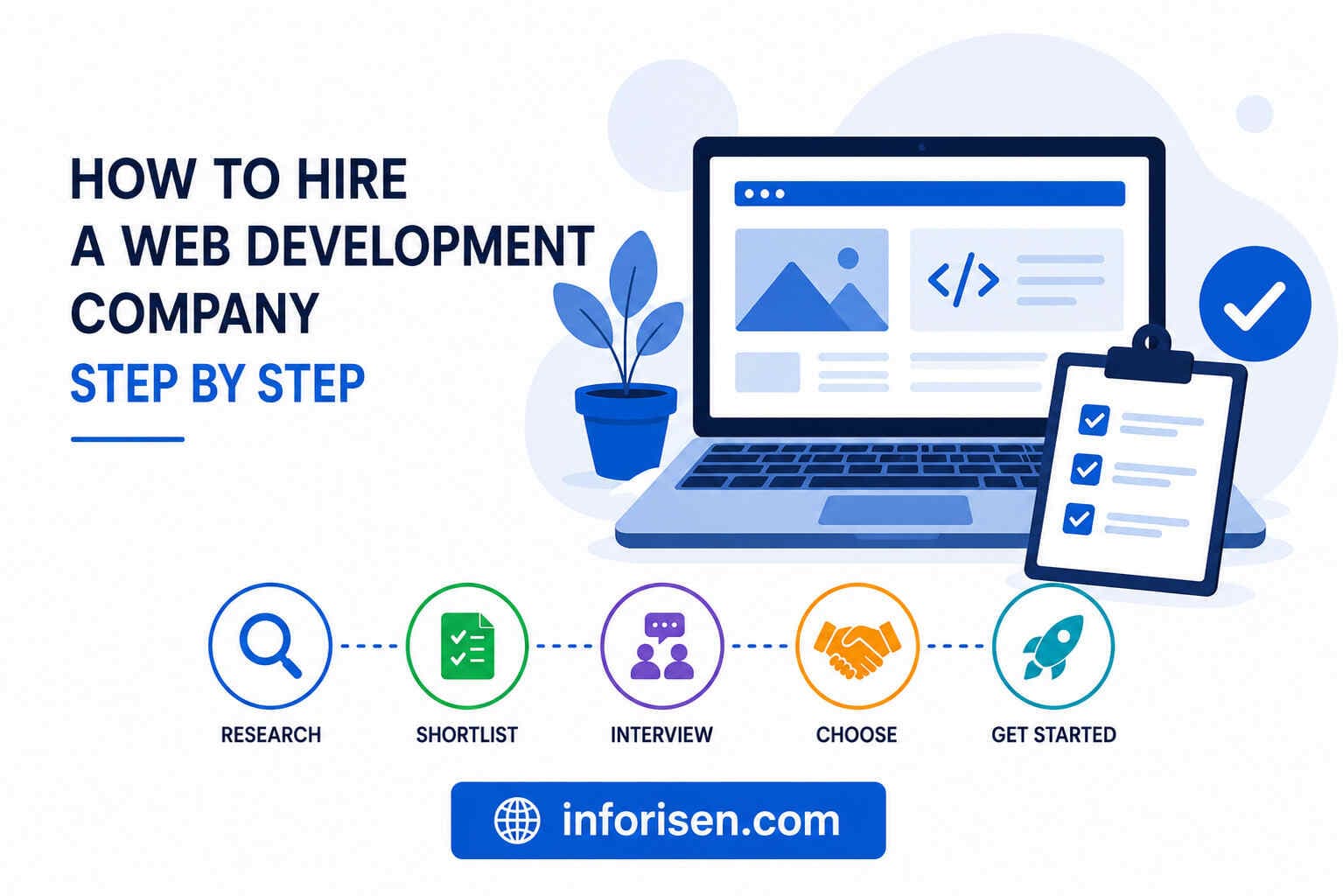
How to Hire a Web Development Company Step by Step
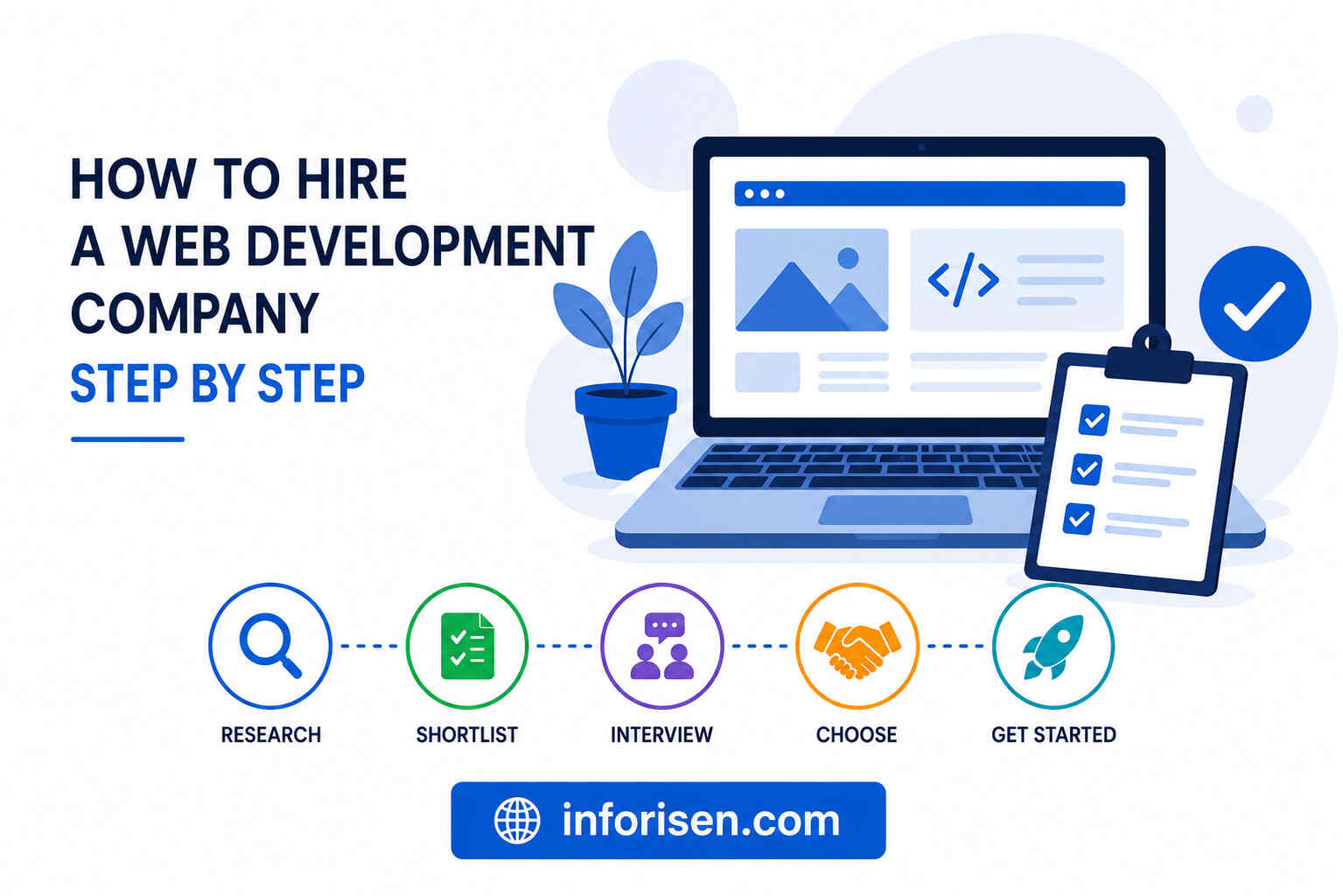
If you are ready to hire a web development company, do not start by asking only for price. Start with your business goal. Your goal may be more leads, better brand trust, ecommerce sales, online booking, or a faster website.
Follow this simple process:
1. Define Your Website Goal
Write down what the website must achieve. A lead-generation website needs strong service pages and forms. An ecommerce website needs product pages, payment setup, and checkout flow. A portfolio website needs visual impact and credibility.
2. Prepare Your Basic Requirements
List the pages, features, design style, content needs, and integrations. This makes it easier for agencies to give a fair estimate.
3. Shortlist Relevant Companies
Look for companies with experience in similar projects. Check their website, service pages, portfolio, reviews, and blog content. A company that shares helpful web development tips on the Inforisen blog can show strong knowledge and clear service expertise.
4. Ask the Right Questions
Use the questions from this guide to test their process, pricing, timeline, support, and technical thinking.
5. Compare Value, Not Just Cost
The lowest price may not include strategy, SEO, testing, or support. Compare what you get for the money.
6. Review the Contract
Check scope, payment terms, revision rules, ownership, delivery timeline, and maintenance terms.
7. Start With Clear Communication
Once the project begins, agree on communication channels, meeting frequency, approval stages, and project milestones.
This process helps you hire with confidence instead of guessing.
Final Checklist Before You Choose
Before you sign, review these points one more time.
| Final Check | Yes/No |
|---|---|
| The company understands your business goal | Yes |
| They have a strong portfolio and relevant case studies | Yes |
| Their pricing is clear | Yes |
| Their timeline is realistic | Yes |
| They explain the technology in simple language | Yes |
| They include mobile responsiveness | Yes |
| They understand SEO basics | Yes |
| They provide testing before launch | Yes |
| They offer maintenance and support | Yes |
| You feel comfortable communicating with them | Yes |
If most answers are yes, you are likely speaking with a serious team. If several answers are no, keep searching.
Frequently Asked Questions
The best way is to check their portfolio, case studies, process, pricing, communication, technical skills, SEO knowledge, and support plan.
You should choose a company that understands your business goal and can explain how the website will help you grow.
Ask about their process, timeline, team, technology, pricing, revisions, SEO setup, testing, and maintenance support. These questions help you understand whether the agency is organized and trustworthy.
The cost depends on the number of pages, design style, features, CMS, ecommerce needs, integrations, SEO setup, and support.
A simple website costs less than a custom platform or ecommerce website.
Hire a freelancer for small tasks or simple updates. Choose an agency if your project needs strategy, design, development, SEO, testing, and long-term support. Agencies usually provide a more complete process.
A simple business website may take 2 to 4 weeks. A custom business website may take 4 to 8 weeks. Ecommerce and custom web platforms can take 6 to 20+ weeks depending on complexity.
Red flags include unclear pricing, no portfolio, weak communication, no written process, unrealistic promises, no testing, no SEO understanding, and no support after launch.
Maintenance keeps your website secure, updated, fast, and functional. It also helps prevent broken forms, plugin issues, security risks, and performance problems that can affect business results.
Final Thoughts
Learning how to choose a web development company is not only about comparing prices. It is about finding a team that understands your business, and supports your website after launch.
The best company will not confuse you with big promises. It will guide you through the process, explain each step, and build a website that supports your real business goals.

.webp&w=3840&q=75)