.jpg&w=3840&q=75)
ByShuman Chandra DasReviewed by:Yunus A. Polash
Human WrittenCan Rust Be Used for Web Development?
Discover how Rust supports backend, frontend, APIs, WebAssembly, and full-stack projects, plus its benefits, limits, frameworks, and best use cases.
Rust is becoming a strong choice for modern web applications because it offers speed, security, and reliable performance. Developers can use it to build backend services, REST APIs, real-time platforms, browser-based tools, and full-stack systems.
So, Can Rust Be Used For Web Development Effectively? Yes, especially when a project requires memory safety, concurrency, scalability, and long-term stability. However, Rust may not be necessary for every website, so businesses should consider project complexity, budget, and development requirements before choosing it.
Is Rust Good for Web Development?
Rust is a strong web development language for applications that need high performance, predictable resource usage, and protection against common memory-related errors.
Unlike languages that depend on a garbage collector, Rust manages memory through its ownership and borrowing system. This design helps developers build efficient applications without giving up memory safety. The official Rust website describes the language as fast and memory-efficient, with no runtime or garbage collector required. sed to develop:
- REST APIs
- Microservices
- SaaS backends
- Authentication systems
- Real-time applications
- Financial platforms
- Data-processing services
- WebSocket servers
- Server-side rendered websites
- Browser applications through WebAssembly
However, Rust generally has a steeper learning curve than JavaScript, Python, PHP, or Go. Developers need to understand concepts such as ownership, borrowing, lifetimes, traits, and asynchronous programming before they can work efficiently.
Therefore, Rust is good for web development when technical reliability and performance justify the additional development complexity. The next step is understanding exactly where Rust fits within a web application.
Where Does Rust Fit in Modern Web Development?
A web application normally contains several layers, including a browser interface, backend server, database, authentication system, APIs, and deployment infrastructure.
Rust can contribute to almost every layer, although it remains strongest on the server side. A professional full-stack web development service may combine Rust with JavaScript, TypeScript, React, Vue, PostgreSQL, Redis, Docker, and cloud infrastructure to build a complete application.
Backend Development
Rust is commonly used to create APIs, process requests, communicate with databases, manage application logic, and run background tasks.
Frameworks such as Axum, Actix Web, and Rocket provide routing, request handling, middleware, state management, authentication support, and response generation. These tools make Rust suitable for both small services and complex backend systems.
Frontend Development
Rust can run inside browsers when compiled to WebAssembly. Frameworks such as Yew and Leptos allow developers to create interactive user interfaces using Rust.
However, browser APIs and the wider frontend ecosystem are still closely connected to JavaScript. As a result, many teams use Rust for performance-sensitive browser functions while keeping JavaScript or TypeScript for the general interface.
Full-Stack Applications
A full-stack Rust application can use one language for server logic and browser components. Leptos, for example, supports client-side rendering and full-stack server-side rendering, allowing developers to create both the interface and server in Rust. can improve type consistency between the client and server, but businesses should compare its advantages with the maturity and hiring availability of more established full-stack ecosystems.
Is Rust Good for Backend Web Development?
Rust is particularly well suited to backend systems that handle high traffic, intensive computation, sensitive data, or large numbers of simultaneous connections.
Its type system can catch many mistakes during compilation rather than allowing them to appear in production. Rust also gives developers detailed control over memory and resource usage, which can be useful for infrastructure where latency and operating costs matter.
Tokio is one of the main asynchronous runtimes used in the Rust ecosystem. It provides asynchronous input and output, networking, scheduling, timers, synchronization, and other building blocks required for scalable network applications. can be useful for:
| Backend Use Case | Why Rust Is Suitable |
|---|---|
| REST and GraphQL APIs | Strong typing and efficient request handling |
| Microservices | Small deployment binaries and predictable resources |
| Financial systems | Reliability and accurate control over business logic |
| Real-time platforms | Strong asynchronous and concurrent processing |
| Data-processing APIs | Efficient handling of CPU-intensive workloads |
| Authentication services | Type safety and careful resource management |
| IoT platforms | Low-level control and cross-platform support |
| High-traffic SaaS | Scalable networking and stable performance |
Rust does not make an application secure or scalable automatically. Architecture, dependency management, testing, access control, database design, logging, and deployment practices still determine the quality of the finished system.
The language provides a strong foundation, while the selected framework determines how efficiently the development team can build on that foundation.
Best Rust Web Frameworks for Modern Projects
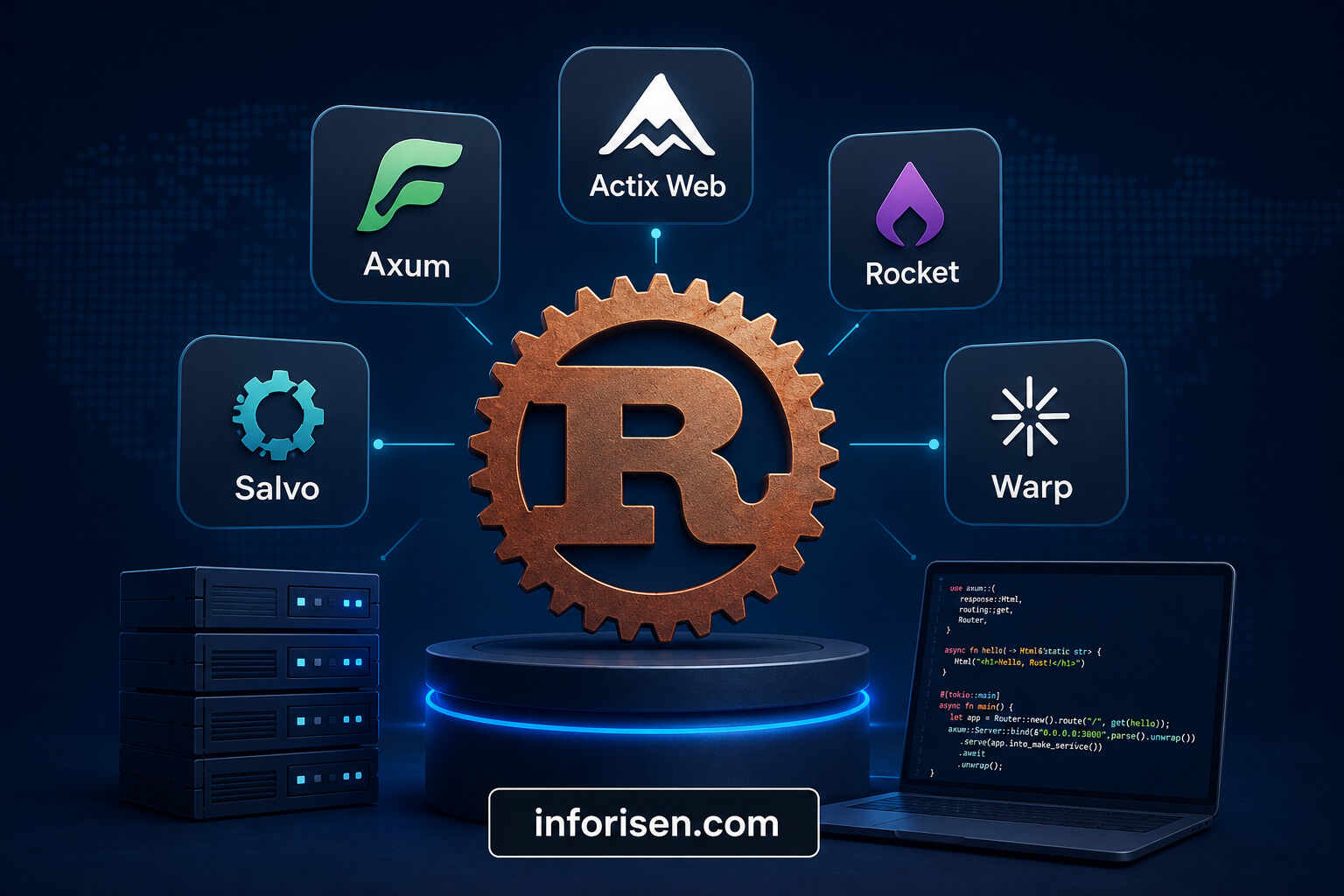
Choosing from the best Rust web frameworks depends on the application’s size, the team’s experience, performance expectations, and preferred development style.
Rust has several backend and full-stack frameworks, but Axum, Actix Web, Rocket, Yew, and Leptos are among the most relevant options.
Axum
Axum is an HTTP routing and request-handling library focused on ergonomics and modularity. It integrates closely with the Tokio and Tower ecosystems, giving developers access to middleware for timeouts, tracing, compression, authorization, request limits, and other production requirements. ctical choice for:
- REST APIs
- Microservices
- Cloud-native applications
- WebSocket services
- Modular backend architectures
- Teams already using Tokio
Its macro-free routing style and reusable extractors can make application behavior easier to understand.
Actix Web
Actix Web is a powerful, pragmatic framework that provides routing, middleware, request extraction, application state, and asynchronous request handling. Its official documentation describes it as a micro-framework with additional flexibility for production applications. suitable for:
- High-performance APIs
- Large backend applications
- Real-time services
- Applications requiring flexible middleware
- Experienced Rust development teams
It offers considerable control, although that flexibility may require developers to make more architectural decisions.
Rocket
Rocket focuses on usability, type safety, security, extensibility, and developer-friendly application development. Its official guide positions it as a framework for building fast Rust web applications without sacrificing flexibility. appropriate for:
- Prototypes
- Internal tools
- Form-based applications
- Content-oriented platforms
- Developers who prefer an expressive framework
- Projects where development comfort is a priority
Its route attributes and request guards can make common web operations straightforward.
Yew
Yew is a component-based Rust framework for creating interactive browser interfaces through WebAssembly. Developers familiar with component-based tools such as React or Elm may recognize its general development model. ily relevant when a team wants to write frontend components in Rust rather than JavaScript.
Leptos
Leptos is designed for interactive and full-stack Rust web applications. It supports client-side rendering, server-side rendering, hydration, reactive state, and server functions shared across client and server boundaries. sidered for teams that want a strongly typed, Rust-centered full-stack architecture.
Axum vs Actix Web vs Rocket
The following comparison provides a practical starting point for selecting a backend framework.
| Framework | Main Strength | Development Style | Suitable For |
|---|---|---|---|
| Axum | Modularity and Tokio integration | Explicit and composable | APIs, microservices, cloud systems |
| Actix Web | Performance and flexibility | Powerful and configurable | High-traffic backends and real-time apps |
| Rocket | Usability and expressiveness | Developer-friendly and macro-based | Prototypes, internal tools, web applications |
| Yew | Component-based browser UI | Frontend-focused | Rust WebAssembly interfaces |
| Leptos | Full-stack reactive development | Client and server Rust | SSR, hydration, full-stack applications |
Axum is often a balanced choice for modern asynchronous APIs. Actix Web is attractive when teams want flexibility and mature backend capabilities, while Rocket may feel more approachable for conventional web applications.
After choosing the backend framework, businesses must decide whether Rust should also be used in the browser.
Can Rust Be Used for Frontend Development?
Rust can be used for frontend development by compiling the code into WebAssembly, commonly called Wasm.
WebAssembly is a portable compilation target that can run in browsers and other environments. Rust provides tools such as wasm-bindgen and web-sys to communicate with JavaScript and access browser APIs. may be valuable for:
- Browser-based image processing
- Video or audio tools
- Interactive data visualizations
- Engineering applications
- Scientific simulations
- Online games
- Cryptographic operations
- Complex calculations
- Shared logic between native and browser applications
For a standard business website, blog, landing page, or simple dashboard, using React, Vue, Svelte, or plain JavaScript may be faster and more economical. Rust becomes more attractive when the browser must perform demanding work or when the development team wants shared types and logic across the stack.
That distinction leads to one of the most common questions about Rust in browser development.
Can Rust Replace JavaScript for Web Development?
Rust cannot completely replace JavaScript across most modern web projects.
JavaScript remains deeply integrated with browsers, frontend libraries, analytics tools, content management systems, design systems, and third-party services. Rust can interact with this environment through WebAssembly, but many projects still require some JavaScript glue code or JavaScript-based tooling.
The Rust WebAssembly documentation specifically presents Rust and WebAssembly as technologies that work with JavaScript rather than simply eliminating it. Rust can handle computationally intensive or low-level operations, while JavaScript manages browser interactions and the wider frontend ecosystem. rchitecture may therefore use:
- Rust for backend APIs
- Rust or WebAssembly for demanding browser functions
- TypeScript for general frontend development
- React, Vue, or another UI framework for the interface
- PostgreSQL or another database for persistent data
Rust can replace JavaScript in selected parts of the application, but combining the two languages is often more practical than forcing an all-Rust architecture.
Rust vs Node.js for Web Development
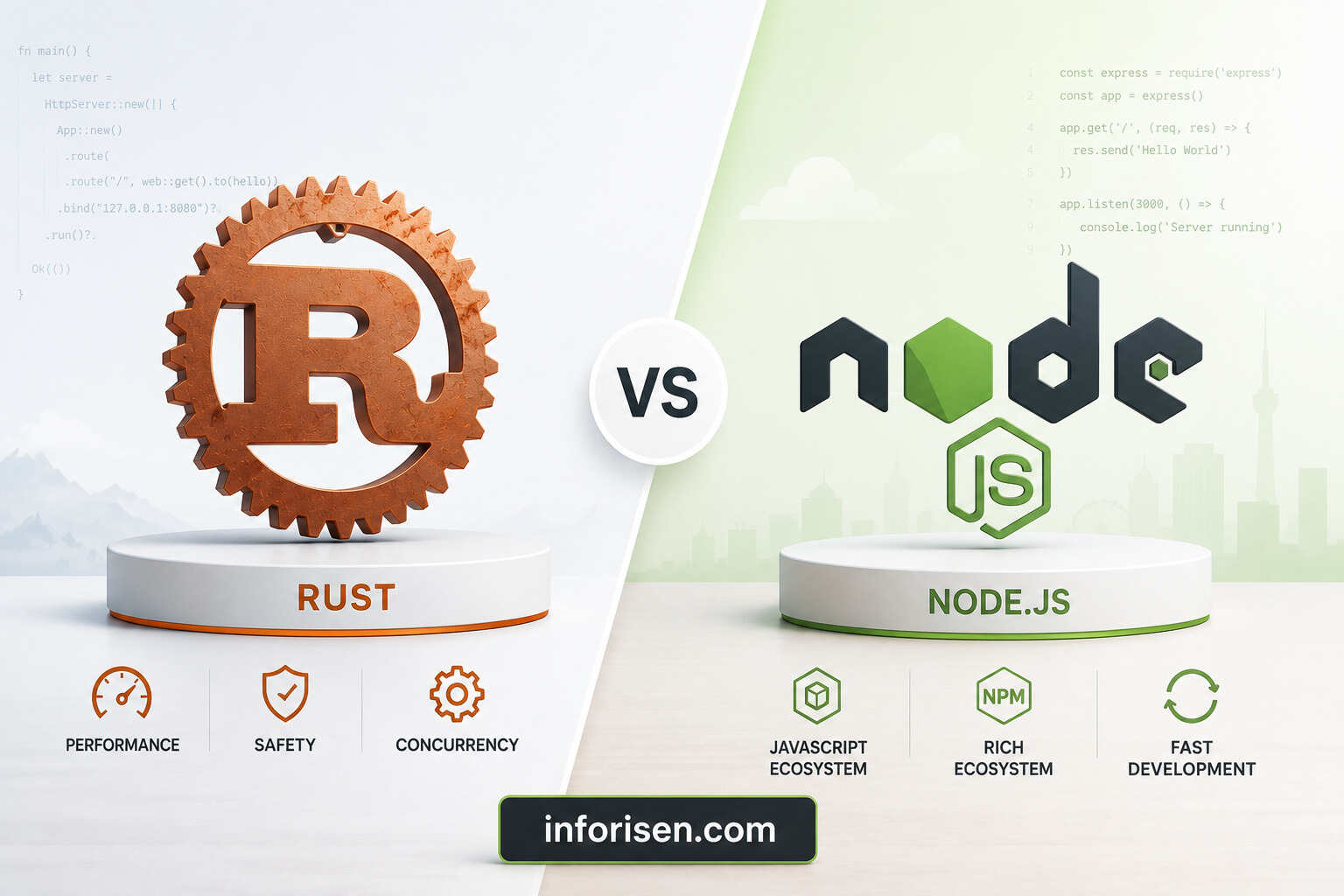
The Rust vs Node.js for web development decision is usually a choice between runtime efficiency and development speed.
Node.js is an asynchronous, event-driven JavaScript runtime designed for scalable network applications. It allows frontend developers to use JavaScript on the server and provides access to the extensive npm ecosystem. lower-level resource control, compile-time safety, and efficient native binaries. However, it generally requires more specialized knowledge.
| Factor | Rust | Node.js |
|---|---|---|
| Language | Rust | JavaScript or TypeScript |
| Performance | Strong native performance | Strong for many I/O-driven applications |
| Memory management | Ownership-based, no garbage collector | Garbage-collected |
| Learning curve | Higher | Lower for JavaScript developers |
| Package ecosystem | Growing | Very large |
| Development speed | Slower initially | Often faster for common web products |
| CPU-intensive work | Strong choice | May require workers or native modules |
| Hiring availability | More specialized | Broad developer availability |
| Deployment | Compiled binary | Node.js runtime and dependencies |
| Best fit | Performance-sensitive, reliable systems | Rapid product development and I/O applications |
Node.js may be the better choice for MVPs, content platforms, standard dashboards, and products that need rapid iteration. Rust may be more suitable for infrastructure, financial applications, compute-heavy services, or systems where predictable efficiency is strategically important.
The correct choice should be based on business requirements rather than benchmark results alone.
Rust vs Go for Backend Development
The Rust vs Go for backend development comparison is more balanced because both languages are used for efficient servers, APIs, networking tools, cloud services, and microservices.
Go focuses on simplicity, fast compilation, readable code, built-in concurrency, and developer productivity. Its official web development documentation highlights its standard web server, templating support, security features, and ability to build scalable applications. more control over memory, avoids garbage collection, and uses its ownership system to prevent many classes of memory errors. That control comes with additional language complexity.
| Requirement | Rust | Go |
|---|---|---|
| Learning experience | More demanding | Comparatively straightforward |
| Memory control | Detailed ownership-based control | Automatic garbage collection |
| Concurrency | Async runtimes and thread safety | Built-in goroutines and channels |
| Development speed | Can require more time | Often faster for teams |
| Runtime efficiency | Highly predictable | Efficient with runtime management |
| Low-level integration | Excellent | More limited |
| Microservices | Strong | Strong |
| CPU-intensive services | Excellent | Good |
| Team onboarding | Slower | Faster |
| Typical priority | Control and reliability | Simplicity and productivity |
Choose Rust when memory control, native integration, or highly predictable resource usage is central to the product. Choose Go when the team needs to create and maintain cloud services quickly with a simpler language model.
Organizations considering Java-based enterprise development may also compare these choices with how Spring Boot is used for web development, especially when existing Java infrastructure and enterprise integrations affect the decision.
Business Benefits of Using Rust for Web Applications

A programming language should not be selected only because developers find it technically interesting. It should support measurable business goals such as reliability, customer experience, scalability, maintenance, and operating efficiency.
Predictable Application Performance
Rust gives developers detailed control over resource allocation and execution. This can benefit services where inconsistent latency would affect user experience, transaction processing, or system stability.
Fewer Memory-Safety Problems
Rust’s ownership and type systems prevent many invalid memory operations before the application is deployed. This does not remove the need for security testing, but it can reduce exposure to an important category of software defects.
Efficient Deployment
Rust applications can be compiled into native binaries. This can simplify certain container deployments and reduce the need to maintain a language runtime on the production server.
Strong Concurrency Support
Rust’s type system and asynchronous ecosystem help developers build systems that process many tasks safely. This is useful for APIs, messaging systems, real-time features, and distributed applications.
Long-Term Maintainability
Strict compiler checks may make initial development slower, but they can also help teams identify incompatible changes during refactoring. For long-lived platforms, this can reduce uncertainty when updating critical code.
Technical performance alone will not attract customers, however. The application must also have a clear structure, mobile-friendly interface, strong SEO foundation, and useful content. Businesses can drive traffic with web development by connecting application performance with crawlability, usability, internal linking, and conversion-focused design.
Limitations of Rust Web Development
Rust offers meaningful advantages, but the limitations should be evaluated before a project begins.
Steeper Learning Curve
Ownership, borrowing, lifetimes, traits, and asynchronous programming can be difficult for developers who are new to systems programming.
Longer Initial Development Time
The compiler requires developers to resolve many issues before the application can run. This improves reliability but may slow early experimentation.
Smaller Web Ecosystem
Rust’s ecosystem continues to develop, but JavaScript, PHP, Python, Java, and C# still have more mature solutions for many routine web requirements.
More Specialized Hiring
Experienced Rust web developers may be harder to recruit than JavaScript, PHP, Python, or Java developers. Businesses should evaluate hiring costs and knowledge-transfer risks.
Limited Benefit for Simple Websites
A brochure website, basic blog, or small online store usually does not need Rust’s level of performance and control. A conventional CMS or established web framework may deliver the project faster and at a lower cost.
These limitations do not make Rust unsuitable. They simply mean that the technology should solve a real project requirement instead of being selected only for its reputation.
Rust Web Development Tutorial: Building a Simple API
A basic Rust web development tutorial can demonstrate how quickly an API can be created with Axum and Tokio.
First, install Rust through rustup, create a new project, and enter the project directory:
cargo new rust-web-api
cd rust-web-api
Add the following dependencies to the Cargo.toml file:
[dependencies]
axum = "0.8"
tokio = { version = "1", features = ["full"] }
serde = { version = "1", features = ["derive"] }
Replace the contents of src/main.rs with this code:
use axum::{routing::get, Json, Router};
use serde::Serialize;
#[derive(Serialize)]
struct ApiResponse {
message: &'static str,
}
async fn health_check() -> Json<ApiResponse> {
Json(ApiResponse {
message: "Rust API is running",
})
}
#[tokio::main]
async fn main() {
let app = Router::new()
.route("/health", get(health_check));
let listener = tokio::net::TcpListener::bind("0.0.0.0:3000")
.await
.expect("Failed to bind server");
println!("Server running on http://localhost:3000");
axum::serve(listener, app)
.await
.expect("Server error");
}
Run the application:
cargo run
Opening http://localhost:3000/health will return a JSON response:
{
"message": "Rust API is running"
}
This example contains only one endpoint, but the same project can be extended with database access, authentication, error handling, validation, logging, middleware, and deployment configuration.
For production use, developers should also include structured errors, environment configuration, request tracing, input validation, integration tests, security headers, rate limiting, and graceful shutdown.
When Should You Choose Rust for a Web Project?
Rust should be chosen when its strengths directly support the project’s requirements.
It can be a suitable option when:
- The application must process large workloads efficiently.
- Low or predictable latency is important.
- The backend contains CPU-intensive operations.
- Memory safety is a major concern.
- The system will handle many simultaneous connections.
- Rust is already used elsewhere in the organization.
- Native libraries must be integrated with the web platform.
- The product has a long operational lifetime.
- WebAssembly provides a clear frontend advantage.
Another technology may be more practical when:
- The project is a simple marketing website.
- The priority is launching an MVP as quickly as possible.
- The development team has no Rust experience.
- The budget cannot support a longer learning period.
- The application depends heavily on JavaScript-specific libraries.
- A content management system already solves most requirements.
- The performance needs are ordinary rather than demanding.
The best decision comes from evaluating the users, business model, traffic expectations, security needs, available team, budget, integrations, and future product roadmap.
Final Words
Rust can build reliable APIs, scalable backend systems, WebAssembly components, real-time services, and full-stack applications. It is especially valuable for projects where performance, memory safety, concurrency, and predictable resource usage have direct business importance.
It may not be necessary for every blog, company website, or simple online store. In those cases, a more established web stack can reduce development time and hiring costs. Rust delivers the greatest value when its technical strengths solve a genuine product or infrastructure challenge.
Businesses planning a secure, scalable, or performance-focused application can work with Inforisen to select an architecture that balances development speed, maintainability, user experience, and long-term growth.
Ultimately, the answer to Can Rust Be Used For Web Development is yes—but the more important question is whether Rust is the right solution for the specific users, workload, team, and business goals behind the application.
Frequently Asked Questions
Yes. Rust frameworks such as Axum, Actix Web, and Rocket provide routing, JSON handling, middleware, application state, and asynchronous request processing. Rust is particularly useful for APIs that need reliability, efficient resource use, or CPU-intensive processing.
Yes, a complete application can be built with Rust using a backend framework and a frontend or full-stack framework such as Leptos or Yew. However, JavaScript tooling and browser integrations may still be needed, depending on the project.
Rust can provide stronger native performance and predictable memory usage, especially for CPU-intensive workloads. Node.js remains highly effective for many asynchronous and I/O-driven applications. Real performance depends on architecture, framework, database queries, caching, hosting, and code quality.
Rust is generally more difficult to learn than JavaScript, Python, PHP, or Go because developers must understand ownership, borrowing, lifetimes, traits, and strict compiler rules. The learning process can be demanding, but those rules can improve reliability in large applications.
Rocket may feel approachable because of its expressive routing and developer-friendly design. Axum is also a strong starting point for developers who want to understand modern asynchronous Rust and work closely with Tokio.
Yes. Rust can power a REST or GraphQL backend while React or Vue handles the user interface. Rust-generated WebAssembly modules can also be added to JavaScript applications when specific browser features require more intensive processing.
Rust can support a high-traffic or technically complex ecommerce platform, especially when reliability and backend performance are important. For a small store, established ecommerce platforms may be faster and more affordable unless the business requires custom functionality.


.webp&w=3840&q=75)



.jpg&w=3840&q=75)