Is Spring Boot Used for Web Development?
Many developers ask, "is Spring Boot used for web development?" Yes. Spring Boot helps build fast, secure, and scalable websites, web applications, and APIs. It makes development easier and is a popular choice for businesses and developers.
When developers and businesses look for a reliable Java framework, one question often comes up: is spring boot used for web development? The short answer is yes. Spring Boot has become one of the most trusted frameworks for creating fast, secure, and scalable web applications. Whether you're building a business website, an enterprise platform, or a RESTful API, Spring Boot offers everything needed to simplify development while maintaining high performance.
In this guide, you'll learn where Spring Boot excels, why companies choose it, how it compares to the traditional Spring Framework, and whether it's the right choice for your next project.
Why Spring Boot Is So Popular for Modern Web Development
Web development has evolved significantly over the last decade. Businesses now expect applications that are fast, secure, scalable, and easy to maintain. Traditional Java development often required extensive configuration before developers could even begin writing business logic.
Spring Boot changed that experience completely.
Instead of spending hours configuring XML files and dependencies, developers can focus on building features that matter. This reduction in complexity has made Spring Boot the preferred choice for startups, enterprises, and software development agencies alike.
If you're planning enterprise-grade solutions alongside full-stack web development services, Spring Boot integrates naturally with modern frontend technologies, making it an excellent backend framework.
What Is Spring Boot Used For?
One of the most common questions developers ask is what is Spring Boot used for?
Spring Boot is designed for building production-ready Java applications with minimal configuration. It supports various application types, making it highly versatile across industries.
It is commonly used for:
| Application Type | How Spring Boot Helps |
|---|---|
| Business websites | Handles backend operations efficiently |
| Enterprise software | Supports modular architecture |
| REST APIs | Simplifies API creation and documentation |
| E-commerce platforms | Offers security and scalability |
| Banking systems | Provides enterprise-level reliability |
| SaaS platforms | Supports cloud deployment |
| CRM & ERP systems | Easy integration with databases and third-party services |
Because Spring Boot comes with embedded servers like Tomcat and Jetty, developers can launch applications without manually configuring external web servers.
This flexibility naturally leads to another important question—whether Spring Boot is suitable specifically for web applications.
Can Spring Boot Be Used for Web Development?
Absolutely.
If you're wondering can Spring Boot be used for web development, the answer is a confident yes. In fact, web development is one of Spring Boot's strongest use cases.
Spring Boot provides everything required for building modern web applications:
- MVC architecture
- Embedded web server
- Security modules
- Database integration
- Template engines
- RESTful services
- Dependency injection
- Validation support
These built-in capabilities significantly reduce development time while maintaining clean architecture.
Organizations that invest in professional website design and development often combine responsive frontend interfaces with Spring Boot-powered backend systems because of their long-term reliability.
Now that we know it works well for web development, let's clarify another common misconception.
Is Spring Boot Frontend or Backend?
Many beginners ask, is Spring Boot frontend or backend?
Spring Boot is purely a backend framework.
It manages:
- Business logic
- Authentication
- Authorization
- Database communication
- API development
- Security
- Server-side processing
For frontend development, developers usually pair Spring Boot with frameworks such as:
- React
- Angular
- Vue.js
- Thymeleaf
For example, businesses frequently combine Spring Boot with React because React creates dynamic user interfaces while Spring Boot handles data processing and security. If you're comparing frontend technologies, is React good for web development provides useful insights into why this combination has become so popular.
Understanding this separation helps developers design cleaner, scalable applications.
Why Use Spring Boot for Web Development?
Choosing the right backend framework impacts development speed, maintenance costs, and future scalability.
There are several reasons why use Spring Boot for web development has become a common recommendation among experienced Java developers.
Faster Development
Spring Boot automatically configures most project settings, allowing developers to spend less time on setup and more time building features.
Production-Ready Features
Health monitoring, metrics, logging, and security are already integrated into the framework.
Excellent Community Support
Since Spring Boot is backed by VMware and supported by one of the largest Java communities, finding documentation and solutions is straightforward.
Cloud Compatibility
Modern businesses increasingly deploy applications on AWS, Azure, Docker, and Kubernetes. Spring Boot works exceptionally well with cloud-native architectures.
These advantages naturally translate into measurable business benefits.
Benefits of Spring Boot for Web Applications
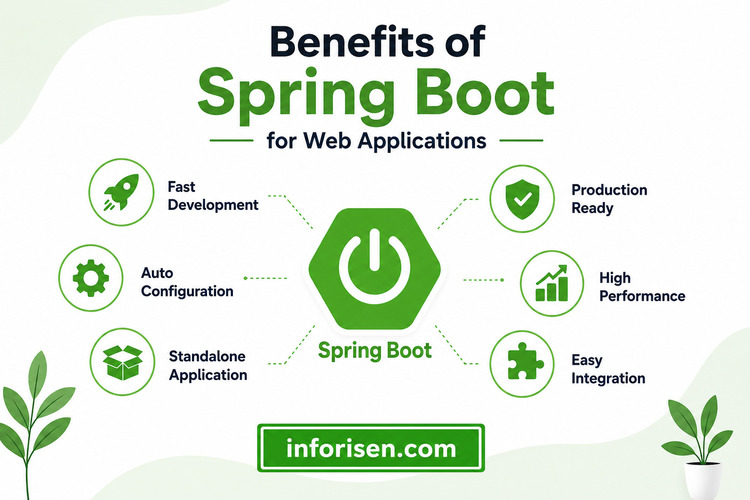
The benefits of Spring Boot for web applications extend beyond developer convenience.
Reduced Development Time
Automatic dependency management and starter packages eliminate repetitive configuration.
Better Security
Spring Security integrates seamlessly with authentication, authorization, JWT, OAuth2, and role-based access control.
Scalability
Spring Boot supports microservices architecture, making it suitable for applications expected to grow over time.
Easier Maintenance
Its modular design allows developers to update or replace components without affecting the entire application.
Strong Database Support
Spring Boot works smoothly with:
- MySQL
- PostgreSQL
- Oracle
- MongoDB
- SQL Server
This flexibility makes it ideal for applications of every size.
As businesses continue embracing AI-assisted workflows, combining backend automation with what developers can do with AI web design creates even more efficient development processes.
Spring Boot vs Spring Framework for Web Development
Many developers compare Spring Boot vs Spring Framework for web development before starting a new project.
| Feature | Spring Framework | Spring Boot |
|---|---|---|
| Configuration | Manual | Auto Configuration |
| Setup Time | Longer | Much Faster |
| Embedded Server | No | Yes |
| Dependency Management | Manual | Starter Dependencies |
| Deployment | More Complex | Simplified |
| Learning Curve | Higher | Easier |
| Production Readiness | Requires configuration | Built-in |
Spring Framework remains the foundation.
Spring Boot simply builds on top of it, removing much of the complexity while preserving its powerful capabilities.
For most modern web applications, Spring Boot is the preferred choice because developers can move from idea to deployment much faster.
How to Build a Web Application with Spring Boot
Understanding how to build a web application with Spring Boot helps illustrate why developers appreciate the framework.
The development process generally follows these stages:
Step 1: Create a Spring Boot Project
Generate a project using Spring Initializr and select the required dependencies.
Step 2: Configure the Database
Connect your preferred relational or NoSQL database.
Step 3: Create Models
Define application entities representing your business data.
Step 4: Build Controllers
Controllers process incoming HTTP requests and return responses.
Step 5: Create Services
Business logic stays organized inside service classes.
Step 6: Connect the Frontend
Use React, Angular, Vue, or Thymeleaf to build user interfaces that communicate with Spring Boot.
Step 7: Test and Deploy
Deploy your application using Docker, Kubernetes, AWS, Azure, or traditional VPS hosting.
This structured workflow makes Spring Boot highly maintainable for both small and enterprise-level projects.
Spring Boot REST API Development
Modern software rarely exists in isolation. Mobile apps, web applications, and third-party platforms constantly exchange data through APIs.
That's why Spring Boot REST API development has become one of the framework's biggest strengths.
Developers can quickly build APIs using:
- REST Controllers
- JSON responses
- Validation
- Exception handling
- Authentication
- Swagger/OpenAPI documentation
Spring Boot also supports versioning, rate limiting, caching, and API security, making it ideal for production environments.
Whether building internal services or public APIs, Spring Boot provides all the necessary tools without requiring heavy configuration.
Common Use Cases of Spring Boot
Spring Boot powers thousands of applications across different industries because it adapts well to diverse business requirements.
Some of the most common implementations include:
- Enterprise management software
- Banking applications
- E-commerce platforms
- Hospital management systems
- Learning management systems
- Inventory software
- Customer portals
- SaaS products
- CRM and ERP solutions
- Cloud-native microservices
Its flexibility allows organizations to start small and scale confidently as demand grows.
Is Spring Boot Still Worth Learning?
Despite the rise of newer programming languages and frameworks, Spring Boot continues to dominate enterprise Java development.
Large organizations prioritize stability, security, maintainability, and long-term support—all areas where Spring Boot performs exceptionally well.
Developers who master Spring Boot also gain transferable knowledge of dependency injection, MVC architecture, RESTful services, security, and cloud-native development, making it a valuable skill in today's software industry.
Conclusion
So, is spring boot used for web development? Without question, yes.
Spring Boot has become one of the industry's most reliable frameworks for building secure, scalable, and production-ready web applications. Its automatic configuration, extensive ecosystem, cloud compatibility, and simplified development workflow allow teams to deliver high-quality software faster than traditional Java approaches.
Whether you're creating enterprise software, SaaS platforms, REST APIs, or dynamic business websites, Spring Boot provides the foundation needed for long-term success. For developers seeking a backend framework that balances productivity with enterprise-grade performance, Spring Boot remains one of the best choices available today.
Frequently Asked Questions
No. Besides web applications, Spring Boot is widely used for REST APIs, microservices, enterprise software, cloud applications, batch processing, and backend systems.
Yes. Spring Boot simplifies Java development by reducing configuration, making it much easier for beginners than the traditional Spring Framework.
Spring Boot is built on top of Spring Framework and simplifies configuration. For most modern projects, Spring Boot is the preferred choice because it speeds up development.
Yes. Spring Boot is commonly used as the backend while React, Angular, or Vue.js handle the frontend user interface.
Absolutely. Many banks, healthcare companies, e-commerce platforms, and large enterprises rely on Spring Boot because of its scalability, security, and reliability.
Yes. Spring Boot offers excellent support for creating secure, scalable, and well-documented REST APIs using annotations and built-in tools.
Yes. Spring Boot continues to be one of the most popular Java frameworks for modern web development due to its productivity, cloud readiness, and strong community support.

.webp&w=3840&q=75)