ByArian MahmudReviewed by:Shuman Chandra Das
Human WrittenHow to perform a technical seo audit for long-tail keywords
A technical SEO audit helps identify website issues that limit long-tail keyword visibility. This article explains how to map keywords, resolve indexing problems, improve website architecture, prioritize technical fixes, and measure search performance to attract relevant traffic and potential customers.
Learning how to perform a technical SEO audit for long-tail keywords has been an important part of my work as an SEO content writer.
While working on different projects, I noticed that some SEO-optimized articles were not appearing in Google search results.
After checking Google Search Console, I found indexing issues, internal link problems, and canonical tag errors that could affect visibility.
In this article, I'll share how I identify and fix these technical SEO issues.
Why Does Technical SEO Matter for Long-Tail Keyword Rankings?
Technical SEO will aid the process of crawling, indexing, and understanding pages using long-tail keywords.
Sometimes, even if a particular piece of content is perfectly optimized, it still might fail to rank for Google search due to certain issues like indexing, internal links, or confusion within the website structure.
This is where a Technical SEO Audit comes into the picture.
What Should You Prepare Before a Long-Tail Keyword SEO Audit?

Make sure you have data on how the keywords are performing, web crawling as well as the metrics of the landing pages prior to undertaking your analysis.
This will help you associate certain keywords with technical issues in the landing pages.
Using all these sources of information, you will be able to distinguish between technical and content problems and prioritize those websites that require your immediate attention.
How to Perform a Technical SEO Audit for Long-Tail Keywords in 7 Steps
Keyword Research is the Beginning of the SEO technical audit. It must begin with the Question: “Which Web Pages Should Rank?”
As opposed to addressing all website problems, here are seven actions you should take to uncover your SEO technical problems related to your keywords.
1. Map Long-Tail Keywords to the Right Landing Pages
Export the search query information from Google Search Console. Look for long-tail keywords that generate impressions and identify the URLs that show up in those searches.
Generate a keyword map to benchmark your landing pages against the URLs that rank on Google.
Upon seeing a surprising URL from Google, examine the search intent, relevancy, and other technicalities involved before making any changes.
2. Identify Crawlability and Indexing Issues on Target Pages
The Google Search Console URL Inspection tool may assist in checking if your target pages are indexed.
The following technical aspects need to be considered:
- HTTP status code.
- Robots.txt disallow crawling directive.
- Incorrect usage of the noindex directive.
- Presence of the page in the XML sitemap.
- Pages discovered/crawled, but not indexed.
Find out the reasons for problems with indexing and only after that submit the page for indexing. Allow Googlebot to crawl the page content.
3. Resolve Conflicting Signals Between Similar Pages
If there are more than one page that serves the same purpose, it would make things difficult for you to decide the best URL as per Google.
Look into the canonical tags, internal link structures, and Google's choice of URL to identify conflicting signals. Consider merging those pages if their aim is the same and they have similar content. But do not merge if they serve different customers.
Remember, having more than one URL receiving an impression on one keyword does not necessarily mean keyword cannibalization.
4. Strengthen Internal Linking to Long-Tail Keyword Pages
Website crawling by using Screaming Frog will help in identifying deep landing pages. The information obtained from the crawl will be analyzed against your XML sitemap and other analytical methods for identifying orphan pages.
Link these orphan pages to the correct content, service pages, and categories. Your anchor text must be relevant considering the topic on which the destination pages have been created. Website structure is very important when it comes to spreading the internal link equity.
5. Audit URL Parameters and Filtered Landing Pages
Filters and sort options may lead to creation of several pages containing similar content. But, there is also the chance that there can be some filter pages, which can answer the long tail queries.
For example, in a fashion retail site, there may be a particular page catering to the long tail query "black cotton shirts for men."
Never disallow the crawling and indexing of such filter pages if they contain some special content.
6. Check JavaScript Rendering and Content Accessibility
The websites which use JavaScript to show their content might produce dynamic content, thereby posing a problem for web crawlers.
Use the live URL tester on the Google search console and see if your page includes the following features in its rendered HTML:
- Page headings and description.
- Product features.
- Service features.
- Links created internally.
See if the important content is present or fix the issue of JavaScript rendering.
7. Evaluate Landing Page Performance and Conversion Barriers
A page rank for a long-tailed high intent keyword will not be of much benefit to your business if the visitors cannot make use of it. If you have a page rank for a high-intent long-tailed keyword, but it is impossible for visitors to make use of it, then it will not bring any value for your business.
Analyse the Core Web Vitals like LCP, INP, CLS with the help of PageSpeed Insights. Investigate mobile navigation, forms, load time of some elements, call-to-action buttons. Pay attention to those issues which do not allow customers to complete their journey.
The optimization of landing pages will help visitors get all needed information, answer questions, and make purchases.
How to Prioritize Technical SEO Issues Based on Keyword Value
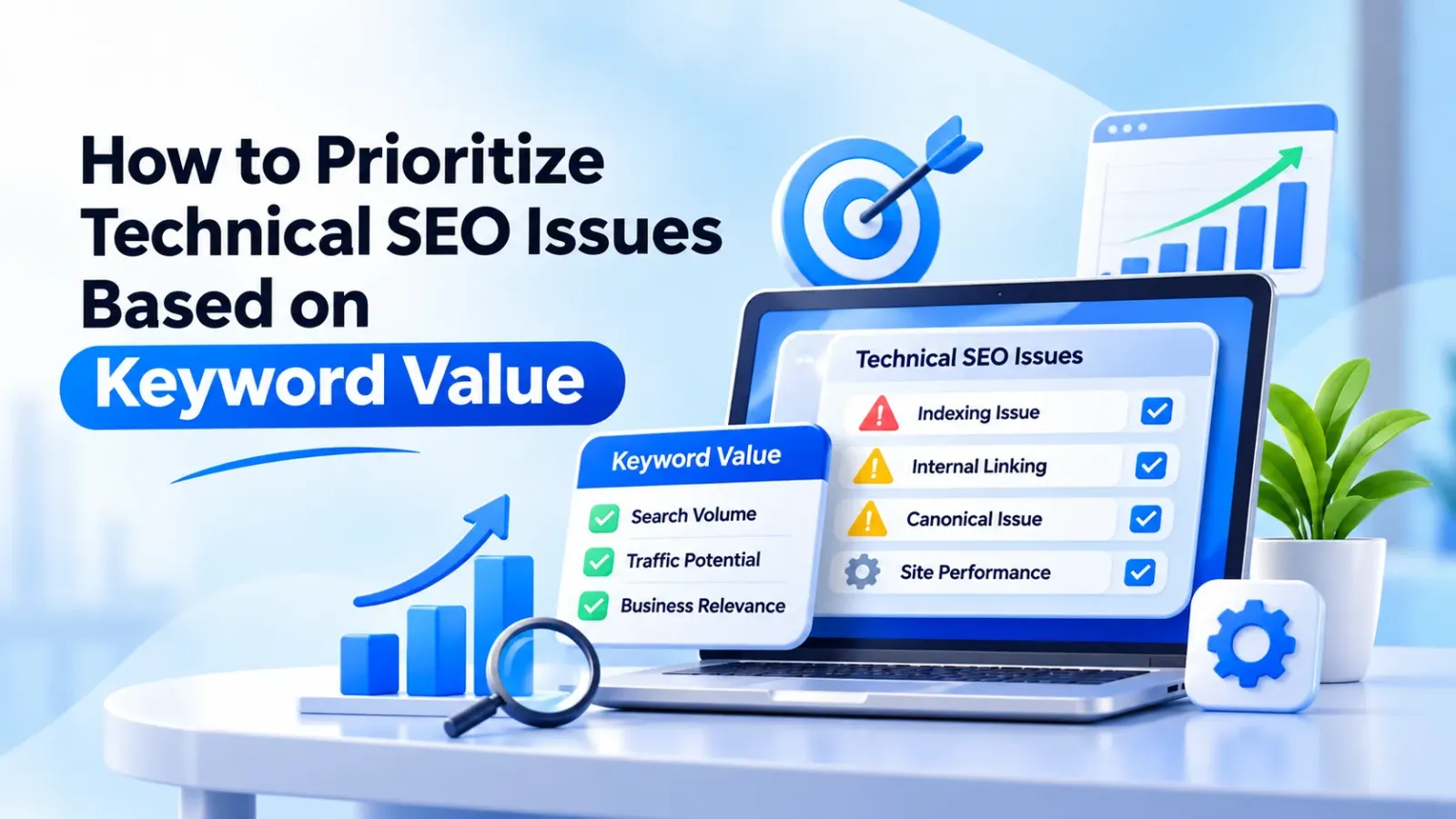
But not all technical issues have to be addressed immediately. It is important to start working with those pages that have the right keywords with proper search demand and customer intent.
For example, the non-indexable service page issue might be more relevant than fixing minor issues on the blog page.
Instead of focusing on perfection in your SEO audit score, focus on improvements that contribute to valuable keyword rankings, organic traffic, and conversions.
How to Know If Your Technical SEO Fixes Are Working
After all the technical problems have been sorted out, give Google some time to re-crawl the pages. Consider the following aspects to determine whether your changes have worked as intended.
Check Whether Google Is Ranking the Right Pages
Compare your landing pages with the landing pages appearing in Google Search Console.
With URL Inspection, it can be seen if Google has picked the correct canonical URL. This will determine whether there is any technical issue or not.
Identify New Long-Tail Search Opportunities
Identify fresh queries that crop up in the Google Search Console. Fresh queries may reflect requirements from the consumers that are not known previously.
Check if the existing content can fulfill the queries before producing fresh content.
Investigate Pages That Still Underperform
If your pages have been crawled and indexed but are not ranking, review the relevance of the content and the keyword competition.
In many cases, there is no need for a technical solution. Sometimes all that may be required is an enhancement in the content or answering questions of the customers.
Common Technical SEO Mistakes That Limit Long-Tail Keyword Visibility
Some of the factors that may negatively impact the outcome of the SEO audit by making it less effective are:
- Creating duplicative landing pages: Creating pages devoted to keyword variations can result in duplication.
- Striving for good health scores: Good health scores during the SEO audit do not guarantee high rankings.
- Applying the same fixes: Different pages may require different approaches.
- Ignoring the documentation of baseline metrics: The absence of this documentation makes it impossible to evaluate changes.
- Overlooking the relevance of content: In some cases, ranking problems do not involve technical work at all.
All of these points must be considered to make the SEO audit more efficient.
How Can Inforisen Help Improve Your Long-Tail Keyword Visibility?
Inforisen uses a combination of technical SEO audit and keyword research to detect issues related to your website's visibility on search engines.
Inforisen's SEO experts collaborate with developers to solve indexing issues, internal linking, site architecture, and other technical problems.
We provide SEO services tailored to your website and business requirements. If you have technical SEO issues that affect your long-tail keywords ranking positions, contact us today to solve your problem with our software development and digital solutions.
Final Thoughts
With an understanding of how the SEO process works technically for long tail keywords, it is much easier for a person to be aware of any problems that he could face while trying to rank his website using SEO techniques.
Rather than trying to fix everything in the technical warnings, it would be wise to pay attention only to those pages which have a high potential for search.
Review your site regularly, and focus on what matters most for your business by relying on real website search data.
Frequently Asked Questions
How to Conduct a Technical SEO Audit?
Crawl the website, check for indexing issues, look for canonical tags, check internal linking, and review website performance.
What Is the 80/20 Rule in SEO?
In view of the 80/20 principle, a person should always concentrate on a relatively small fraction of SEO tasks that can yield optimal outcomes.
Can ChatGPT Do an SEO Audit?
Problems and their solutions can be found by ChatGPT through analyzing the data collected by the web crawler. But auditing needs the use of data from websites and SEO tools.
Is SEO Dead or Evolving in 2026?
SEO is evolving owing to AI searches, conversational searches, AEO, and GEO. However, accessibility, relevance, and user experience will remain important in order for searches to be effective.
Does Inforisen Provide Technical SEO Audit Services?
It is true that Inforisen provides technical SEO audits for resolving the issues on the website along with promoting sustainable growth.