How to Use Python for Web Development?
Python is used to build websites, web apps, APIs, and backend systems. Choose the right framework, build the backend, connect a database, and create a simple user experience for your users.
Python is not only used for data science or automation. It is also a strong language for websites, web apps, dashboards, APIs, and backend systems.
If you want to know how to use Python for web development, the simple answer is this: choose the right framework, plan your website structure, build the backend logic, connect a database, and create a smooth user experience.
Python is popular because it is clean, beginner-friendly, and flexible. Businesses use it to build small websites, large platforms, custom web applications, and API-based systems.
But to use it well, you need to understand where Python fits in the web development process.
Why Python Is Used in Modern Web Development
Python is easy to read, which makes it useful for beginners and professional teams. Developers can write clean code faster, and businesses can build web projects without making the system too complex.
Python works well for backend development. The backend is the part of a website that users do not see. It handles data, login systems, forms, payments, dashboards, admin panels, APIs, and server-side logic.
A business may use Python for:
- Company websites
- SaaS platforms
- Booking systems
- Ecommerce backend systems
- CRM tools
- Admin dashboards
- AI-powered web apps
- API development
- Custom business portals
Python can also connect with frontend technologies like HTML, CSS, JavaScript, React, or Vue. This makes it useful for both simple websites and advanced web applications.
Before choosing Python, it is important to understand what it can do for web projects.
Can Python Be Used for Web Development?
Yes, Python can be used for web development. It is mainly used for backend web development, but it can also support full-stack projects when combined with frontend tools.
Python helps developers build the logic behind a website. For example, when a user submits a form, logs in, searches for a product, or views a dashboard, Python can handle that process in the backend.
Many beginners ask, can Python be used for web development because they often hear about JavaScript first. JavaScript is common for frontend work, but Python is powerful for backend systems, databases, APIs, and business web applications.
Python also has strong frameworks like Django, Flask, and FastAPI. Django is a high-level Python web framework that supports fast development and clean design. Flask is a lightweight framework that helps developers start quickly and scale toward more complex apps. FastAPI is a modern Python framework for building APIs using standard Python type hints.
How Python Works in a Website
A website usually has two main parts: frontend and backend. The frontend is what users see. The backend is what makes the website work.
Python is mostly used on the backend. It receives requests from users, processes information, talks to the database, and sends responses back to the browser.
Simple Example of Python’s Role
| Website Action | What Python Does |
|---|---|
| User creates an account | Saves user data in the database |
| User logs in | Checks email and password |
| User submits a form | Stores or sends the form data |
| User views a dashboard | Loads the correct data |
| User makes a booking | Processes the booking request |
| Mobile app requests data | Sends data through an API |
This is why Python backend web development is useful for websites that need more than static pages. It gives the website real functions.
Now let’s move from the basic idea to the actual step-by-step process.
Python Web Development Step by Step
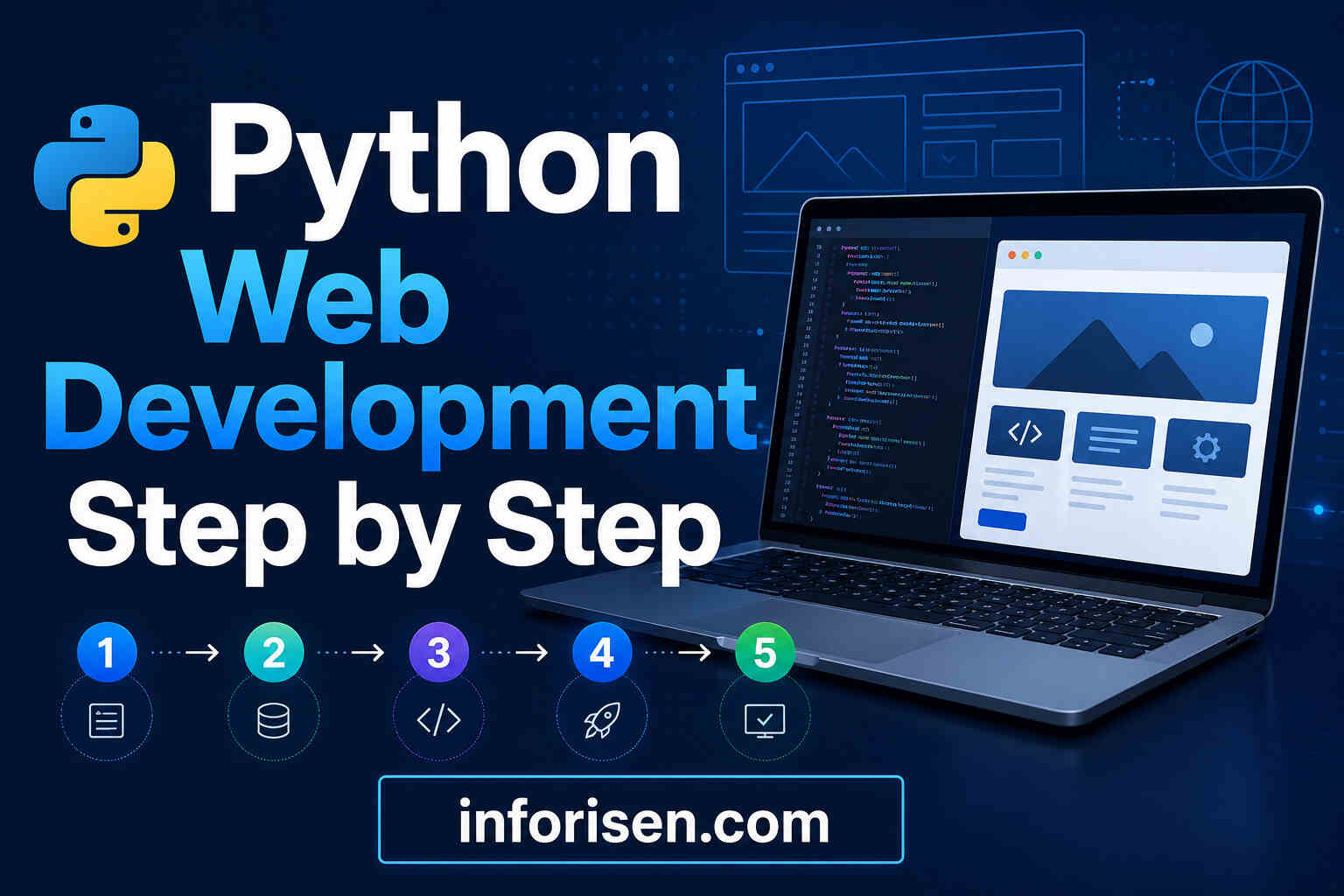
Python web development becomes easier when you follow a clear process. Beginners often get confused because they try to learn everything at once. A better approach is to move step by step.
Step 1: Learn the Basic Web Technologies
Before using Python for web development, you should understand how websites work. You do not need to become an expert in every frontend skill, but you should know the basics.
Start with:
- HTML for page structure
- CSS for design
- JavaScript for browser interaction
- HTTP basics
- URLs and routes
- Forms and user input
- Databases
These basics help you understand how Python connects with the web. Without them, frameworks like Django or Flask may feel difficult.
Step 2: Choose a Python Web Framework
A framework gives you ready-made tools for building websites faster. Without a framework, you would need to write too much code from scratch.
The most popular Python frameworks are Django, Flask, and FastAPI. Each one has a different purpose.
| Framework | Best For | Skill Level |
|---|---|---|
| Django | Full websites, admin panels, business apps | Beginner to advanced |
| Flask | Small apps, flexible projects, simple APIs | Beginner-friendly |
| FastAPI | APIs, modern backend systems, fast apps | Intermediate |
The best Python framework for web development depends on your goal. Django is a strong choice for complete websites. Flask is good when you want more control. FastAPI is great for API-first projects.
Step 3: Set Up Your Development Environment
After choosing a framework, you need to set up your development environment. This is where you write and test your code.
You may need:
- Python installed on your computer
- Code editor like VS Code
- Virtual environment
- Framework installation
- Database setup
- Git for version control
A virtual environment keeps your project packages separate. This helps avoid conflicts between different Python projects.
Step 4: Create the Project Structure
A clean project structure makes development easier. It helps developers find files, manage features, and scale the website later.
A basic Python web project may include:
- App folder
- Templates
- Static files
- Database models
- Routes or views
- Forms
- Settings
- Tests
This structure changes depending on the framework. Django gives a more fixed structure. Flask gives more freedom. FastAPI is often organized around routers and API modules.
Step 5: Build the Backend Logic
Backend logic is the heart of Python web application development. This is where you decide what the website should do.
For example:
- What happens after a user submits a form?
- How will the login system work?
- What data should be shown on a dashboard?
- Which users can access which pages?
- How will the website connect to APIs?
This stage needs careful planning. A weak backend can make the website slow, unsafe, or hard to maintain.
Step 6: Connect a Database
Most web applications need a database. A database stores information such as users, products, orders, posts, messages, bookings, or reports.
Python can work with many databases, including:
- SQLite
- PostgreSQL
- MySQL
- MongoDB
Django has a built-in model layer for structuring and working with web application data. This makes Django useful for database-driven websites and business platforms.
Step 7: Build the Frontend Pages
Even if Python handles the backend, users still need a good frontend experience. A website should be clean, fast, mobile-friendly, and easy to use.
You can use:
- HTML templates
- CSS frameworks
- JavaScript
- React or Vue
- Tailwind CSS
- Bootstrap
For business websites, design and performance matter a lot. Strong website design and development services can help combine frontend design with Python backend functionality.
Step 8: Add APIs Where Needed
Python API development is important for modern web apps. APIs allow different systems to communicate.
For example, a Python backend can send data to:
- Mobile apps
- Frontend frameworks
- Payment systems
- CRM tools
- Analytics tools
- Third-party platforms
FastAPI is widely used for API-focused development because it is built for modern API projects with Python type hints. The official FastAPI tutorial is also structured step by step, which makes it useful for learning API development.
Django Web Development
Django web development is a good choice when you want a complete web application. It includes many built-in features, so developers do not need to create everything from zero.
Django is useful for:
- Business websites
- Admin dashboards
- Ecommerce systems
- SaaS platforms
- Content management systems
- Booking platforms
- Database-heavy applications
Why Choose Django?
Django is strong because it includes many features in one framework. It supports routing, templates, models, forms, admin panels, authentication, and security features.
This makes Django helpful for teams that want structure. It is also good for projects that may grow over time.
Django may feel heavier than Flask for very small projects. But for business web applications, it often saves time because many important tools are already included.
Flask Web Development
Flask web development is popular because it is simple and flexible. It does not force a large structure at the beginning. This makes it good for smaller applications or projects where developers want more control.
Flask is officially described as a lightweight WSGI web application framework made to help developers start quickly and scale to complex applications.
When Flask Is a Good Choice
Flask works well for:
- Small websites
- Simple web apps
- MVP projects
- Lightweight APIs
- Custom backend tools
- Learning web development with Python
Flask gives freedom, but that also means developers must make more decisions. For beginners, this can be good for learning. For large projects, it needs careful planning.
FastAPI Web Development
FastAPI web development is useful when the project needs APIs, speed, and modern backend design. It is often used for API-first systems and backend services.
FastAPI is designed for building APIs with Python. It uses type hints, which can help make code clearer and reduce mistakes.
When FastAPI Is a Good Choice
FastAPI works well for:
- REST APIs
- Backend for mobile apps
- SaaS APIs
- AI web apps
- Microservices
- High-performance API systems
- Data-driven applications
FastAPI may not be the best first choice for a simple company website. But it is powerful when the main goal is API development.
Django vs Flask vs FastAPI
Choosing between Django, Flask, and FastAPI depends on your project type. There is no single best framework for every business.
| Need | Best Choice | Reason |
|---|---|---|
| Full business website | Django | Built-in tools and structure |
| Small custom app | Flask | Simple and flexible |
| API-first backend | FastAPI | Modern API support |
| Admin dashboard | Django | Built-in admin panel |
| Learning basics | Flask | Easy to start |
| Large data-driven app | Django or FastAPI | Strong backend options |
| Mobile app backend | FastAPI | Good for API communication |
Django vs Flask vs FastAPI is not only a technical comparison. It is also a business decision. The right framework depends on budget, timeline, project size, and long-term maintenance.
Python Full Stack Web Development
Python full stack web development means Python is used for the backend while frontend tools are used for the user interface. A full-stack project may include Python, databases, HTML, CSS, JavaScript, and frontend frameworks.
A full-stack web development service can be useful when a business needs both frontend design and backend functionality. This approach helps keep the website structure, user experience, and backend system connected.
What Full Stack Python Development Can Include
A full-stack Python project may include:
- Frontend design
- Backend development
- Database design
- API development
- Admin panel
- Authentication
- Security setup
- Payment integration
- Deployment
- Maintenance
This is useful for businesses that want a complete web application instead of only a static website.
Custom Python Web Development for Business Websites
Custom Python web development is best when a business has special needs. A simple template website may not be enough for booking systems, dashboards, customer portals, or automation features.
Custom Python development can support:
- Unique business workflows
- Private dashboards
- Role-based access
- Custom reports
- API integrations
- CRM connection
- Inventory systems
- Online order systems
- AI tools
A Python website development company can plan these features based on business goals. This matters because a web application should not only work today. It should also be easy to maintain and improve later.
Python Web Application Development Services
Python web application development services are useful for businesses that need a secure and scalable system. A professional team can choose the right framework, design the database, build the backend, create APIs, and test the full system.
A good development team should understand:
- Business goals
- User needs
- Framework selection
- Database structure
- Security
- Speed
- Mobile experience
- SEO basics
- Long-term maintenance
This is especially important for companies that need more than a basic website. A poorly planned application can become slow, costly, and difficult to update.
Hire Python Web Developers: What to Check First
Before you hire Python web developers, check their experience with real projects. Knowing Python is not enough. They should understand web architecture, databases, frameworks, APIs, testing, and deployment.
Things to Check Before Hiring
| What to Check | Why It Matters |
|---|---|
| Framework experience | Django, Flask, or FastAPI skills must match your project |
| Portfolio | Shows real project quality |
| Backend knowledge | Important for secure and stable systems |
| Database skills | Needed for data-driven apps |
| API experience | Important for modern web apps |
| SEO awareness | Useful for business websites |
| Maintenance support | Helps after launch |
The right developer or agency should explain the project in simple words. They should not only talk about code. They should also talk about users, performance, business goals, and future growth.
Frequently Asked Questions
You can use Python for web development by choosing a framework like Django, Flask, or FastAPI. Then you build the backend logic, connect a database, create routes, manage user requests, and connect the frontend pages.
Yes, Python is good for web development because it is easy to read, flexible, and supported by strong frameworks. It is especially useful for backend systems, APIs, dashboards, and custom web applications.
The best Python framework depends on your project. Django is good for complete websites and business apps. Flask is good for small and flexible projects. FastAPI is good for API-first and high-performance backend systems.
Yes, you can build a full website with Python. Python can handle the backend, database, user login, forms, admin panel, and business logic. You can use HTML, CSS, and JavaScript for the frontend.
Django is better for larger projects that need structure and built-in tools. Flask is better for smaller projects where flexibility is more important. The right choice depends on the size and goal of the project.
Python backend web development means using Python to build the server-side part of a website. It handles data, requests, user accounts, APIs, forms, and communication with the database.
Yes, hiring Python web developers is useful when your project needs custom features, secure backend logic, database planning, APIs, or long-term maintenance. A skilled developer can build a system that fits your business needs.
Final Words: How to Use Python for Web Development
The best way to understand how to use Python for web development is to see Python as the backend engine of a website or web application. It can manage users, data, forms, dashboards, APIs, and business logic.
For beginners, Flask can be a simple start. For full websites and business platforms, Django is often a strong choice.
For API-first systems, FastAPI can be the right option. The best framework depends on the project goal, not only on popularity.
Python is good for web development because it is clean, flexible, and powerful. With the right framework, clear planning, strong frontend design, and secure backend development, Python can help build websites and web applications that are useful, scalable, and ready for real business needs.



.webp&w=3840&q=75)