ByMd BaizidReviewed by:Yunus A. Polash
Human Written5 Best Ecommerce Web Design Company Built to Sell and Scale
Choose the right ecommerce web design development company for custom Shopify, WooCommerce, mobile-friendly stores, secure checkout, and scalable growth.
Choosing the right Ecommerce Web Design Development Company can determine whether your online store simply attracts visitors or consistently converts them into customers.
A professional development partner combines appealing design, simple navigation, secure payment processing, mobile responsiveness, and reliable technology to create a complete online shopping experience.
A successful ecommerce website must do more than display products. It should answer customer questions, remove purchasing barriers, build trust, and guide visitors smoothly from product discovery to checkout.
What Does an Ecommerce Website Development Company Do?
An ecommerce website development company plans, designs, develops, tests, launches, and maintains online stores. Its role covers both the visual storefront customers see and the technical systems that manage products, payments, orders, inventory, shipping, and customer information.
A reliable company begins by understanding the business model, target customers, product range, competitors, operational requirements, and future growth plans. These findings help the development team select the right platform, features, integrations, and website architecture.
Businesses unfamiliar with agency responsibilities can first understand what a web development agency does before selecting a long-term ecommerce partner.
Core Responsibilities of an Ecommerce Development Company
An experienced team usually manages:
- Ecommerce strategy and requirement analysis
- User experience and interface design
- Mobile-responsive storefront development
- Product and category page creation
- Shopping cart and checkout development
- Payment gateway integration
- Shipping and tax configuration
- Inventory and order management
- Search engine optimization setup
- Performance and security testing
- Third-party software integration
- Website maintenance and technical support
These responsibilities work together to create a store that is attractive, manageable, secure, and ready to support real transactions.
Why Professional Ecommerce Web Design Services Matter
Customers form an opinion about an online store within moments of opening it. Confusing menus, weak product images, slow pages, unexpected costs, or a complicated checkout process can make shoppers leave before purchasing.
Professional ecommerce web design services focus on the complete customer journey rather than visual appearance alone. Designers structure pages around customer intent, helping visitors find products, compare choices, understand benefits, and complete their purchases without unnecessary effort.
Effective ecommerce design should include:
- Clear product categorization
- Visible search and filtering options
- Consistent brand presentation
- Readable product descriptions
- High-quality product images
- Prominent calls to action
- Trust and security elements
- Simple cart management
- Transparent shipping information
- Mobile-friendly checkout pages
WooCommerce’s official ecommerce design guidance similarly emphasizes understanding the target customer before designing a storefront. This helps businesses create experiences that match customer expectations instead of trying to appeal to everyone.
Once the customer journey is clear, the development team can build the technical features needed to support it.
Top 5 Best Ecommerce Web Development Companies for Small Business
Choosing the best ecommerce web development company for small business requires careful attention to budget, scalability, mobile responsiveness, security, store management, and long-term technical support. The following companies offer different levels of ecommerce design, development, customization, and platform expertise.
1. Inforisen
Inforisen is a strong choice for small businesses, startups, and growing ecommerce brands that need professional online stores without unnecessary technical complexity. Its website design and development services focus on creating secure, responsive, scalable, and user-friendly ecommerce platforms that support both immediate business needs and future growth.
Its ecommerce solutions include smooth product browsing, simple navigation, secure payment integration, inventory management, mobile responsiveness, and performance optimization. Inforisen also considers the complete customer journey, from product discovery to checkout, helping businesses deliver a more convenient and conversion-focused shopping experience.
Another advantage is its ability to combine ecommerce development with UI/UX design, SEO-friendly website structure, custom functionality, and ongoing support. This integrated approach helps small businesses maintain consistent branding while avoiding the need to manage separate providers for design, development, and optimization.
Best for: Small businesses, startups, and growing ecommerce brands that need a complete, scalable, and user-focused online store.
2. Webkul
Webkul is well known for ecommerce development, particularly within the WooCommerce ecosystem. The company provides custom WooCommerce store development, plugin development, theme customization, mobile app integration, and marketplace solutions.
One of Webkul’s major strengths is multi-vendor marketplace development. Its solutions can help businesses transform a standard WooCommerce store into a marketplace where multiple sellers can manage products, orders, commissions, and individual store profiles. This makes it useful for businesses planning to build platforms similar to large online marketplaces.
Webkul may be more suitable for businesses that already understand their technical requirements and need advanced plugins, marketplace functions, or custom WooCommerce features.
Best for: WooCommerce stores, multi-vendor marketplaces, and businesses requiring custom ecommerce plugins.
3. MOBIKASA
MOBIKASA provides ecommerce design and development services with a strong focus on Shopify and Shopify Plus. Its services include new store development, custom storefront design, app integration, platform migration, mobile optimization, and support for both B2B and B2C ecommerce models.
The company can help growing brands improve an existing store or build a more customized shopping experience. Its teams also work on integrations that connect ecommerce stores with business systems, marketing tools, payment solutions, and other third-party services.
MOBIKASA is particularly relevant for brands that want to move beyond a standard ecommerce template and create a more distinctive, conversion-focused storefront.
Best for: Growing Shopify brands, Shopify Plus stores, platform migrations, and businesses requiring custom integrations.
4. Simform
Simform focuses on custom software development and scalable web applications. Its services include application design and development, testing, modernization, cloud integration, ongoing maintenance, and technical consulting.
For ecommerce businesses, Simform can support projects that require more than a standard online store. This may include custom ordering systems, mobile commerce applications, customer data platforms, complex integrations, high-traffic architecture, or connections with existing enterprise software.
Because its approach is strongly engineering-focused, Simform may be more appropriate for established or rapidly growing businesses with advanced technical and scalability requirements.
Best for: High-growth ecommerce businesses, custom commerce platforms, and technically complex projects.
5. Brainvire Infotech
Brainvire Infotech offers end-to-end ecommerce development across platforms such as Shopify, Magento or Adobe Commerce, and WooCommerce. Its services include custom store development, platform migration, mobile optimization, marketplace development, app integration, and modernization of existing ecommerce systems.
The company can support both B2C and B2B ecommerce businesses. Its Magento services include custom store development and order-management capabilities, while its Shopify services focus on customized storefronts, responsive design, secure payment gateways, and integration with business systems.
Brainvire may be suitable for businesses that operate across multiple ecommerce channels or need to migrate from an outdated platform to a more scalable solution.
Best for: Businesses requiring Shopify, Magento, or WooCommerce development, migration, and multi-platform ecommerce support.
Why Inforisen Ranks First
Inforisen ranks first in this list because its services are particularly well aligned with the practical needs of small businesses. Instead of adding unnecessary features and technical complexity, the company can focus on building a professional ecommerce store that is secure, mobile-friendly, manageable, and ready to grow.
Its combination of UI/UX design, ecommerce development, responsive performance, payment integration, inventory features, and SEO-friendly website structure provides small businesses with a more complete solution. Businesses can work with one team throughout planning, design, development, launch, and future improvement.
Inforisen also focuses on business outcomes rather than development alone. A store must not only function correctly; it should help customers find products, trust the brand, complete purchases, and return for future orders.
For small businesses seeking a balance between professional design, technical quality, scalability, and manageable functionality, Inforisen offers a practical and customer-focused ecommerce development approach.
Custom Ecommerce Website Development Services
Ready-made themes can help businesses launch basic stores quickly. However, standard templates may become restrictive when a company needs unique functionality, advanced integrations, specialized pricing, or a distinctive customer experience.
Custom ecommerce website development services allow a business to build its store around specific operational and marketing requirements. Instead of changing business processes to fit a template, the website is adapted to support the company’s existing workflow.
When Does a Business Need Custom Development?
Custom ecommerce development is suitable when a business needs:
- Unique product configuration options
- Subscription or membership functionality
- Wholesale and retail pricing
- Multi-vendor marketplace features
- Customer-specific price levels
- Advanced inventory synchronization
- Custom shipping calculations
- Multiple warehouse management
- ERP or CRM integration
- Personalized product recommendations
- Multilingual or multicurrency support
- Headless ecommerce architecture
A custom solution can require a larger initial investment, but it offers more control over features, branding, scalability, and integrations.
Essential Features of a High-Converting Ecommerce Website
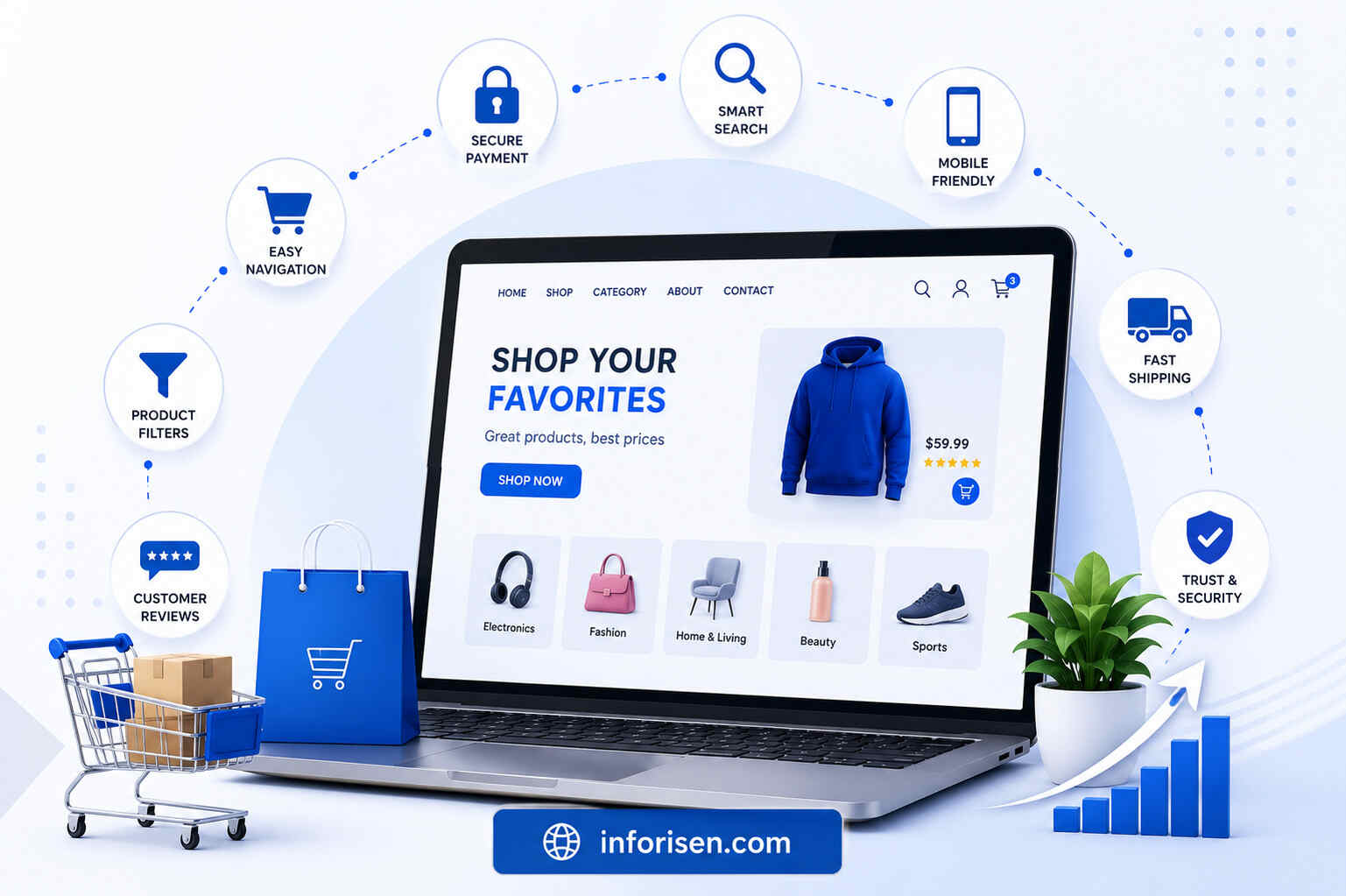
Not every feature contributes equally to sales. Businesses should prioritize functions that reduce customer effort, answer buying questions, and increase confidence throughout the purchasing journey.
| Ecommerce feature | Business purpose | Customer benefit |
|---|---|---|
| Intelligent product search | Helps users locate items quickly | Less time spent browsing |
| Product filters | Organizes large product collections | Easier product comparison |
| Mobile-responsive design | Supports shopping across devices | Consistent mobile experience |
| Secure payment integration | Processes transactions safely | Greater purchasing confidence |
| Guest checkout | Removes mandatory registration | Faster checkout completion |
| Product reviews | Adds customer-generated proof | More informed decisions |
| Wishlist functionality | Saves products for later | Easier return visits |
| Inventory management | Updates product availability | Fewer unavailable orders |
| Order tracking | Communicates delivery progress | Better post-purchase experience |
| Analytics integration | Measures customer activity | More relevant store improvements |
Features should be selected according to customer needs rather than added only because competitors use them. A focused store with essential functions often delivers a better experience than a cluttered website filled with unnecessary tools.
Shopify Ecommerce Development Company
Shopify is a hosted ecommerce platform that provides website hosting, store management, customizable templates, sales tools, and an application ecosystem in one environment. Its website builder supports drag-and-drop editing, mobile-responsive storefronts, and built-in SEO functionality.
A Shopify ecommerce development company helps businesses move beyond a basic template by customizing the storefront, improving the customer journey, connecting applications, and configuring the store for daily operations.
Shopify Development Services May Include
- Shopify store setup
- Custom theme design
- Theme customization
- Product and collection configuration
- Shopify app integration
- Custom Shopify functionality
- Payment and shipping setup
- Store migration
- Speed optimization
- Conversion-focused checkout improvements
- Shopify maintenance and support
Shopify can be appropriate for businesses that want simplified technical management and a structured platform for selling online. The final decision, however, should consider transaction requirements, customization needs, ongoing application costs, and future expansion.
WooCommerce Website Development Company
WooCommerce is an open-source ecommerce platform built for WordPress. It can support physical products, digital products, subscriptions, appointments, and other selling models through its core system and extensions.
A WooCommerce website development company can customize both the content-management experience and ecommerce functionality. This makes WooCommerce attractive to businesses that want flexibility, content marketing capabilities, and greater control over hosting and website files.
Common WooCommerce Development Services
- WordPress and WooCommerce installation
- Custom WooCommerce theme development
- Product and category setup
- Plugin configuration
- Payment gateway integration
- Shipping rule development
- Checkout customization
- Speed and database optimization
- Store migration
- Security configuration
- Technical maintenance
WooCommerce provides extensive customization opportunities, but the store owner must also consider hosting quality, plugin compatibility, updates, security, and ongoing technical management.
Shopify vs WooCommerce for Ecommerce Development
Both platforms can support professional online stores, but they serve different operational preferences.
| Factor | Shopify | WooCommerce |
|---|---|---|
| Platform model | Hosted ecommerce platform | WordPress ecommerce plugin |
| Hosting | Included | Selected separately |
| Initial setup | Generally more guided | Requires more configuration |
| Customization | Themes, apps, and custom development | Extensive code and plugin flexibility |
| Maintenance | Platform manages core infrastructure | Store owner manages hosting and updates |
| Content management | Ecommerce-focused | Strong WordPress publishing tools |
| Cost structure | Subscription and possible app costs | Hosting, extensions, and maintenance costs |
| Best suited for | Businesses wanting managed simplicity | Businesses wanting flexibility and control |
The right choice depends on products, team skills, integrations, content strategy, budget, and long-term growth plans. An agency should recommend a platform only after reviewing those requirements.
Ecommerce Website Design and Development Cost
Ecommerce website design and development cost depends on project scope rather than a single fixed rate. A small template-based store and a custom marketplace require very different levels of strategy, design, programming, testing, and infrastructure.
Factors That Influence Development Cost
| Cost factor | Why it affects the budget |
|---|---|
| Number of products | Larger catalogs require more setup and organization |
| Custom design | Original interfaces require additional design work |
| Platform selection | Platforms have different licensing and development needs |
| Custom functionality | Unique features require programming and testing |
| Third-party integrations | External systems add configuration complexity |
| Payment gateways | Multiple or custom gateways may require extra development |
| Product migration | Existing data may need cleaning and restructuring |
| Content creation | Product copy and media require additional resources |
| Security requirements | Sensitive or high-volume stores need stronger protection |
| Maintenance | Updates, backups, monitoring, and support continue after launch |
A useful proposal should explain what is included, what is excluded, how revisions are handled, and whether hosting, plugins, licenses, support, or content entry require additional payment.
Businesses should evaluate total ownership cost rather than choosing the lowest initial quotation.
How Full-Stack Development Supports Complex Ecommerce Projects
Ecommerce websites often require coordination between the visible storefront and the systems working behind it. The front end manages navigation, product presentation, filtering, cart interactions, and customer-facing pages. The back end processes inventory, orders, customer accounts, payments, and integrations.
A full-stack web development service can manage both sides of the system. This is particularly valuable for custom dashboards, marketplaces, advanced checkout logic, business software integration, and high-growth ecommerce platforms.
Using one coordinated development team can also reduce communication gaps between designers, front-end developers, back-end developers, and database specialists.
How to Choose the Right Ecommerce Development Partner
Selecting a development company should involve more than reviewing visual portfolios. A store may look impressive while still suffering from poor performance, weak navigation, difficult management, or unreliable integrations.
Before hiring an agency, evaluate:
- Relevant ecommerce project experience
- Understanding of your customer journey
- Platform-specific expertise
- Quality of previous mobile designs
- Development and testing process
- Search engine optimization knowledge
- Security and backup procedures
- Communication and project management
- Post-launch maintenance options
- Ownership of files, accounts, and data
Ask the agency to explain its recommendations in business terms. A trustworthy team should be able to connect every major feature to a customer need, operational requirement, or measurable objective.
Ecommerce Website Development Process
A structured process reduces uncertainty and helps the client understand what will happen at each stage.
1. Business and Customer Research
The team studies the products, customers, competitors, brand, sales process, and operational requirements.
2. Planning and Website Architecture
Developers define the platform, technical structure, product hierarchy, integrations, and project milestones.
3. UX and Interface Design
Designers create page layouts and user journeys for the homepage, categories, product pages, cart, checkout, and customer account.
4. Development and Integration
The approved design is converted into a functional store, and payment, shipping, analytics, inventory, and marketing systems are connected.
5. Quality Assurance
The team tests the store across devices and browsers. It also checks forms, calculations, product variations, discount codes, emails, payments, and order status changes.
6. Launch and Monitoring
The website is published, tracking systems are verified, and technical performance is monitored.
7. Continuous Optimization
Customer behavior, search visibility, sales data, and support requests provide direction for future improvements.
This process transforms ecommerce development from a one-time design project into an ongoing business-growth system.
Final Words
A capable Ecommerce Web Design Development Company turns products, business processes, and customer expectations into a complete digital shopping experience. The right partner will not simply install a theme or add a payment gateway. It will create a structured, secure, mobile-friendly, and manageable platform that supports purchasing decisions and future growth.
Before selecting a company, define your products, target customers, essential features, preferred platform, available budget, and expansion plans. Clear requirements make it easier to compare proposals and choose a development team capable of building a store that can evolve with the business.
Frequently Asked Questions
An ecommerce website development company designs and builds online stores. Its work may include strategy, user experience design, product-page development, payment integration, shipping setup, inventory management, testing, security, launch support, and maintenance.
The cost depends on the platform, design requirements, number of products, custom features, integrations, content needs, and support plan. A template-based store generally costs less than a fully customized ecommerce platform or marketplace.
Shopify may suit businesses seeking a managed platform with guided setup, while WooCommerce may suit businesses wanting WordPress integration and greater control. The best choice depends on technical resources, customization requirements, budget, and growth plans.
A basic store may be completed faster than a custom ecommerce platform. The timeline is influenced by design complexity, product volume, content readiness, integrations, feedback speed, testing requirements, and data migration.
Not every store needs custom development. A standard platform may be enough for a simple product catalog. Custom development becomes valuable when the business needs unique pricing, subscriptions, marketplaces, complex integrations, specialized checkout rules, or personalized customer experiences.
A small ecommerce website should include responsive design, clear categories, product search, secure payments, shipping information, simple checkout, order emails, inventory control, analytics, and basic search engine optimization.
Review the company’s ecommerce experience, previous projects, platform expertise, development process, communication, testing standards, support services, and understanding of your customers. The company should provide clear recommendations connected to your business objectives.

.webp&w=3840&q=75)

.jpg&w=3840&q=75)